Summary: Enterprise multi-agent LLM orchestration replaces single AI assistants with specialized AI teams that collaborate to handle complex business workflows more accurately and efficiently. By assigning dedicated roles for planning, research, compliance, analysis, writing, and validation, organizations can reduce hallucinations, improve scalability, and maintain better governance. Powered by frameworks like CrewAI and LangGraph, these autonomous AI systems integrate enterprise knowledge, shared memory, and human oversight to deliver reliable, production-ready automation that drives real business value.
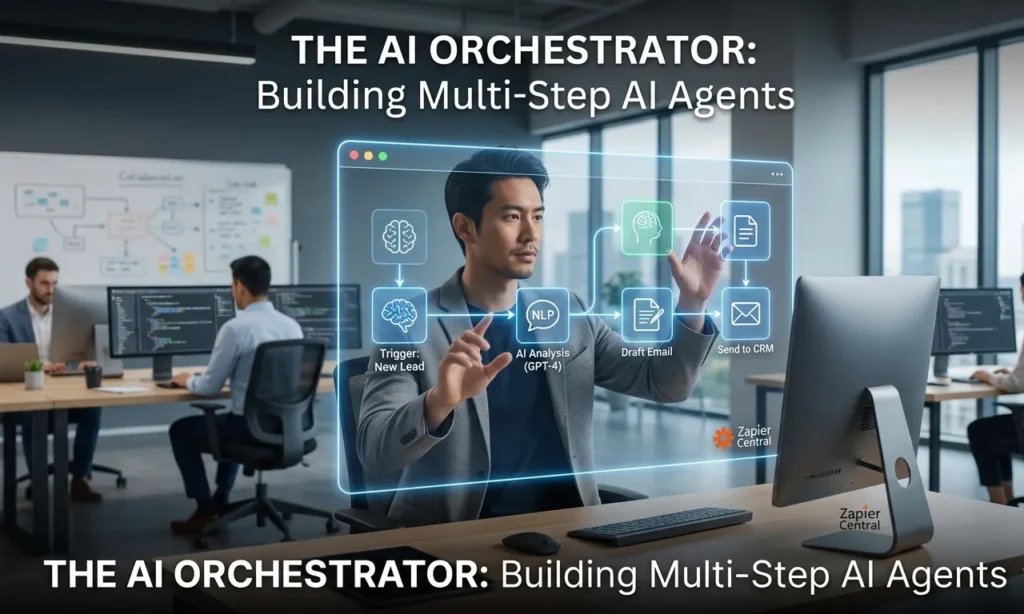
The AI Orchestrator: Building Multi-Step AI Agents with Zapier Central
Summary: This blog explores how Zapier Central enables businesses to build AI-powered orchestrators that go beyond traditional automation. These intelligent AI agents can understand requests, retrieve internal knowledge, coordinate tasks across multiple systems, and automate complex workflows directly within Slack. By combining AI reasoning, workflow automation, and integrations with tools like CRMs, knowledge bases, and project management platforms, Zapier Central helps organizations reduce manual work, improve response times, and scale operations efficiently. The article also covers AI agent training, workflow setup, best practices, and the advantages of AI orchestration over traditional chatbots for modern business operations.
The Great Migration: Step-by-Step Guide: Zapier/Make to n8n
Summary: This blog explains how to migrate from Zapier or Make to n8n. It covers workflow auditing, setup, rebuilding, testing, and deployment. n8n offers more flexibility, better control, AI capabilities, and lower costs at scale. A structured migration process helps avoid downtime, prevent data loss, and create a more scalable automation system.
Beyond Rule-Based: Scaling Your Business with Agentic RPA Bots
Summary: Agentic RPA goes beyond traditional rule-based automation by combining RPA with AI technologies such as machine learning, OCR, NLP, and autonomous agents. These intelligent bots can understand data, make decisions, adapt to changing situations, and continuously improve over time. Businesses are using Agentic RPA across healthcare, banking, customer support, logistics, and HR to automate complex workflows, improve efficiency, and reduce manual effort. As AI capabilities continue to advance, Agentic RPA is becoming a key driver of intelligent automation, helping organizations scale operations, lower costs, and create more flexible and autonomous business processes.