
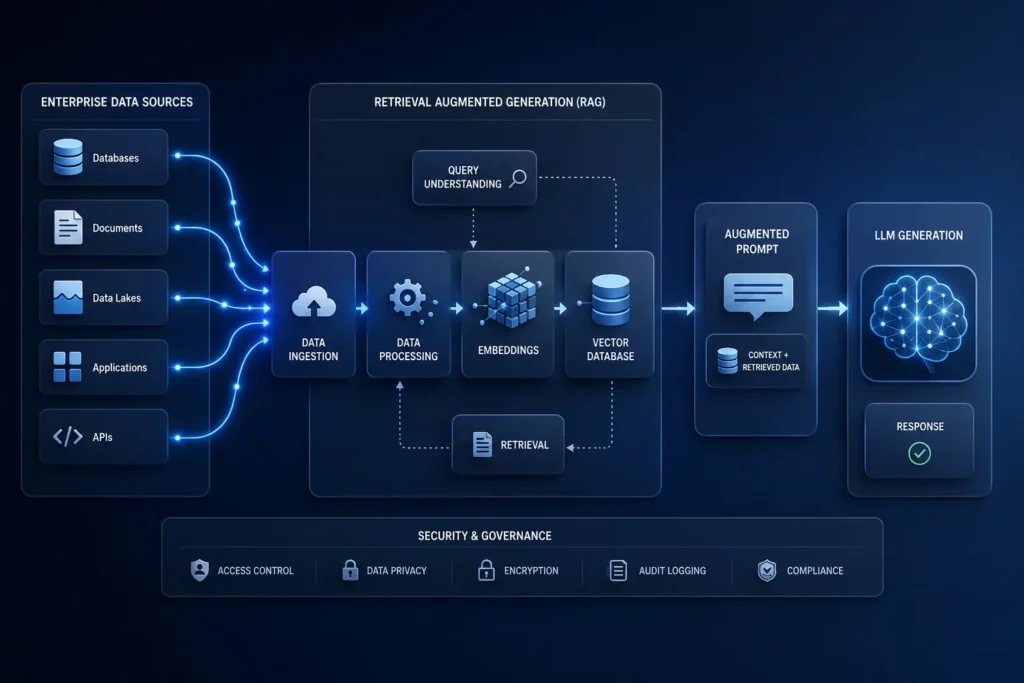
Summary: Ever wondered how AI can answer questions using your company’s latest internal data instead of outdated knowledge? This blog explains how Retrieval-Augmented Generation (RAG) helps enterprises connect large language models with internal data to deliver accurate, secure, and up-to-date responses. It outlines limitations of standalone LLMs and details the full RAG pipeline, including data ingestion, document chunking, embeddings, vector databases, reranking, and prompt augmentation. It also highlights security, scalability, and best practices for enterprise-ready AI systems.
Don’t Let Workflows Crash: The n8n Performance Guide for Power Users
Summary: As n8n workflows scale, businesses need more than the default setup to maintain performance and reliability. By optimizing infrastructure, using Queue Mode, improving database and memory management, and monitoring workflows in real time, organizations can prevent crashes, handle larger workloads, and build a scalable automation system that supports long-term growth.
The Error-Free Office: Advanced Error Handling, Paths, and Sub-Zaps in Zapier
Summary: Building reliable Zapier automations requires more than simple workflows. By using Paths for conditional logic, Sub-Zaps for modular design, and advanced error handling with retries and autoreplay, businesses can prevent failures and minimise downtime. Standardising data with JSON formatting and validation further reduces errors and improves reliability. A defensive automation approach creates scalable, resilient workflows that continue operating smoothly even when APIs, data, or external systems encounter issues.
RPA vs API Automation: Which to Use in 2026
Summary: RPA and API automation serve different purposes in modern enterprise automation. APIs are faster, more scalable, secure, and reliable, making them ideal for high-volume, long-term business processes. RPA remains essential for legacy systems, vendor portals, Citrix environments, and applications without API access. In 2026, leading organizations use a hybrid approach called Agentic Process Automation (APA), where AI agents orchestrate both APIs and RPA bots. This strategy combines API efficiency with RPA flexibility, enabling automation across modern and legacy systems alike.
The Deepfake Defense: How to Protect Your Brand’s Voice in an AI World
Summary: Deepfakes have become a major cybersecurity threat in 2026, enabling attackers to impersonate executives, manipulate public perception, and steal sensitive information. Organizations must adopt AI-powered detection, LLM observability, digital watermarking, and C2PA content authentication to verify media authenticity and prevent fraud. Industries such as healthcare face heightened risks due to regulatory and data privacy concerns. By implementing zero-trust security, monitoring AI-generated content, and establishing trusted sources of verified media, businesses can protect their reputation, maintain customer trust, and defend against evolving AI-driven threats.
The Digital Harvest: How Blockchain is Securing the Future of Agriculture
Summary: Blockchain is helping modernize agriculture by improving transparency, traceability, and trust across the food supply chain. By combining blockchain with IoT sensors, businesses can track products from farm to shelf, verify quality, reduce food waste, and meet growing sustainability regulations. Smart contracts enable faster payments for farmers and reduce reliance on intermediaries, while real-time data improves operational efficiency. As regulations tighten and consumers demand proof of ethical sourcing, blockchain provides a secure foundation for a more transparent, sustainable, and resilient agricultural industry.
When Do You Need Zapier Consulting? 7 Signs Your Business Automation Is Holding You Back
Summary: Many businesses outgrow DIY Zapier automations as workflows become more complex, costly, and difficult to manage. Common warning signs include frequent errors, tangled processes, unnecessary task usage, manual data cleanup, unsupported app integrations, and uncontrolled “shadow automation” created by teams. As companies adopt AI-powered workflows, proper governance, error handling, and human oversight become even more important. Working with a Zapier consultant helps optimize costs, improve reliability, connect custom systems, and build scalable automations that support business growth instead of slowing it down.
Intelligent Document Processing (IDP) with AI and RPA: A Complete Implementation Guide for 2026
Summary: Intelligent Document Processing (IDP) combines AI, machine learning, and RPA to automate document understanding, data extraction, and system integration far beyond traditional OCR. It helps businesses eliminate manual data entry, reduce errors, speed up processing, and unlock actionable data from PDFs and paper documents. Successful implementation requires process auditing, the right cloud or on-prem tech stack, strong data governance, and human-in-the-loop validation. As IDP evolves toward agentic AI, organizations gain a major competitive advantage through faster, smarter, and more scalable operations.
Workflow Automation vs RPA: Choosing the Right Engine for Your Business Efficiency
Summary: Workflow Automation and RPA both improve efficiency but solve different problems. Workflow Automation connects modern cloud applications through APIs to streamline end-to-end business processes, while RPA mimics human actions within software interfaces, making it ideal for legacy systems without API access. Businesses should choose based on whether they need system integration or task emulation. In many cases, a hybrid approach delivers the best results by combining workflow orchestration with RPA execution. The key is matching the right automation tool to the business need.
Is Your Private Data Leaking to ChatGPT? The Hidden Risks of Shadow AI
Summary: Shadow AI occurs when employees use public AI tools without approval, potentially exposing sensitive company data, confidential information, and customer details. While these tools improve productivity, they create serious security, compliance, and privacy risks. Simply banning AI is ineffective; businesses need secure alternatives. Private AI solutions, such as RAG-based systems, allow companies to use AI capabilities while keeping internal data protected. The future of enterprise AI depends on balancing innovation with strong data security.