

Introduction
Large Language Models (LLMs) are changing how financial institutions and healthcare providers work. From detecting fraud and assisting customer support to summarizing medical records and processing complex documents, AI is helping organizations improve efficiency, reduce manual work, and deliver better services.
However, these industries also handle some of the world’s most sensitive information, including payment details, patient records, insurance claims, and personally identifiable information (PII). Using AI without strong security measures can expose confidential data, lead to compliance violations, and damage customer trust.
That’s why secure LLM integration for fintech and healthcare is no longer optional. Building a secure AI solution involves much more than connecting a language model it requires private infrastructure, encryption, access controls, data anonymization, and continuous monitoring. In this guide, we’ll explore the key security challenges, compliance requirements, and best practices for deploying enterprise LLMs that protect sensitive data while delivering real business value.
Why Secure LLM Integration Matters in Regulated Industries?

Artificial Intelligence has now become a strategic investment tool that can help organizations achieve efficiency and provide better experiences for customers. But, the effectiveness of the use of AI technology relies on the user’s trust in it. In sectors like banking or healthcare, the consequences of security failures can lead to legal or financial repercussions.
Unlike traditional applications of software, LLMs can deal with vast amounts of natural language data. User interactions, finance reports, medical files, legal papers, and internal repositories of knowledge can be fed to the AI system. The interactions without any protection measures can result in leaking sensitive data and even compliance violations.
Secure integration of the LLMs is an approach aimed at securing such information while giving organizations the benefits of artificial intelligence technology.
The Growing AI Adoption Across Regulated Industries
Financial institutions are adopting AI for a wide range of use cases, including:
- Intelligent customer support
- Loan document analysis
- Fraud detection assistance
- Financial reporting
- Regulatory compliance reviews
- Risk assessment
Similarly, healthcare organizations are leveraging AI for:
- Clinical documentation
- Medical record summarization
- Patient communication
- Insurance claim processing
- Medical research support
- Administrative automation
Each of these applications involves sensitive information that must remain confidential. A secure AI deployment ensures that data is processed responsibly without exposing protected information to unauthorized users or external systems.
The High Cost of AI Data Breaches
Data breaches are expensive, but the consequences extend far beyond financial losses. Organizations may also face regulatory investigations, legal action, operational disruption, and a decline in customer trust.

Some of the most significant risks include:
Regulatory Penalties
Healthcare organizations must comply with regulations such as HIPAA, while financial institutions often operate under PCI-DSS, GDPR, SOC 2, and various regional financial regulations. Failing to protect customer data can result in substantial fines and mandatory corrective actions.
Loss of Customer Confidence
Customers expect organizations to safeguard their personal information. A security incident involving AI systems can damage a company’s reputation, making customers hesitant to share sensitive information in the future.
Operational Disruption
Recovering from a cyberattack often requires extensive investigations, system downtime, infrastructure upgrades, and legal reviews. These disruptions can significantly affect business continuity.
Competitive Disadvantage
Organizations that fail to establish secure AI practices may struggle to expand AI adoption across critical business functions because of internal resistance, regulatory concerns, or customer skepticism.
Why Are Public AI Tools Not Enough?
Public AI platforms have made advanced language models accessible to organizations of all sizes. While these platforms are excellent for brainstorming, content creation, or learning, they are generally not suitable for handling confidential financial or healthcare information without strict governance.
Several factors make public AI tools unsuitable for regulated environments.
- Limited Control Over Data
Organizations often have limited visibility into how external AI providers store, process, or retain submitted information. Without clear governance policies, sensitive business data could be exposed to unnecessary risks.
- Compliance Challenges
Regulated industries require strict audit trails, access controls, encryption standards, and data governance policies. Public AI platforms may not provide the level of control required to satisfy organizational compliance requirements.
- Shared Infrastructure
Many public AI services operate on shared cloud environments. While providers implement strong security measures, regulated organizations often require dedicated or isolated infrastructure to meet internal security policies.
- Lack of Enterprise Governance
Organizations need detailed monitoring capabilities, approval workflows, user permissions, and policy enforcement. Public AI tools typically offer limited governance compared to enterprise AI deployments.
These limitations highlight why businesses handling regulated data increasingly invest in private AI environments rather than relying solely on public AI platforms.
The Biggest Security Challenges in Financial and Healthcare AI
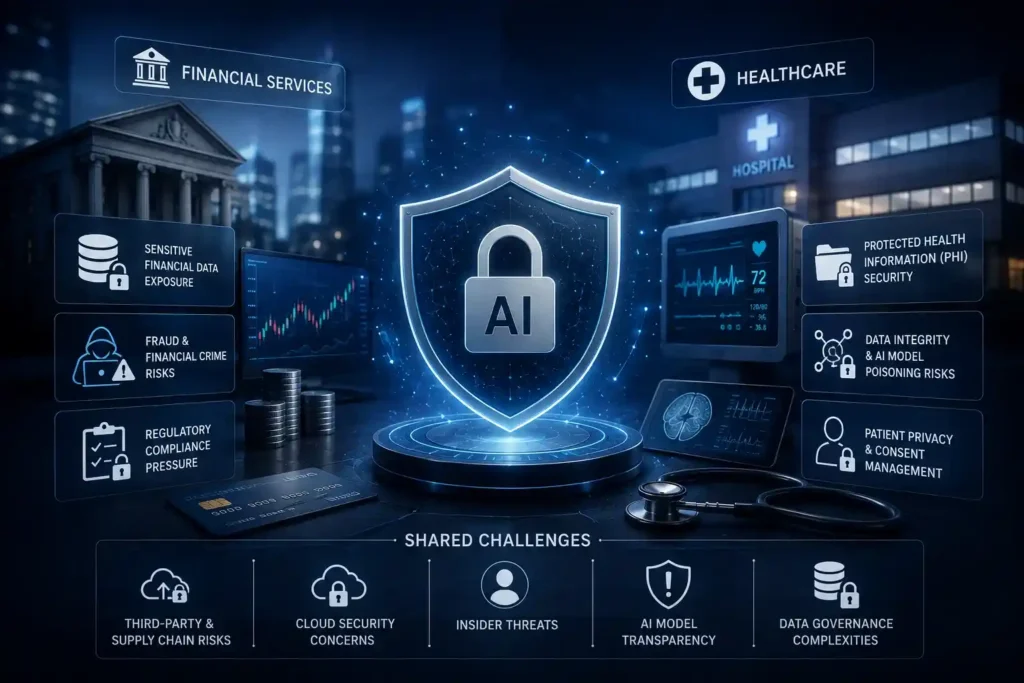
Building secure AI systems involves much more than protecting the model itself. Organizations must secure every component involved in collecting, storing, retrieving, processing, and delivering information.
Below are the most common security challenges that organizations face when integrating LLMs into enterprise workflows.
Protecting Sensitive Customer Information
The primary concern for both healthcare and financial organizations is safeguarding confidential customer data.

Examples include:
- Patient medical histories.
- Prescription information.
- Laboratory reports.
- Insurance claims.
- Credit card information.
- Bank account details.
- Financial transactions.
If this information is exposed through AI interactions, organizations may face severe compliance violations and loss of customer trust.
Protecting sensitive data requires encryption, access controls, anonymization, secure storage, and continuous monitoring throughout the AI workflow.
Meeting Complex Compliance Requirements
Regulated industries must comply with multiple standards simultaneously.
For example:
| Industry | Common Compliance Standards |
| Healthcare | HIPAA, HITECH, GDPR |
| Banking | PCI-DSS, SOX, GDPR |
| Insurance | SOC 2, ISO 27001, GDPR |
| FinTech | PCI-DSS, SOC 2, AML regulations |
These policies include an organization’s ability to prove how customer data is protected, which users accessed the data, when the data was accessed, and how the data was processed.
A safe LLM architecture will help meet this compliance need through thorough audit logging, access control, and data protection.
AI Hallucinations and Inaccurate Responses
Even the most advanced language models can generate incorrect or misleading responses, commonly referred to as hallucinations. In regulated industries, inaccurate information can create serious consequences.
For example:
- Incorrect investment recommendations
- Misinterpreted financial regulations
- Inaccurate summaries of patient records
- Wrong insurance policy explanations
Organizations should never allow AI-generated responses to replace human expertise in high-risk scenarios. Instead, AI should assist professionals while critical decisions remain subject to human review and approval.
Insider Threats and Unauthorized Access
Not every security risk originates from external attackers. Employees, contractors, or third-party vendors with excessive permissions may unintentionally or deliberately expose sensitive information.
Common risks include:
- Sharing confidential AI outputs externally
- Accessing customer records without authorization
- Exporting sensitive datasets
- Misusing administrator privileges
Implementing role-based access controls, multi-factor authentication, least-privilege principles, and detailed audit logging helps minimize insider risks while ensuring accountability.
Core Principles of Secure LLM Integration
Successfully deploying AI in regulated industries requires more than choosing a powerful language model. Security must be embedded into every layer of the architecture, from infrastructure and data storage to user access and monitoring.

The following principles form the foundation of secure enterprise AI deployments.
1. Deploy LLMs in Private and Controlled Environments
Organizations handling regulated data should prioritize private deployments over public AI services whenever possible. Running models in dedicated cloud environments, virtual private clouds (VPCs), or on-premises infrastructure gives businesses greater control over data residency, network security, and compliance.
Private deployments also allow organizations to integrate AI with internal security tools, identity management systems, and monitoring platforms without exposing sensitive information to external environments.
2. Encrypt Data Throughout the AI Lifecycle
Encryption should protect information at every stage, including when data is transmitted between applications, stored in databases, or processed by AI systems. Strong encryption standards help reduce the risk of unauthorized access, even if infrastructure is compromised.
In addition to encrypting business data, organizations should also secure API communications, authentication tokens, and backup systems to maintain end-to-end protection.
3. Implement Role-Based Access Controls
Not every employee requires access to every AI capability or dataset. Role-based access control (RBAC) ensures that users can only access the information necessary for their responsibilities. Combined with multi-factor authentication and identity management, RBAC helps prevent unauthorized access and reduces the risk of insider threats.
4. Monitor, Audit, and Continuously Improve
Secure AI deployment is an ongoing process rather than a one-time implementation. Organizations should continuously monitor AI usage, review access logs, detect unusual behavior, and regularly assess their systems for new vulnerabilities.
Comprehensive audit trails also support regulatory compliance by providing visibility into who accessed AI systems, what data was processed, and when specific actions occurred.
HIPAA-Compliant LLM Pipelines for Healthcare
Healthcare organizations generate vast amounts of unstructured data every day, from physician notes and discharge summaries to laboratory reports and insurance documentation. LLMs can help process this information more efficiently, but they must do so without compromising patient privacy or violating regulatory requirements.
A HIPAA-compliant LLM pipeline is designed to protect Protected Health Information (PHI) throughout the AI workflow. Rather than sending raw patient data directly to an AI model, organizations build secure layers that sanitize, control, and monitor every interaction.
Protect PHI Before AI Processing
Before the data is input into the language model, it should be identified and safeguarded. This data consists of patient names, addresses, dates of birth, medical records, and other personal identifiers.
Using automated data masking and de-identification minimizes the risk of disclosure of private data while also providing AI with access to the context behind it.
For example, a clinical note such as:
“Sarah Johnson, DOB 15/07/1985, was diagnosed with Type 2 diabetes.”
can be transformed into:
“Patient A was diagnosed with Type 2 diabetes.”
This enables AI to assist with documentation or summarization without revealing sensitive patient details.
Secure Retrieval of Medical Knowledge
Healthcare organizations often combine LLMs with internal knowledge bases to provide accurate responses. Instead of relying solely on the model’s built-in knowledge, the AI retrieves information from approved medical guidelines, hospital policies, or clinical documentation.
Organizations implementing LLM Integration can securely connect enterprise knowledge bases with AI systems while maintaining strict access controls and governance. This approach improves response accuracy while ensuring that only authorized users can access protected information.
Maintain Complete Audit Trails
Every interaction with an AI system should be recorded, including:
- User identity
- Timestamp
- Documents accessed
- AI prompts
- Generated responses
- Administrative actions
Comprehensive audit logs help healthcare providers demonstrate compliance during regulatory audits while simplifying security investigations if suspicious activity occurs.
Keep Humans in the Decision Loop
AI should support healthcare professionals rather than replace clinical judgment.
For high-risk activities such as treatment recommendations, medication summaries, or diagnostic assistance, AI-generated outputs should always be reviewed by qualified medical professionals before being used in patient care.
This human oversight significantly reduces the risk of incorrect recommendations affecting patient safety.
PCI-DSS Private AI Deployment for Financial Services
Financial institutions manage some of the most valuable and highly classified information in the world. Payment card numbers, personal identity information, bank account numbers, and transaction history all demand a high level of security due to PCI-DSS guidelines and financial compliance regulations. As per KPMG’s survey on artificial intelligence within the finance industry in 2024, 57% of finance executives believe that the return on investment from AI has surpassed their expectations with advantages such as cost reductions, accelerated reporting, and effective risk management.
- Protect Cardholder Data
Payment information should never be processed by AI without appropriate safeguards.
Sensitive elements such as:
- Card numbers
- CVV codes
- Expiration dates
- Account credentials
should be tokenized or removed before reaching the AI system. This minimizes compliance risks while allowing AI to process the surrounding business context.
- Isolate AI Infrastructure
Financial organizations often deploy AI within dedicated cloud environments or virtual private networks to reduce exposure to external threats.
Network segmentation ensures that AI workloads remain isolated from critical payment systems, reducing the potential impact of security incidents.
- Secure API Communications
Most enterprise AI systems communicate through APIs. These interfaces should be protected using:
- TLS encryption
- Authentication tokens
- API gateways
- Rate limiting
- Continuous monitoring
Securing API traffic prevents unauthorized access while protecting sensitive customer interactions.
- Continuous Compliance Monitoring
Security is not a one-time project. Organizations should continuously monitor:
- Access permissions
- Infrastructure changes
- AI usage patterns
- Security events
- Compliance violations
Automated monitoring allows security teams to detect unusual behavior before it develops into a significant incident.
Finance Data Anonymization Layers
Anonymization of data is among the key security measures implemented in enterprise AI systems. Rather than having the LLM process the customer’s data directly, the organization deploys an anonymization layer that removes the sensitive information and replaces it with something else, thus keeping the confidentiality of the data and its business context intact.
| Anonymization Technique | How It Works | Example | Key Benefit |
| Tokenization | Replaces sensitive information with non-sensitive tokens while securely storing the original data. | Account Number: 7834-5678-9123 → Account Number: <Token_34892> | Ensures confidential data is never directly exposed to the AI model. |
| Pseudonymization | Replaces personal identifiers with aliases while maintaining consistency across records. | John Smith → Customer ASarah Ahmed → Customer B | Preserves relationships between records without revealing real identities. |
| Dynamic Data Masking | Displays only part of sensitive information based on user permissions. | 4111 1111 1111 4321 → **** **** **** 4321 | Protects confidential data while allowing authorized users to complete their tasks. |
| Prompt Filtering | Automatically detects and removes confidential information before prompts are sent to the LLM. | Removes account numbers, patient IDs, or other regulated data from user prompts. | Prevents accidental exposure of sensitive information and supports compliance. |
| Output Validation | Reviews AI-generated responses to ensure they do not disclose sensitive information or violate policies. | Blocks responses containing confidential customer data or unauthorized financial or medical advice. | Reduces the risk of data leakage, compliance violations, and inaccurate AI outputs. |
Building a Secure Enterprise LLM Architecture
A secure enterprise AI platform combines multiple security controls that work together to protect sensitive information throughout the AI lifecycle.
A typical architecture includes the following components:
- Identity Provider (SSO and Multi-Factor Authentication)
- API Gateway
- Data Anonymization Layer
- Enterprise Knowledge Base
- Secure Vector Database
- Private LLM
- Policy and Compliance Engine
- Monitoring and Audit Logging
- Human Approval Workflow
Each layer performs a specific security function before information moves to the next stage.
For example, user authentication verifies identity before granting access. The anonymization layer removes sensitive information before prompts reach the model, while policy engines enforce organizational rules regarding acceptable AI usage.
Organizations that have already invested in enterprise RAG architecture can further strengthen security by applying document-level permissions, encrypted vector databases, and retrieval policies. Choosing the right orchestration framework also plays an important role in building scalable and secure enterprise AI applications. For a deeper comparison of enterprise AI frameworks, explore Best Frameworks for Enterprise LLM Deployment.
Rather than assuming internal systems are trustworthy by default, modern enterprise AI architectures increasingly follow Zero Trust principles, where every request is continuously verified regardless of its origin.
Best Practices for Secure AI Deployment
Building a secure AI platform requires more than deploying a powerful language model. Organizations need a combination of strong security controls, governance policies, and continuous monitoring to protect sensitive data and maintain regulatory compliance.
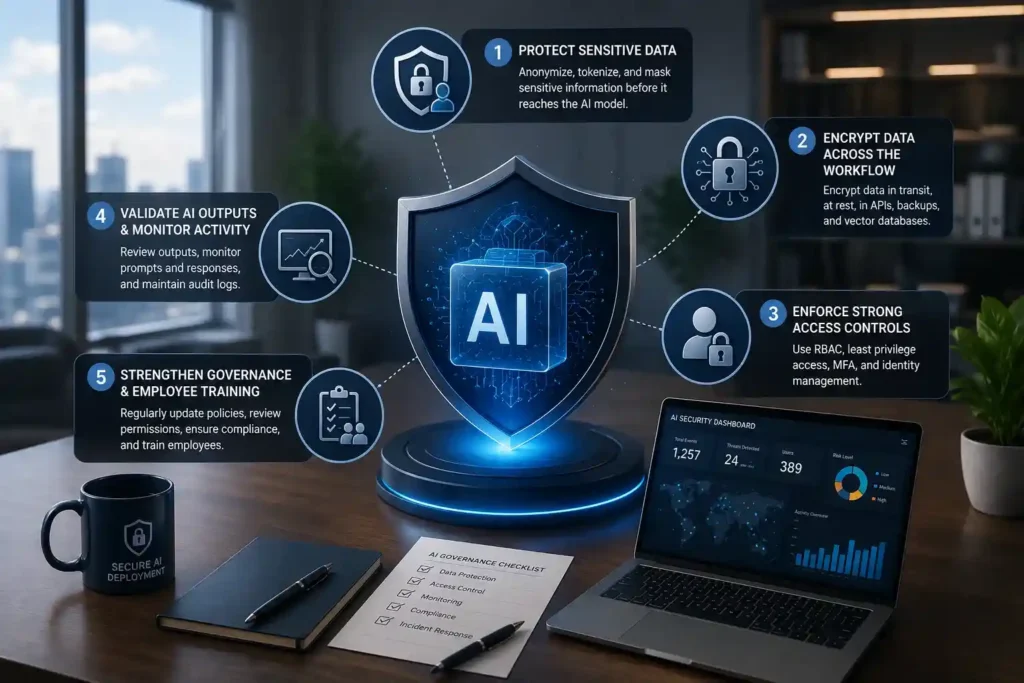
Here are five best practices every organization should follow:
1. Protect Sensitive Data Before It Reaches the AI Model
Never allow raw financial, medical, or personally identifiable information (PII) to be processed without protection. Use techniques such as data anonymization, tokenization, and masking to remove or replace sensitive information before it is sent to the LLM. This reduces the risk of data exposure while preserving the context needed for AI to perform effectively.
2. Encrypt Data Across the Entire AI Workflow
Encryption should be applied throughout the AI lifecycle to safeguard information from unauthorized access. Protect data in transit between systems, data stored in databases and backups, API communications, and vector databases using industry-standard encryption protocols. End-to-end encryption helps ensure sensitive information remains secure, even if systems are compromised.
3. Enforce Strong Access Controls
Implement role-based access control (RBAC) and the principle of least privilege so employees only have access to the AI tools and datasets required for their roles. Combining RBAC with multi-factor authentication (MFA) and identity management minimizes insider threats and prevents unauthorized access to critical systems.
4. Validate AI Outputs and Continuously Monitor Activity
LLMs can occasionally generate inaccurate or inappropriate responses. Review AI-generated outputs before they are used in high-risk scenarios such as financial recommendations or clinical workflows. At the same time, continuously monitor prompts, responses, user activity, and authentication events through centralized logging to quickly detect suspicious behavior and support compliance audits.
5. Strengthen AI Governance Through Regular Reviews and Employee Training
Security is an ongoing process, not a one-time implementation. Regularly update governance policies, review user permissions, and assess compliance controls to address emerging threats. In addition, train employees on responsible AI usage, secure data handling, compliance requirements, and incident reporting. A well-informed workforce plays a crucial role in preventing accidental data leaks and maintaining a secure AI environment.
Conclusion
Large Language Models are revolutionizing the banking and healthcare sectors through automation, enhancing customer service, accelerating research, and enabling operations. Nevertheless, the usefulness of AI is dependent on how safe it is deployed.
Enterprises dealing with regulated data cannot rely only on advanced language models. The enterprises need to have secure architectures that integrate private installations, encryption, anonymization, identity management, audit logging, and continuous monitoring to ensure the confidentiality of data.
Through taking a security-first approach, businesses will find it easier to scale their AI projects safely while retaining the trust of their customers. At Techelix, we help businesses build secure and scalable AI solutions with our LLM Integration services, enabling intelligent automation while maintaining data privacy, compliance, and security. From enterprise AI workflows to custom LLM applications, we help organizations unlock the full potential of AI.