
Introduction
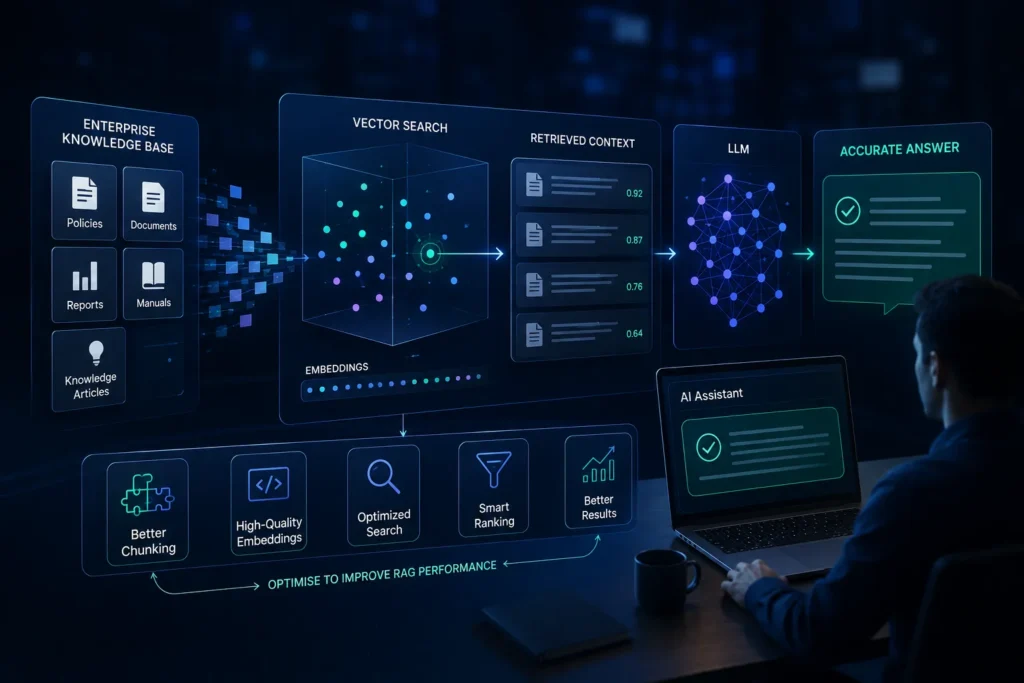
You invested in a powerful large language model, connected it to your enterprise knowledge base, and expected accurate, context-aware answers. Instead, your AI assistant retrieves outdated policies, misses critical documents, or confidently delivers the wrong information. Sound familiar?
The efficiency of a RAG application is determined largely by how well information is retrieved before the model generates its response. No matter how sophisticated the language model is, it cannot generate correct answers if the input context is irrelevant or outdated.
That is why optimizing vector search to make a good RAG for enterprises has become one of the key priorities for businesses.
The problem usually isn’t the LLM; it’s the retrieval layer powering your RAG system. Even the most advanced model can only generate responses from the information it receives. If the wrong documents are retrieved, inaccurate answers become inevitable. That’s why vector search optimisation for enterprise RAG has become one of the most important priorities for organisations building reliable AI applications. By optimising how knowledge is chunked, embedded, searched, and ranked, businesses can dramatically improve retrieval accuracy, reduce hallucinations, and deliver AI experiences that users can genuinely trust.
Why Do Most Enterprise RAG Systems Not Have an LLM Problem?
When an AI assistant gives an incorrect answer, the language model is usually the first thing people blame. It’s an understandable assumption because the LLM is the part users interact with directly.
But let’s take a closer look at what actually happens when someone asks a question.
Imagine an employee types:
“What is the approval process for international business travel?”
The language model doesn’t search your company’s documents on its own. Instead, the question is converted into an embedding and sent to a vector database. The database retrieves the documents it believes are most relevant, and only then does the LLM generate an answer using those retrieved documents as context.
If the retrieval layer returns outdated policies, unrelated travel guidelines, or incomplete sections of the documentation, the model has no way of knowing that better information exists elsewhere. It can only respond based on what it receives. Think of it like asking a researcher to write a report after handing them the wrong reference material. Even the world’s best researcher can’t produce an accurate report without access to the right sources.
This is why retrieval quality has such a profound impact on enterprise AI. In fact, many organizations discover that switching from one leading LLM to another results in only marginal improvements. On the other hand, optimizing retrieval can dramatically increase answer accuracy without changing the language model at all.
The Retrieval Layer Is the Real Intelligence Behind RAG
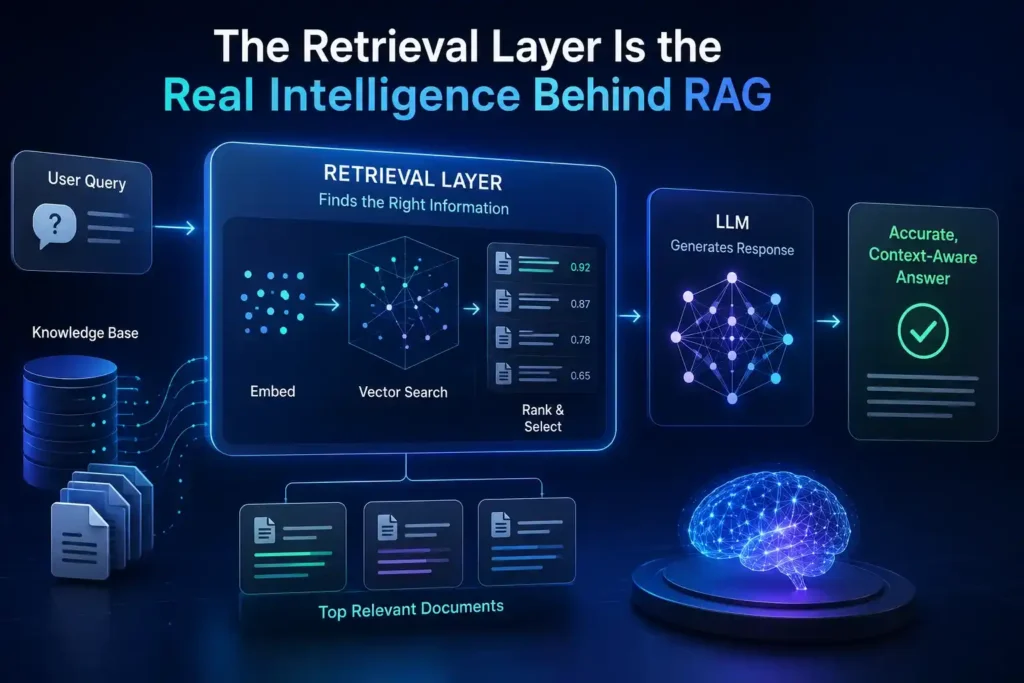
One of the biggest misconceptions about Retrieval-Augmented Generation is that the LLM does most of the work. In reality, retrieval is responsible for determining what knowledge the model can access.
A simplified RAG workflow looks like this:
- Enterprise documents are collected from various sources such as SharePoint, Confluence, internal wikis, PDFs, databases, or cloud storage.
- These documents are cleaned, processed, and divided into manageable chunks.
- Each chunk is converted into a mathematical representation called an embedding.
- The embeddings are stored inside a vector database.
- When a user submits a query, that query is also converted into an embedding.
- The vector database searches for the closest matching document chunks.
- The retrieved content is passed to the LLM, which uses it to generate a response.
Although the language model generates the final answer, the retrieval layer decides what information the model is allowed to see.
Why Good Vector Search Still Produces Bad Results?
Many enterprise teams are surprised when they discover that even a well-known vector database doesn’t automatically guarantee Many organizations assume that using a powerful vector database automatically guarantees accurate retrieval. In reality, vector search is only one part of the RAG pipeline.
Imagine searching for “How do I reset a customer’s enterprise license?” If the document was split into poorly structured chunks, the retrieval system might return only part of the instructions, leaving the AI to generate an incomplete answer. Likewise, a healthcare search for “latest patient discharge protocol” may surface an outdated document if older versions aren’t filtered with metadata.
The issue isn’t the language model; it’s the retrieval process. Accurate RAG depends on more than vector similarity. Factors like document chunking, embedding quality, metadata filtering, indexing, and re-ranking all work together to determine whether your AI retrieves the right information or the wrong one.
Every stage of the pipeline influences the final result, including:
- How documents are divided into chunks.
- Which embedding model is used.
- Whether metadata is available for filtering.
- How vectors are indexed.
- How retrieved documents are ranked before reaching the LLM.
Optimizing just one of these areas can improve search quality. Optimizing all of them transforms the entire RAG system.
What Does Vector Search Optimization Actually Mean?
When people hear the term “vector search optimization,” they often think about making searches faster. Speed is certainly important, especially for enterprise applications serving thousands of users, but performance is only one part of the equation. The real objective is to improve retrieval quality.
An optimized retrieval system should consistently answer questions like:
- Did we retrieve the most relevant document?
- Did we retrieve enough context?
- Did we avoid outdated or duplicate information?
- Did we prioritize authoritative sources?
- Did we return information that actually answers the user’s question?
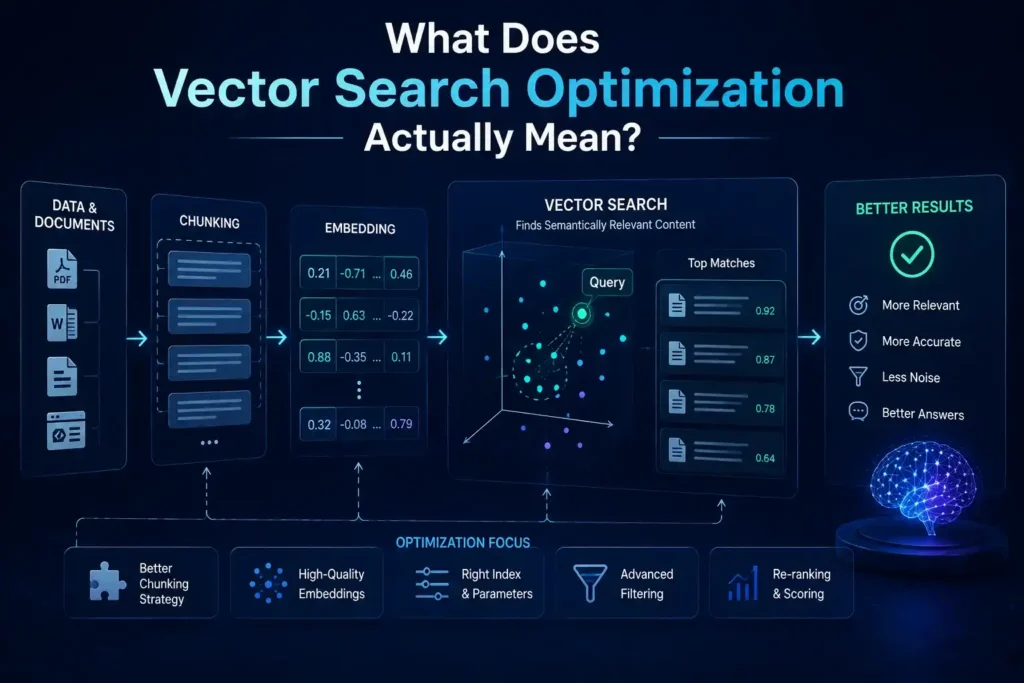
In other words, optimization isn’t about retrieving more documents; it’s about retrieving better ones.
This distinction is crucial because adding irrelevant context can actually make an LLM perform worse. Large language models attempt to reason over everything they’re given. If half of the retrieved documents are unrelated, the model has to separate useful information from noise, increasing the likelihood of incomplete or incorrect responses.
High-performing enterprise RAG systems therefore focus on maximizing precision while maintaining strong recall. They retrieve enough information to answer the question thoroughly, but not so much that the model becomes distracted by irrelevant content. Achieving that balance requires improvements throughout the retrieval pipeline, starting with one of the most overlooked aspects of enterprise AI: how documents are chunked before they ever become embeddings.
Optimisation Starts Long Before Vector Search
One of the biggest misconceptions about Retrieval-Augmented Generation (RAG) is that optimization begins inside the vector database. In reality, retrieval quality is largely determined long before a query is ever searched.
Think of your RAG pipeline as a library. Even the fastest librarian won’t be able to help if the books are poorly organised, missing chapters, or filed under the wrong categories. Similarly, a vector database can only retrieve the information that has been prepared and indexed correctly.
This is why organisations that achieve consistently accurate AI responses spend as much time preparing their knowledge as they do selecting models or infrastructure. The first;and arguably most important—step is deciding how your documents are transformed into embedding.
Stop Splitting Documents Blindly: Why Chunking Matters More Than You Think
It is a crucial stage of the RAG pipeline process, but usually it is implemented using basic techniques, like fixed-size splitting. Though it is easy to do, it can result in loss of context and partial information retrieval by the AI.
Contemporary approaches to the RAG pipeline involve semantic chunking, which means that splitting is performed not depending on tokens, but on the meaning of texts. In this way, chunks contain pieces of information that are related to each other, such as sections, procedures, and guidelines.
Moreover, overlapping chunks will help keep context between these chunks, making retrieval of complete information possible. It may take some time to preprocess data, but, as a result, the AI will deal with complete concepts.
Better Embeddings Lead to Better Retrieval
Embeddings are the foundation of effective RAG retrieval. They convert text into meaningful representations, helping AI systems understand concepts beyond exact keywords.
A strong embedding model can recognize that terms like “cancel,” “terminate,” and “deactivate” share the same intent, improving search accuracy.
For enterprises, domain-specific understanding is essential. Better embeddings reduce irrelevant results, improve retrieval precision, and provide LLMs with the right context for reliable answers.
Generic vs Domain-Aware Embedding:
| Understanding | Handles common language and general concepts | Understands industry-specific terminology and context |
| Accuracy | May miss specialized meanings | Provides more relevant retrieval results |
| Best For | General knowledge search and simple use cases | Enterprise RAG systems in healthcare, legal, finance, and manufacturing |
| Example | May treat “release” and “deployment” as different terms | Understands both terms can refer to the same process |
| Retrieval Quality | Higher chances of irrelevant results | More precise and context-aware retrieval |
Why Similar Meaning Isn’t Always Enough?
Semantic search has transformed enterprise search by understanding the intent behind a query rather than relying on exact keyword matches. For example, if someone searches for “employee resignation process,” a semantic search engine can also retrieve documents titled “offboarding procedure” because it recognizes that both phrases describe the same concept.
However, semantic understanding has its limits. In enterprise environments, many queries depend on exact terms rather than similar meanings. Consider a search for “ISO 27001 password policy.” While a semantic search engine may retrieve documents about cybersecurity, authentication, or access management, the user is specifically looking for the policy related to ISO 27001. Broader security documents may be relevant, but they don’t answer the question accurately.
The same challenge arises with product model numbers, API endpoints, software versions, legal clauses, and compliance standards, where precision matters more than semantic similarity. This is why relying solely on vector search can reduce retrieval accuracy. Enterprise RAG systems need a retrieval approach that understands context without losing the importance of exact keywords and technical terms.
Hybrid Lexical Semantic Search: The Best of Both Worlds
Hybrid lexical semantic search combines keyword matching with vector-based understanding to improve retrieval accuracy in enterprise RAG systems. Semantic search captures the intent behind a query, while lexical search ensures important exact terms are not overlooked. Together, they create a more reliable retrieval process.
Key benefits of hybrid search include:
- Better Accuracy: Combines conceptual understanding with precise keyword matching.
- Improved Context Retrieval: Finds relevant information even when users use different wording.
- Preserves Important Terms: Ensures product names, codes, and technical keywords receive proper importance.
- Reduces Irrelevant Results: Balances broad semantic matches with exact search signals.
Hybrid search is especially useful for technical documentation, legal contracts, healthcare protocols, financial records, and product catalogs where both meaning and precision are essential.
Metadata: The Secret Weapon Most Teams Ignore
Metadata adds valuable context beyond document content, helping RAG systems understand which sources are relevant, trusted, and up to date.
By using attributes like department, publication date, document type, version, and approval status, organizations can filter out outdated or irrelevant information before retrieval begins.
This creates a cleaner search space, improves retrieval precision, reduces latency, and helps AI systems deliver more accurate answers.
Improving Embedding Chunk Retrieval Is About Context, Not Quantity
Increasing the number of retrieved chunks does not always improve RAG performance. More documents can introduce noise, forcing the LLM to process irrelevant information before finding the right context.
Effective embedding chunk retrieval focuses on quality over quantity. Each retrieved chunk should:
- Contain a complete and meaningful idea.
- Provide enough context to stand alone.
- Come from current and trusted sources.
- Avoid duplication and unnecessary information.
The goal is simple: retrieve fewer but more relevant chunks so the AI can generate faster, more accurate, and better-grounded responses.
A Strong Retrieval Pipeline Is Built Layer by Layer
High-performing enterprise RAG systems are not built with a single optimization they improve through multiple layers working together.
Smarter chunking, better embeddings, hybrid search, and metadata filtering each enhance retrieval quality. While every improvement may seem small, together they create a stronger pipeline that delivers more accurate context and helps LLMs generate reliable answers. To understand how these components fit into a complete enterprise RAG solution, explore our guide on RAG Architecture: Connect Enterprise Data to LLMs Securely.
Finding the Right Document Is Only Half the Job
By now, we’ve seen that retrieval quality depends on far more than choosing a vector database. Better chunking, stronger embeddings, metadata filtering, and hybrid lexical-semantic search all help the system retrieve more relevant information.
But even after applying these improvements, another challenge remains.
Imagine your retrieval engine returns ten documents that are all reasonably relevant to a user’s query. Some directly answer the question, while others only touch on the topic. If all ten are passed to the language model in the same order, there’s no guarantee that the most useful information will receive the attention it deserves.
This is where many enterprise RAG systems hit their next bottleneck. Retrieving relevant documents is important, but ranking them correctly is what transforms good retrieval into great retrieval.
Why Similarity Scores Don’t Always Reflect Relevance?
Most vector databases rank results based on similarity scores. If two embeddings are mathematically close in vector space, they are assumed to be relevant. Vector databases typically rank results based on similarity scores, assuming that documents with similar embeddings are the most relevant. While this approach is effective, mathematical similarity does not always match human understanding of relevance.
For example, a search query like “How do I renew an enterprise software license?” may retrieve documents about software subscriptions, license activation, account management, or product onboarding. Although these topics are related, they may not actually answer the user’s specific question.
The challenge is that vector search identifies conceptual connections but may struggle to determine which document provides the most useful answer. To improve accuracy, modern enterprise RAG systems use additional ranking techniques, such as reranking models, to prioritize the most relevant context before passing it to the LLM.
Cross Encoder Re-ranking Models: Adding a Second Opinion
Vector search is excellent at finding a broad set of potentially relevant documents, but it does not always determine which result is the most useful. This is where cross encoder reranking models add value by providing a deeper relevance check. Unlike embedding models that compare documents based on vector similarity, cross encoders evaluate the user query and each retrieved document together. This allows them to understand the exact relationship between the question and the content.
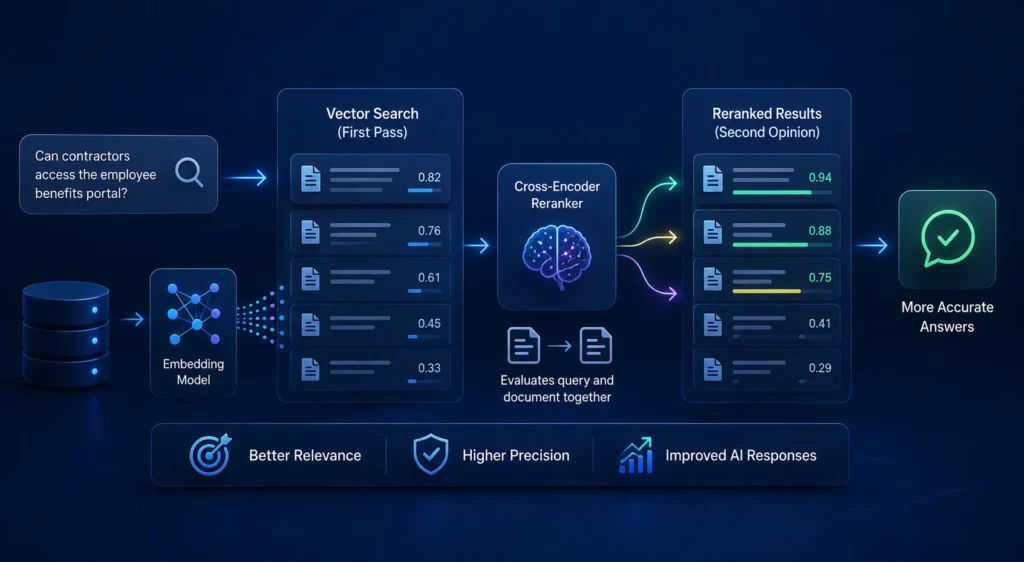
For example, a search query like “Can contractors access the employee benefits portal?” may retrieve documents about contractors, benefits, HR systems, and permissions. A cross-encoder goes beyond topic matching and determines which document actually answers the user’s question.
By reranking the retrieved results, organizations can reduce irrelevant context, improve retrieval precision, and provide LLMs with the most valuable information for generating accurate responses.
Measuring Retrieval Performance Instead of Guessing
Many organizations focus only on the final AI response when evaluating RAG performance. However, inaccurate answers often originate from poor retrieval rather than the language model itself. Without measuring retrieval quality, teams cannot identify where improvements are actually needed.
Enterprise teams are now treating retrieval as a measurable system by tracking key metrics that reveal how effectively the right information is being found.
Key Retrieval Evaluation Metrics:
- Precision@K
Measures how many retrieved documents are actually relevant. Higher precision means fewer irrelevant results and more useful context for the AI model. - Recall@K
- Shows whether the correct information appears within the retrieved results. If important documents are missed, the LLM cannot generate accurate answers.
- Mean Reciprocal Rank (MRR)
- Measures how early the first relevant document appears in the ranking. Faster access to the right information improves answer quality.
- Normalized Discounted Cumulative Gain (NDCG)Evaluates whether the most relevant documents are ranked higher instead of being buried under less useful results.
Tracking these metrics helps organizations optimize retrieval performance, reduce errors, and build more accurate and reliable RAG systems.
The Enterprise Mistakes That Quietly Hurt RAG Performance
Even advanced RAG systems can fail when basic implementation issues are overlooked. Small decisions around data quality, ranking, and maintenance can significantly impact retrieval accuracy.
- Outdated Knowledge Base: Failing to refresh embeddings causes AI systems to retrieve old policies, documents, and information.
- Ignoring Document Importance: Treating all documents equally prevents the system from prioritizing trusted and updated sources.
- Poor Data Quality: Duplicate files, bad OCR, inconsistent formatting, and incomplete data reduce retrieval accuracy.
- Focusing Only on Speed: Fast retrieval is useless if the system returns irrelevant information. Accuracy should come first.
- No Continuous Optimization: Without monitoring and regular improvements, RAG performance declines over time.
Conclusion
The future of enterprise RAG will not be defined by larger language models alone, but by how effectively organizations connect AI systems with accurate, trusted knowledge. Optimizing retrieval through better data pipelines, advanced search strategies, and continuous evaluation is essential for building reliable AI solutions at scale.
For businesses looking to build high-performing RAG applications and maximize the value of enterprise AI, with Techelix expertise in LLM integration and AI optimization, businesses can transform their knowledge systems into intelligent solutions that deliver meaningful, context-aware results.
In the end, better AI answers always begin with better retrieval, and organisations that invest in this foundation will be the ones leading the next generation of enterprise intelligence.