
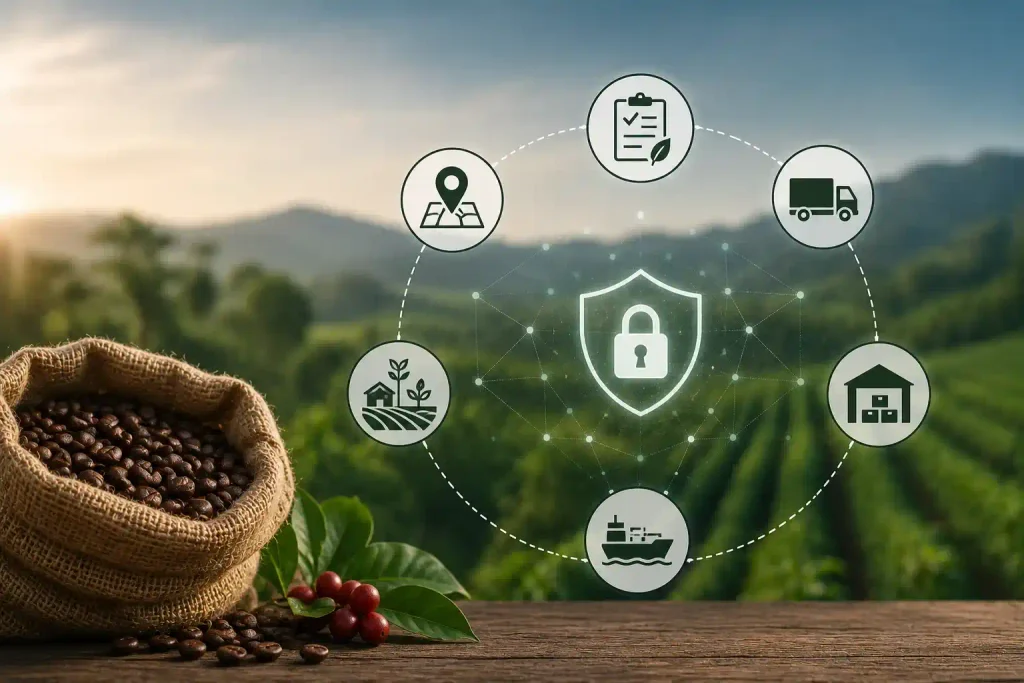
Agricultural supply chains are entering a new era of accountability, where businesses must prove where products come from, how they move, and whether they meet regulatory requirements. The EU Deforestation Regulation (EUDR) is accelerating this shift, making reliable traceability increasingly important for commodities such as coffee, cocoa, soy, cattle, palm oil, rubber, and wood. Blockchain traceability in agriculture can create a tamper-resistant record connecting farms, batches, processors, and logistics partners to establish verifiable farm to fork provenance.
But blockchain is not just about storing data, it is about creating measurable business value. This article explores how blockchain can support EUDR compliance, strengthen IoT sensor data integrity, improve supply-chain visibility, and control cost per scan ROI. It also examines how businesses can start with a focused pilot, measure its financial impact, and scale traceability when the numbers prove the investment.
1. Why EUDR Is Turning Agricultural Traceability Into a Business Requirement?
Agricultural supply chains have traditionally depended on a combination of invoices, certificates, spreadsheets, PDFs, emails, paper records, and manual declarations. The problem isn’t necessarily that information does not exist. The problem is that proving it exists, proving where it came from, and proving that it has not been altered can be difficult.
EUDR makes this challenge more concrete.
Under the regulation, relevant operators need to collect information including the country of production, geolocation of production plots, production dates or time ranges, supplier information, and evidence demonstrating that products are deforestation-free and legally produced. (Eur-Lex)
For agricultural businesses sourcing from hundreds or thousands of farms, this creates a data architecture problem.
A useful traceability system therefore needs to answer questions such as:
- Where was the commodity produced?
- Which farm or plot did it come from?
- When was it produced?
- Who handled it?
- Which batch was it combined with?
- What happened during transportation?
- Which documents support the claim?
- Can the history be independently verified?
- Can the information be retrieved quickly during an audit?
This is where blockchain can become useful.
Blockchain should not be viewed as a replacement for every existing database. Its value is in creating a shared, tamper-resistant record of critical events and proofs across participants that may not fully trust one another.
For example, a coffee exporter could create a digital identity for each originating batch and connect it with:
Farm → Plot → Harvest → Collection → Processing → Warehouse → Shipment → Importer
Each event can be associated with timestamps, documents, location information, batch IDs, and supporting sensor data.
That creates a digital chain of custody rather than a collection of disconnected records.
Blockchain Does Not Automatically Make Data True:
This distinction is critical.
Blockchain can make recorded data difficult to alter after it has been committed to the ledger. It cannot guarantee that the information entered at the beginning was truthful.
If a farmer enters the wrong location, putting that information on-chain does not make the location correct.
The strongest architecture therefore combines blockchain with:
- GPS and geolocation data
- IoT sensors
- mobile data capture
- satellite or remote-sensing inputs
- document verification
- identity management
- validation rules
- permissioned access
- off-chain databases for large documents and operational data
The blockchain becomes the trust layer, rather than the entire technology stack.
2. Designing a Farm-to-Fork Provenance System That Can Scale
A successful traceability platform should not begin by putting every possible piece of agricultural data on-chain. Instead, start by identifying the events that actually matter commercially and operationally.
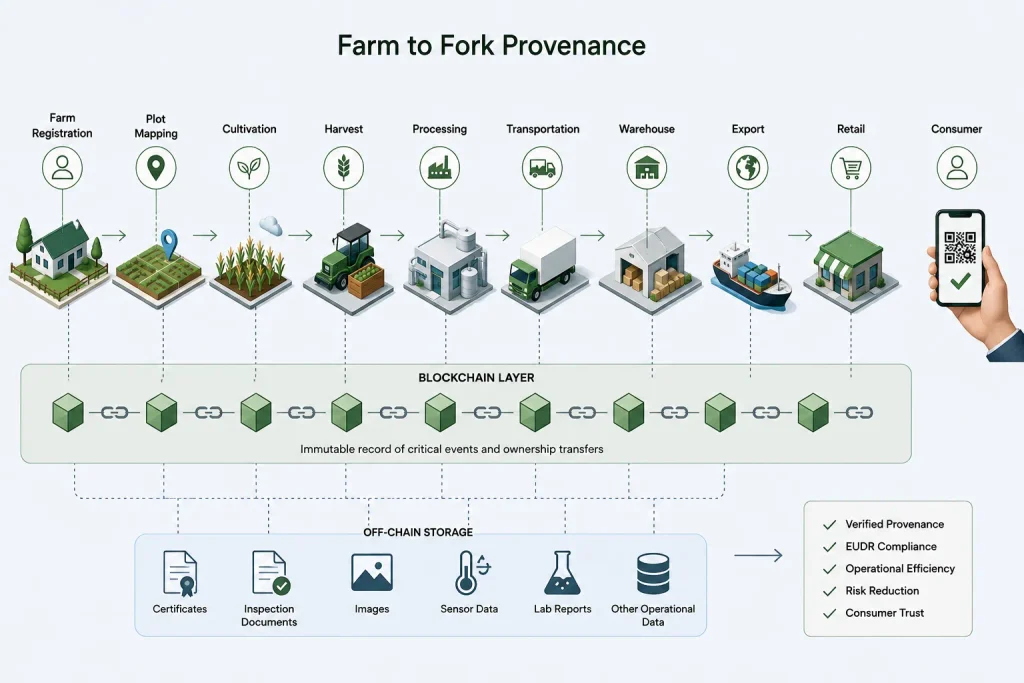
A typical farm to fork provenance architecture can look like this:
| Supply Chain Stage | Data Captured | Blockchain Role | Business Value |
|---|---|---|---|
| Farm registration | Farm ID, producer, location | Verify farm identity | Establish source |
| Plot mapping | GPS coordinates, polygon, crop | Record provenance reference | Support EUDR evidence |
| Cultivation | Crop, production period, certifications | Timestamp key events | Improve traceability |
| Harvest | Batch ID, quantity, date | Create batch record | Establish chain of custody |
| Processing | Facility, process, input/output batches | Link batch transformations | Prevent provenance gaps |
| Transportation | Vehicle, route, temperature | Anchor critical events | Monitor logistics |
| Warehouse | Receipt, quantity, quality | Record custody transfer | Reduce disputes |
| Export | Shipment, documents, destination | Link compliance evidence | Simplify reporting |
| Retail | Product/batch/QR code | Provide verified provenance | Increase transparency |
This architecture creates an important separation between operational data and proof of critical events.
Large files such as certificates, inspection documents, images, and sensor streams may remain in conventional cloud storage or databases. Their hashes, timestamps, identifiers, or critical events can be anchored to the blockchain.
That approach can dramatically reduce blockchain storage requirements while preserving the integrity of the evidence.
Where IoT Sensor Data Integrity Fits
IoT can add another layer of trust.
Consider a refrigerated shipment of fresh produce.
A temperature sensor might record:
2°C → 3°C → 4°C → 8°C → 9°C → 4°C
A conventional system can store this information.
A blockchain-enabled architecture can additionally record verified references to important events or threshold violations.
If the temperature exceeds the acceptable range, the system can trigger:
- An automated alert.
- A quality inspection.
- A shipment exception.
- A smart-contract workflow.
- A downstream notification.
This is particularly valuable because IoT sensor data integrity becomes part of the product’s provenance.
The same principle can apply to:
- Temperature
- Humidity
- Soil moisture
- Cold-chain conditions
- GPS location
- Storage conditions
- Irrigation events
- Harvest timestamps
- Processing conditions
The objective is not to put every sensor reading directly on-chain.
The objective is to create a trustworthy connection between physical events and digital records.
Building the Pilot Around One Traceability Loop
The most common mistake is starting too broadly.
A company might attempt to digitize:
15 crops + 30 suppliers + 10 countries + 50 logistics partners
before proving whether the system actually creates value.
A better pilot might look like:
One commodity → one region → 20–50 farms → one processor → one export route
The pilot should establish a measurable baseline.
For example:
- Current time required to verify a batch
- Current manual documentation cost
- Number of missing records
- Average audit preparation time
- Number of reconciliation errors
- Number of scans per shipment
- Cost of each verification event
- Time required to trace a product back to source
Once those metrics are known, blockchain can be evaluated against an actual business process instead of a technology hypothesis.
3. From Pilot to Payback: Measuring Cost Per Scan ROI
This is where blockchain traceability becomes a financial conversation. A blockchain project should not be justified simply by saying that it improves transparency.
Management needs to know:
What does each traceability event cost, and what does the business gain from it?
The cost per scan ROI provides a useful starting point.
Suppose a company processes 1 million traceability scans annually.
If the complete technology infrastructure, transaction fees, integration, monitoring, support, and operational overhead cost $100,000 per year:
Cost per scan = $100,000 ÷ 1,000,000 = $0.10
That number becomes much more useful when compared with measurable benefits.
| Metric | Before Traceability | After Traceability | Potential Business Impact |
|---|---|---|---|
| Manual verification time | 20 min/batch | 5 min/batch | Lower labor cost |
| Audit preparation | 10 days | 2 days | Lower compliance overhead |
| Batch lookup | Hours | Minutes | Faster investigations |
| Documentation errors | High | Lower | Fewer disputes |
| Recall investigation | Broad/manual | Targeted | Reduced recall exposure |
| Traceability scans | Manual | Digital | Measurable unit economics |
| Supplier verification | Periodic | Continuous/event-based | Better visibility |
| Compliance evidence | Distributed | Linked records | Faster reporting |
The actual numbers will vary by organization, but the framework remains the same.
A Simple Traceability ROI Formula
A practical model can be:
Annual ROI = (Annual Benefits − Annual Traceability Cost) ÷ Annual Traceability Cost × 100
Where annual benefits can include:
- Labor savings
- Lower audit preparation costs
- Reduced product recall exposure
- Reduced fraud and substitution
- Faster dispute resolution
- Lower documentation costs
- Reduced shipment delays
- Improved supplier compliance
- Premium revenue from verified provenance
For example, imagine a traceability platform costs $180,000 annually to operate.
If it generates:
- $70,000 in administrative savings
- $60,000 in reduced audit/compliance costs
- $90,000 in logistics and dispute savings
- $80,000 in avoided recall and quality exposure
Total measurable benefit:
$300,000
Then:
ROI = ($300,000 − $180,000) ÷ $180,000 × 100 = 66.7%
This is the type of business case that can move blockchain from an innovation budget into an operational investment.
Cost Per Scan Should Decline With Scale
A pilot may have relatively high unit economics.
For example:
| Stage | Annual Scans | Annual Cost | Cost Per Scan |
|---|---|---|---|
| Pilot | 50,000 | $40,000 | $0.80 |
| Early production | 250,000 | $75,000 | $0.30 |
| Regional scale | 1,000,000 | $150,000 | $0.15 |
| Enterprise scale | 5,000,000 | $400,000 | $0.08 |
The objective isn’t simply to make the blockchain system cheaper.
It is to ensure that traceability economics improve as transaction volume increases.
This is why architecture matters.
A poorly designed system can become expensive if every sensor reading, document, and workflow generates an unnecessary blockchain transaction.
A better architecture can use:
- Off-chain storage
- Batch anchoring
- Layer-2 or scalable blockchain infrastructure where appropriate
- Event-based transactions
- Data compression
- Selective on-chain records
- API-based integrations
- Permissioned networks where suitable
The result is a traceability platform designed around business economics rather than blockchain novelty.
4. Making Blockchain Traceability Operationally Useful
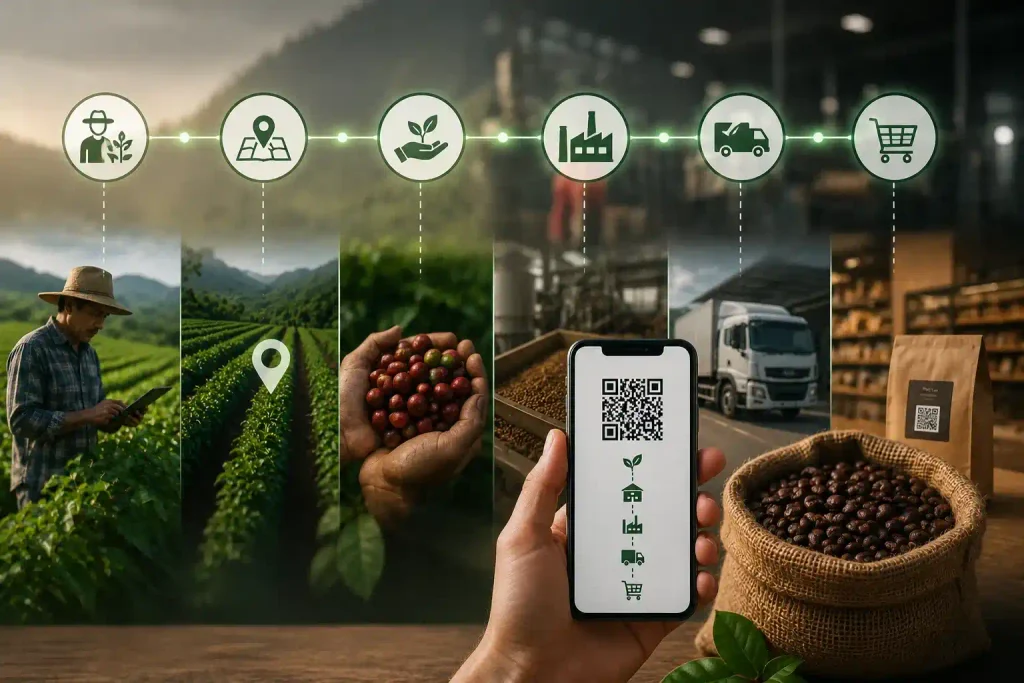
Blockchain traceability delivers the most value when it becomes part of existing workflows instead of creating another system employees have to maintain.
For farmers, the interface might simply be a mobile application.
A farmer could:
- Register a plot.
- Capture GPS coordinates.
- Record a harvest.
- Scan a batch.
- Upload supporting documentation.
- Transfer custody to a collector.
The blockchain infrastructure operates behind the scenes.
For processors, the system can automatically associate incoming batches with production records.
For logistics providers, APIs can connect shipment events and sensor data.
For retailers, a QR code can expose selected provenance information to customers without exposing confidential supplier data.
This creates different views of the same underlying provenance system.
The Consumer Layer
Farm-to-fork provenance becomes particularly powerful when the same verified data can support consumer transparency.
A QR code could show:
Product → Farm → Region → Harvest → Processing → Certification → Shipment
The objective isn’t to overwhelm consumers with blockchain terminology.
Consumers don’t necessarily care that a blockchain exists.
They care about questions such as:
- Where did this come from?
- Was it produced responsibly?
- Is the claim verifiable?
- Who produced it?
- When was it harvested?
- Can I trust the information?
Blockchain is valuable when it makes those answers more credible.
Compliance Should Become a Byproduct of Good Data Architecture
A mature system shouldn’t require teams to manually assemble an EUDR package at the end of every reporting cycle. Instead, relevant evidence should be captured throughout the supply chain. The EUDR requires information such as production location and geolocation, and its due-diligence framework also includes information collection, risk assessment, and risk mitigation. (Eur-Lex)
That means an agricultural traceability architecture should be designed around continuous evidence collection.
Rather than:
Produce → Store documents → Search documents → Build report
the workflow becomes:
Produce → Capture → Validate → Link → Monitor → Report
That difference is significant.
Compliance stops being a periodic paperwork exercise and becomes an operational data process.
5. The Pilot-to-Payback Roadmap
The best blockchain agriculture implementations typically progress through controlled stages.
Phase 1: Map the Business Case
Start with the problem rather than the technology.
Identify:
- Which commodity has the highest compliance pressure?
- Which supply chain has the weakest traceability?
- Where are manual costs highest?
- Which data is currently unreliable?
- Which process creates the largest financial risk?
- How many traceability events occur annually?
The output should be a measurable business case.
Phase 2: Build the Minimum Viable Traceability Layer
Select one product and one supply chain.
Create the minimum architecture required to capture:
Origin → Batch → Custody → Processing → Shipment
Don’t build every possible feature.
The goal is to prove that the system can produce reliable provenance at an acceptable cost per event.
Phase 3: Integrate IoT and External Evidence
Once the core workflow works, integrate:
- GPS
- IoT sensors
- Satellite information
- ERP systems
- Warehouse systems
- Logistics platforms
- Certification systems
This is where IoT sensor data integrity becomes increasingly important.
The platform should distinguish between raw data, validated data, and blockchain-anchored evidence.
Phase 4: Automate Compliance and Exceptions
Once sufficient data is available, automate workflows around:
- Missing geolocation
- Incomplete supplier information
- Temperature violations
- Quantity mismatches
- Certification expiry
- Suspicious batch movements
- High-risk sourcing
- Missing due-diligence evidence
Instead of asking employees to inspect every record, the system can focus attention on exceptions.
Phase 5: Scale Based on Unit Economics
Only after the pilot demonstrates acceptable economics should the platform expand.
Track:
Cost per scan + Cost per batch + Cost per supplier + Compliance cost + Operational savings
If the economics improve as volume grows, expand into additional regions, suppliers, commodities, or markets.
If they do not, optimize the architecture before scaling.
6. What a Production-Ready Architecture Looks Like
A production-ready agricultural traceability platform is rarely just a blockchain application. It is a connected technology ecosystem that brings together farm-level data, supply-chain systems, IoT devices, validation processes, blockchain infrastructure, and compliance tools. Each layer has a specific role, while blockchain provides the trusted foundation for recording critical supply-chain events.
Data Capture Layer
The process starts where agricultural data is generated. Farm applications, QR scanners, GPS devices, IoT sensors, and partner APIs capture information about farms, plots, batches, environmental conditions, and product movements.
Integration Layer
The captured data needs to connect with existing business systems, including ERP, warehouse management, logistics, certification, and supplier platforms. APIs and integration services help maintain a consistent flow of information across the supply chain.
Validation Layer
Before important information is recorded or referenced on the blockchain, it should be validated. This layer can perform data-quality checks, identity verification, geospatial validation, duplicate detection, and business-rule checks to reduce inaccurate or incomplete records.
Blockchain Layer
The blockchain acts as the trusted record for critical events. It can maintain immutable references to batch movements, custody transfers, provenance events, certifications, and smart-contract conditions without requiring every piece of operational data to be stored directly on-chain.
Off-Chain Data Layer
Large or frequently changing information—such as documents, images, detailed sensor histories, and operational records—can remain in conventional databases or cloud storage. Blockchain can store the relevant hashes, identifiers, or references needed to verify their integrity.
Analytics & Compliance Layer
Once data is connected and validated, businesses can use dashboards and analytics to monitor traceability, identify supply-chain risks, generate EUDR evidence, and prepare audit documentation. This turns raw supply-chain data into actionable compliance and operational insights.
Experience Layer
Different participants can access the information they need through farmer applications, supplier portals, auditor dashboards, internal traceability interfaces, or consumer-facing QR experiences. The underlying data remains connected while each user receives an appropriate view.
The result is more than a blockchain ledger. It becomes a digital evidence infrastructure for the agricultural supply chain, connecting physical products with verifiable digital records from farm to fork.
Businesses looking to implement this approach can explore Blockchain for Agriculture solutions for agricultural traceability, immutable farm records, IoT integration, smart contracts, and export compliance. For additional context on using blockchain to connect farm data, provenance, smart contracts, and supply-chain operations, see Techelix’s article on how blockchain is securing the future of agriculture.
7. The Real Payback Is Bigger Than Compliance
EUDR may be the forcing function pushing agricultural businesses toward better traceability, but compliance is only one part of the potential return. A well-designed blockchain traceability platform can improve operational efficiency, reduce supply-chain risks, strengthen supplier relationships, and create new commercial opportunities.
Lower Compliance Costs
Instead of repeatedly collecting documents and reconciling information manually, businesses can maintain a continuously updated digital evidence trail. This reduces administrative effort and makes compliance processes more efficient.
Faster Audits
With provenance records linked to specific farms, batches, and transactions, auditors can access relevant information faster instead of searching through disconnected spreadsheets, emails, and paper documents.
Better Recall Management
When a quality or safety issue occurs, businesses can quickly trace affected batches and identify the farms, suppliers, processors, or shipments involved. This enables more targeted recalls and reduces unnecessary disruption.
Reduced Fraud
A verifiable chain of custody makes it more difficult to manipulate information related to product origin, certifications, quantities, or processing history, strengthening trust across the supply chain.
Stronger Supplier Relationships
A shared traceability system gives farmers, suppliers, processors, and buyers a common source of verified information for deliveries, certifications, and transactions, reducing disputes and improving coordination.
Premium Provenance
Verified information about product origin, sustainability, and production practices can help businesses differentiate products, build consumer trust, and support premium pricing or stronger buyer relationships.
Faster Payments
Smart contracts can automate payment workflows when predefined conditions such as; verified delivery, quantity, or quality are met, helping reduce payment delays and administrative overhead.
The business case for blockchain traceability, therefore, should go beyond “we need to comply with EUDR.” The stronger opportunity is to use EUDR as a catalyst for building digital infrastructure that makes the agricultural supply chain more trustworthy, measurable, efficient, and commercially valuable.
Conclusion:
EUDR is making agricultural traceability a business priority, but companies don’t need to transform their entire supply chain at once. Start with one commodity, one supply chain, and measurable metrics such as cost per scan, compliance savings, and operational efficiency.
The goal of blockchain traceability in agriculture is to create a trusted digital thread from farm to fork that improves compliance, visibility, and efficiency. Start small, prove the ROI, and scale when the numbers work. The best blockchain pilot is the one that proves the business case.