
Introduction
Large language models (LLMs) are transforming enterprise operations by automating workflows, improving customer experiences, and enabling intelligent decision-making. However, deploying an LLM in a business environment is not as simple as connecting an API. Enterprises need frameworks that can integrate proprietary data, manage complex workflows, ensure security, and deliver reliable results at scale.
Choosing the right LLM framework has become a critical decision for AI teams. Solutions like LangChain, LlamaIndex, and CrewAI offer different approaches to building enterprise AI applications, from data integration and retrieval to multi-agent collaboration. Understanding their capabilities helps businesses create AI systems that are scalable, efficient, and production-ready.
Why does Enterprise LLM Deployment Require More Than Just an LLM?
Building an initial LLM application is easy enough, but building an enterprise-grade system from scratch comes with its own set of difficulties. Companies need AI-based applications that would allow accessing internal documents, working with external systems, automating processes, and giving correct answers based on reliable information.
The first challenge to overcome is integrating LLMs with proprietary enterprise data. Since language models are trained on generic datasets, they have no idea about the internal information of companies. Retrieval-Augmented Generation (RAG) solves this problem, giving the opportunity for AI systems to find relevant information from company databases and documents to generate their answers.
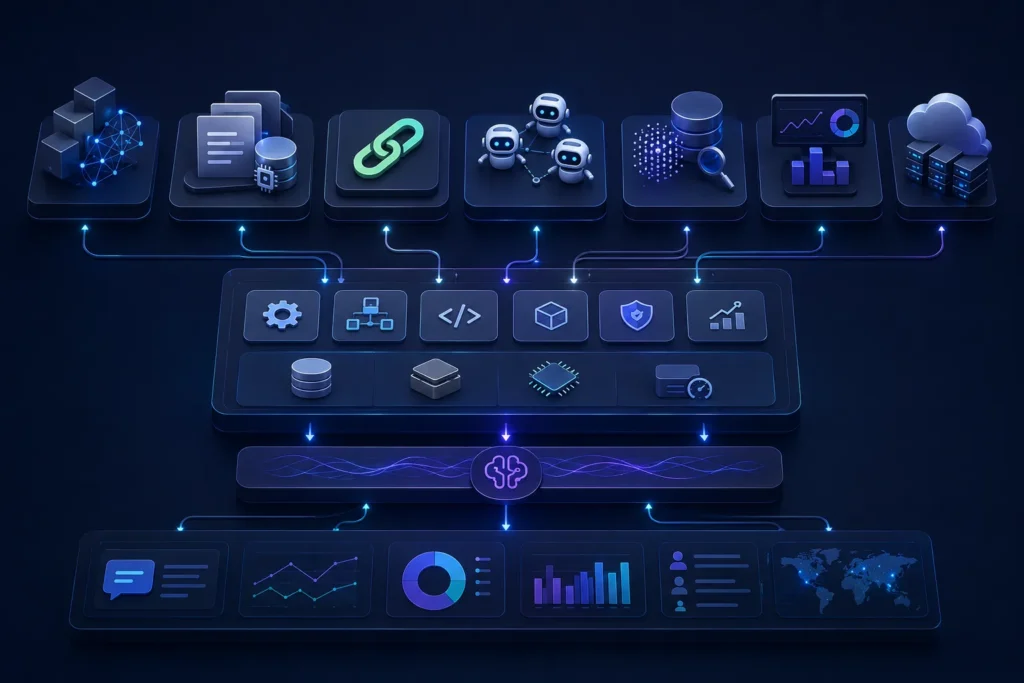
Moreover, companies need efficient workflow management. Enterprise work is not limited to a simple prompt but involves a series of actions like retrieving information, performing analysis, using APIs, validating results, etc. Frameworks make it easier by simplifying workflow management and automation.
Finally, security, scalability, and observability are required as well. Enterprise applications need to have robust security mechanisms to protect sensitive information, be able to scale to hundreds of thousands of users, and monitor the performance of AI. Otherwise, it becomes impossible to debug errors, optimize costs, and improve responses.
Common Enterprise LLM Deployment Challenges:
Private enterprise data access | Retrieval-Augmented Generation (RAG) |
Complex business workflows | Workflow orchestration |
External system integration | Tool calling and connectors |
Reducing hallucinations | Grounded retrieval and validation |
Growing user demand | Scalable architecture |
Production monitoring | Observability and tracing |
Data protection | Security and access controls |
What Makes the Best Frameworks for Enterprise LLM Deployment?
A strong enterprise LLM framework should provide more than basic model connectivity. It should support the complete AI development lifecycle, from data retrieval and workflow creation to deployment and monitoring. Multi-model support is one of the most important requirements. Enterprises often use different models, including GPT, Claude, Gemini, and open-source alternatives. A flexible framework allows teams to switch between models without rebuilding their applications.
Strong RAG capabilities are also essential because most enterprise AI solutions depend on accurate access to company knowledge. Efficient indexing, document processing, and retrieval improve response quality while reducing hallucinations. Additionally, enterprise frameworks must support AI agents, tool integrations, memory management, and observability. These capabilities allow organizations to create intelligent systems that can perform complex tasks while remaining manageable in production environments.
Characteristics of an Enterprise-Ready LLM Framework
Multi-model support | Enables flexibility across different AI providers |
RAG capabilities | Improves accuracy using enterprise knowledge |
Workflow orchestration | Manages complex AI processes |
Agent support | Enables autonomous task execution |
Tool integration | Connects AI with business applications |
Observability | Tracks performance and costs |
Security | Protects sensitive enterprise data |
With these requirements in mind, LangChain and LlamaIndex have emerged as two of the most widely adopted frameworks for building enterprise AI applications. While both support powerful LLM solutions, their approaches and strengths are significantly different.
LangChain: The Enterprise Orchestration Framework

When organizations are moving further from AI chatbots and trying out more complex use cases for AI, there is a need for frameworks which could cope with the level of complexity in modern LLM workflows. That is why LangChain became so popular.
LangChain is an open-source platform that helps to develop applications based on LLMs by linking LLMs to external data sources, APIs, databases, and other business tools. Instead of seeing LLM as a tool which is responsible only for generating texts, LangChain is aimed at developing complete AI-based workflows.
The main advantage of the platform is that it focuses on orchestration. The process of developing enterprise AI apps usually involves a number of connected steps. For instance, an AI customer support agent needs to comprehend the request, find some information in the documentation, access the customer’s record, create a response, and change the state of the corresponding ticket in the ticketing system. It becomes quite complicated to control such processes manually.
That is why LangChain uses the mechanisms of chains, agents, tools, and memory systems to control the workflow and develop applications capable of reasoning and taking actions.
LangChain’s Role in Enterprise AI Applications
One of LangChain’s strongest use cases is building AI assistants that go beyond basic question-answering. Enterprises can use it to create:
- Internal knowledge assistants.
- Customer support automation systems.
- AI copilots for employees.
- Document analysis platforms.
- Workflow automation solutions.
- AI agents that interact with external tools
For example, a financial organization could build an AI assistant that retrieves customer information, analyzes transaction history, checks company policies, and generates personalized recommendations. LangChain provides the orchestration layer that connects all these activities together.
Another major advantage is its extensive integration ecosystem. LangChain supports various models, databases, vector stores, and APIs, allowing enterprises to build flexible architectures without being locked into a single technology provider.
It can work with popular AI providers such as OpenAI, Anthropic Claude, Google Gemini, Azure OpenAI, and open-source models. It also integrates with databases and vector platforms including Pinecone, Chroma, FAISS, and PostgreSQL-based solutions.
Key Features That Make LangChain Enterprise-Friendly
1. Chains and Workflow Management
The original concept behind LangChain was creating “chains” where multiple AI operations could be connected together. A chain defines a sequence of actions, such as taking user input, retrieving information, processing data, and generating a final response.
This approach makes complex AI workflows easier to design, test, and maintain.
For enterprise applications, this is especially useful when business processes involve predictable sequences of tasks.
2. AI Agents and Tool Integration
Modern AI applications increasingly require systems that can make decisions and use external tools. LangChain supports agent-based architectures where AI models can determine which tools to use based on user requests.
For example, an enterprise AI agent might:
- Search a company database.
- Analyze retrieved information.
- Call an external API.
- Generate a business report.
This ability makes LangChain valuable for organizations looking to automate complex workflows rather than simple conversational interactions.
3. Memory and Context Management
Enterprise applications often require maintaining context across conversations. A customer service assistant, for example, needs to remember previous interactions to provide relevant responses.
LangChain provides memory capabilities that allow applications to maintain conversation history and use previous information when generating responses.
This improves user experience by making AI interactions more natural and personalized.
4. Monitoring and Production Management
Moving an AI application into production requires visibility into how the system performs. Developers need to understand:
- Which prompts produce better results
- Where failures occur
- How many tokens are being consumed
- How much each request costs
- How long responses take
Tools like LangSmith help teams monitor, debug, and optimize LangChain applications, making it easier to manage AI systems at scale.
Limitations of LangChain:
Despite its flexibility, LangChain is not without challenges. Its broad ecosystem can sometimes make architecture decisions complicated, especially for teams new to LLM development.
Because LangChain provides many different components, poorly designed applications can become difficult to maintain as they grow. Developers need clear architecture patterns to prevent unnecessary complexity.
Additionally, LangChain focuses more on orchestration rather than specialized data management. While it supports RAG applications, organizations dealing with massive document repositories may require additional tools designed specifically for enterprise knowledge retrieval.
This is where LlamaIndex becomes an important alternative.
LlamaIndex: Built for Enterprise Knowledge Retrieval
While LangChain focuses on connecting different AI components together, LlamaIndex takes a different approach by focusing on data.
Enterprise organizations generate massive amounts of information every day, including documents, reports, research papers, customer records, technical manuals, and internal knowledge bases. The challenge is not only generating responses with an LLM but ensuring those responses are based on accurate and relevant business information.
LlamaIndex is designed specifically to solve this problem.
It acts as a bridge between enterprise data sources and language models, helping organizations organize, index, and retrieve information efficiently.
LlamaIndex’s Role in Enterprise AI Systems:
The primary strength of LlamaIndex is its advanced approach to Retrieval-Augmented Generation (RAG).
In a typical RAG architecture:
- Enterprise documents are collected from different sources.
- Information is processed and converted into searchable representations.
- Relevant content is retrieved based on user queries.
- The retrieved information is provided to the LLM.
- The model generates a response using trusted company data.
LlamaIndex simplifies this entire pipeline.
For organizations working with large volumes of documents, this capability is extremely valuable. Industries such as healthcare, finance, legal services, and manufacturing often require AI systems that can search and understand thousands of documents while maintaining accuracy and compliance.
Why Enterprises Choose LlamaIndex?
One of LlamaIndex’s biggest advantages is its strong focus on data organization. It provides tools for:
- Document ingestion
- Data indexing
- Query optimization
- Metadata filtering
- Knowledge retrieval
- Semantic search
For example, a healthcare organization could use LlamaIndex to build an AI assistant that searches medical guidelines, research documents, and internal policies to provide accurate information to employees.
Similarly, a legal company could create an AI research assistant capable of analyzing contracts, regulations, and case documents.
LangChain vs LlamaIndex: Detailed Comparison for Enterprise LLM Deployment
When choosing between LangChain and LlamaIndex, enterprises often look for a single winner. However, the reality is that both frameworks were designed with different priorities. LangChain focuses on creating intelligent workflows and connecting different AI components, while LlamaIndex focuses on making enterprise data accessible and useful for LLM applications.
The decision should depend on the type of AI system an organization wants to build. A customer-facing AI assistant, an internal automation platform, and an enterprise knowledge search system may require completely different architectures.
Understanding the differences between these frameworks helps businesses select the right foundation for scalable AI solutions.
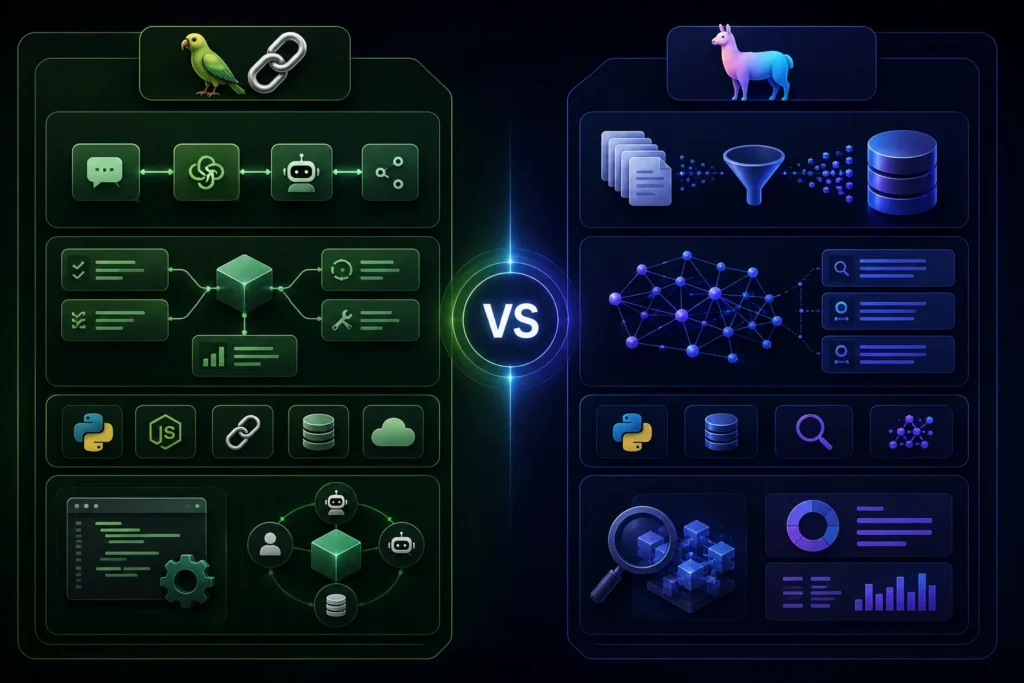
LangChain vs LlamaIndex: Feature Comparison
Primary Focus | LLM workflow orchestration | Enterprise data retrieval and RAG |
Main Purpose | Building AI applications and agents | Connecting LLMs with private knowledge |
Best Use Cases | AI assistants, automation, agents, copilots | Enterprise search, document intelligence, knowledge systems |
Workflow Management | Excellent support for complex workflows | Limited compared to LangChain |
Agent Development | Advanced agent capabilities | Supports agents but focuses more on retrieval |
RAG Support | Strong | Advanced and specialized |
Data Indexing | Basic to moderate | One of its strongest capabilities |
Tool Integration | Large ecosystem of APIs and tools | Focused mainly on data connectors |
Memory Management | Built-in memory capabilities | More focused on data context |
Model Flexibility | Supports multiple LLM providers | Supports multiple LLM providers |
Learning Curve | Moderate due to many components | Moderate with focus on data workflows |
Best Fit | Application logic and orchestration | Knowledge-heavy AI applications |
Should Enterprises Choose LangChain or LlamaIndex?
The answer depends on the application’s primary goal.
Organizations building complex AI workflows often benefit from LangChain because it provides stronger orchestration capabilities. Teams creating enterprise search platforms or document-based assistants may find LlamaIndex more suitable because of its advanced retrieval features.
However, many real-world enterprise deployments do not choose one over the other. Instead, they combine both frameworks to create more powerful AI architectures.
For example:
- LlamaIndex manages enterprise documents and retrieves relevant information.
- LangChain controls the workflow and connects AI with external business systems.
- The LLM generates the final response.
This combination allows organizations to benefit from the strengths of both frameworks.
The Rise of Multi-Agent AI: Where CrewAI Fits In
As enterprise AI continues to evolve, organizations are moving beyond single-agent assistants toward systems where multiple AI agents collaborate to complete complex tasks.
This shift has increased interest in CrewAI multi agent orchestration.
Traditional AI applications usually depend on one model responding to one request. Multi-agent systems take a different approach by assigning different responsibilities to specialized agents.
For example, an enterprise market research system could include:
- Research Agent: Collects information from different sources.
- Analysis Agent: Examines trends and identifies insights.
- Writing Agent: Creates reports and summaries.
- Review Agent: Checks accuracy and improves quality.
Instead of asking one AI system to perform every task, each agent focuses on a specific role and works together toward a common goal.
How Crew AI Complements Enterprise LLM Frameworks?
CrewAI is not designed to replace LangChain or LlamaIndex. Instead, it adds another layer of intelligence by managing collaboration between AI agents.
A modern enterprise AI architecture may look like this:
Foundation Model | GPT, Claude, Gemini, Llama | Generates reasoning and responses |
Knowledge Layer | LlamaIndex | Retrieves enterprise information |
Workflow Layer | LangChain | Manages tools, logic, and application flow |
Agent Layer | CrewAI | Coordinates multiple specialized agents |
Database Layer | Vector databases | Stores searchable knowledge embeddings |
Monitoring Layer | LangSmith and other tools | Tracks performance and improves reliability |
This approach creates a modular AI system where each technology handles the area it performs best.
Modern Enterprise AI Stack: Combining Multiple Frameworks
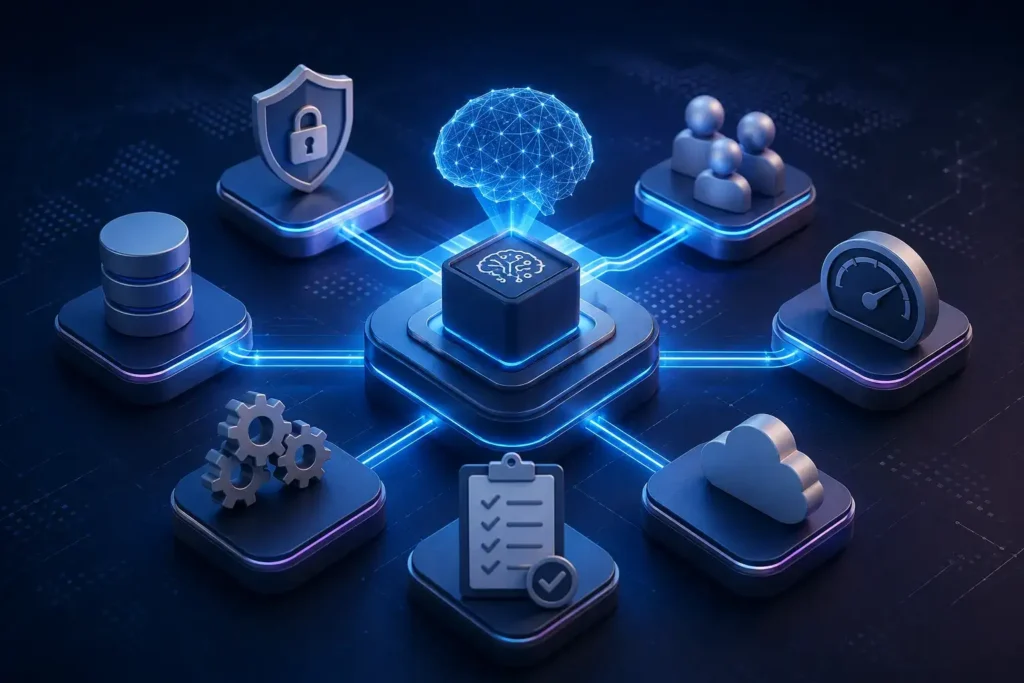
Successful enterprise AI deployments rarely depend on a single framework. Instead, companies are building flexible technology stacks where different tools solve different challenges.
A typical production architecture may include:
Language Models | GPT, Claude, Gemini | Text generation and reasoning |
Data Processing | LlamaIndex | Document processing and retrieval |
AI Orchestration | LangChain | Workflow management |
Multi-Agent Systems | CrewAI | Agent collaboration |
Vector Database | Pinecone, Weaviate, Chroma | Semantic search storage |
Monitoring | LangSmith, Arize AI | Performance tracking |
Infrastructure | AWS, Azure, Docker | Scalable deployment |
This modular approach gives enterprises greater flexibility. As AI models continue to improve, organizations can replace individual components without rebuilding their entire system.
Choosing the Right Framework for Your Enterprise AI Project
There is no universal framework that works for every enterprise use case. The right choice depends on business goals, data complexity, and workflow requirements.
Build AI assistants and copilots | LangChain |
Create enterprise search systems | LlamaIndex |
Automate complex workflows | LangChain + Agents |
Build multi-agent AI teams | CrewAI |
Develop document-based AI applications | LlamaIndex + LangChain |
Create autonomous business processes | CrewAI + LangChain + LlamaIndex |
The future of enterprise AI will likely not be dominated by a single framework. Instead, organizations will rely on combinations of specialized tools that work together to create intelligent, scalable, and reliable AI systems.
Conclusion:
hoosing the right framework for enterprise LLM deployment is not about selecting a single technology but building a complete AI stack that supports data retrieval, workflows, security, and monitoring.
LangChain, LlamaIndex, and CrewAI solve different challenges: LangChain focuses on workflow orchestration, LlamaIndex connects enterprise knowledge with LLMs through retrieval, and CrewAI enables multi-agent collaboration. The future of enterprise AI will rely on combining these specialized tools to build scalable and reliable AI systems.
Companies that develop flexible, modular, and secure AI architectures will have a significant advantage as language models continue to evolve. By combining the right frameworks with reliable LLM integration approaches, businesses can transform experimental AI projects into scalable enterprise solutions.