

Introduction:
Building AI-powered applications has become easier than ever, but managing the cost of running Large Language Models (LLMs) in production remains a major challenge. While an AI feature may cost only a few cents during testing, expenses can grow rapidly as user traffic, API calls, and token usage increase.
Many businesses focus on choosing the most advanced AI model without considering its long-term operating costs. Factors like input and output tokens, conversation history, response length, and model selection all contribute to your monthly AI bill. Without proper planning, these costs can quickly exceed expectations.
That’s why using an LLM API cost calculator before development is essential. Estimating your costs early helps you select the right model, optimize your AI architecture, and avoid unexpected budget overruns. In this guide, you’ll learn how LLM pricing works, how to calculate LLM API costs, and the best strategies to keep your AI expenses under control while maintaining performance.
Why You Should Estimate LLM API Costs Before Development?
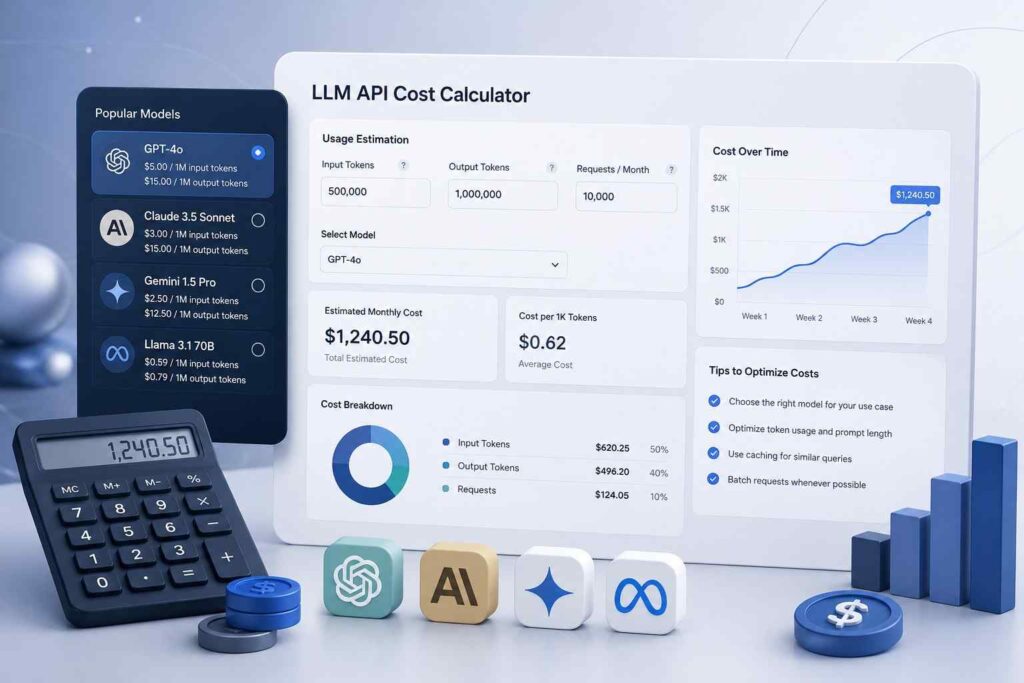
Many AI projects exceed their expected budget because of small design decisions that become expensive at scale.
Some common reasons include:
- Token usage increases as user traffic grows.
- Output tokens typically cost significantly more than input tokens.
- Premium models can be many times more expensive than lightweight alternatives.
- Architectural decisions such as conversation history, Retrieval-Augmented Generation (RAG) implementations, and AI agents increase token consumption.
If you’re building a RAG-powered application, understanding how retrieval impacts token usage is equally important. Our guide on RAG Architecture: Connect Enterprise Data to LLMs Securely explains how retrieval pipelines and context management influence both performance and API costs. Estimating costs before development allows businesses to optimize their architecture before spending money in production.
How LLM API Pricing Works?
Understanding the pricing model is the first step toward calculating your AI expenses accurately.
1. Tokens Are the Billing Unit
LLM providers charge based on tokens, not words or API requests.
As a general estimate:
- 1 token ≈ ¾ of an English word
- 1,000 words ≈ 1,300–1,400 tokens
Every prompt and every generated response consumes tokens.
2. Input Tokens vs Output Tokens
Each API request contains two separate costs.
Input Tokens
These include:
- User prompts
- System prompts
- Conversation history
- Retrieved documents
- Tool definitions
Output Tokens
These include everything generated by the model, including reasoning tokens on supported models.
Since output tokens usually cost 4–6× more than input tokens, response length has a major impact on your bill.
3. Additional Pricing Factors
Several features can reduce or increase your total AI costs.
| Cost Factor | Impact |
|---|---|
| Prompt caching | 75–90% savings on repeated prompts |
| Batch processing | Around 50% lower cost |
| Model tiering | Up to 25× cheaper for simple tasks |
| Long context windows | Higher pricing for very large prompts |
These optimizations can dramatically reduce production expenses.
Current LLM API Pricing (August 2026)
Below is a simplified overview of current pricing across major providers.
Anthropic Claude
| Model | Input / 1M Tokens | Output / 1M Tokens |
|---|---|---|
| Claude Haiku 4.5 | $1 | $5 |
| Claude Sonnet 5 | $2 ($3 after intro pricing) | $10 ($15 standard) |
| Claude Opus 5 | $5 | $25 |
| Claude Fable 5 | $10 | $50 |
OpenAI GPT
| Model | Input | Output |
|---|---|---|
| GPT-5.6 Luna | $0.20 | $1.20 |
| GPT-5.4 | $2.50 | $15 |
| GPT-5.6 Sol / GPT-5.5 | $5 | $30 |
| GPT-5.5 Pro | $30 | $180 |
Google Gemini
| Model | Input | Output |
|---|---|---|
| Gemini 3.1 Flash Lite | $0.25 | $1.50 |
| Gemini 3.6 Flash | $1.50 | $7.50 |
| Gemini 3.1 Pro | $2 | $12 |
| Gemini 3.1 Pro (Long Context) | $4 | $18 |
The gap between entry-level and flagship models can be as high as 20–50×, making model selection one of the biggest cost decisions.
How to Calculate LLM API Cost?
The calculation itself is straightforward.
Cost Per Request
Cost =
(Input Tokens ÷ 1,000,000 × Input Price)
+
(Output Tokens ÷ 1,000,000 × Output Price)
Monthly Cost
Monthly Cost =
Cost Per Request × Monthly Requests
To estimate accurately, gather the following information:
- Average input tokens.
- Average output tokens.
- Expected monthly requests.
- Selected AI model.
- Applicable discounts such as caching or batch processing.
Example LLM API Cost Calculation
Imagine a customer support chatbot with:
- 50,000 conversations each month.
- 3 exchanges per conversation.
- 600 input tokens.
- 250 output tokens.
- Claude Sonnet 5 pricing.
Estimated monthly cost:
| Category | Cost |
|---|---|
| Input Tokens | $180 |
| Output Tokens | $375 |
| Total | ≈ $555/month |
Switching to a lower-cost model such as Claude Haiku reduces the monthly expense to roughly $277.50, demonstrating the impact of model selection.
Estimated Monthly Costs by AI Use Case
| Application | Estimated Monthly Cost |
|---|---|
| Internal FAQ Bot | $10–40 |
| Customer Support Chatbot | $300–800 |
| Document Summarization | $150–600 |
| Code Assistant | $15–50 per developer |
| RAG Knowledge Assistant | $400–1,600 |
| Autonomous AI Agent | $750–3,000+ |
Agentic AI and Retrieval-Augmented Generation (RAG) applications usually consume more tokens due to multiple reasoning steps and larger context windows.
Best Practices to Reduce LLM API Costs
Once you have estimated your AI expenses, the next step is optimizing them. Small improvements in your application architecture and model selection can significantly lower your monthly API bill without compromising performance. Another important consideration is whether your application actually requires model fine-tuning. In many enterprise use cases, integrating an existing LLM with your business data is significantly more cost-effective than training a custom model. Our detailed comparison of LLM Fine-Tuning vs Integration Cost explains when each approach delivers the best return on investment.

Consider these proven cost optimization strategies:
1. Prevents Unexpected Budget Overruns
Estimate your AI expenses in advance and avoid costly surprises as your application scales. This enables better financial planning and keeps projects within budget.
2. Helps You Choose the Right AI Model
Compare the costs of different LLMs to find the best balance between performance and affordability. Not every task requires a premium model.
3. Optimizes Resource Utilization
By analyzing token usage, request volume, and response length, you can identify opportunities to reduce unnecessary API calls and lower operational costs.
4. Improves Scalability Planning
Forecast AI expenses based on expected user growth and traffic, ensuring your infrastructure and budget can support increased demand over time.
5. Supports Better Business Decisions
Accurate cost estimates make it easier to evaluate the return on investment (ROI) of AI initiatives, justify budgets, and select the most cost-effective deployment strategy.
Common Cost Estimation Mistakes
Accurately estimating LLM API costs requires more than applying a simple pricing formula. Many businesses underestimate their AI expenses because they overlook factors that significantly impact token usage and overall costs. Avoid these common mistakes to create a more realistic budget.
1. Estimating Only Ideal Token Usage
Many calculations are based on short, perfect-case prompts. In reality, retries, error handling, user variations, and additional context often increase token consumption.
2. Ignoring Output Token Costs
Output tokens are typically much more expensive than input tokens. Long or detailed responses can quickly increase your monthly API bill if response length isn’t properly managed.
3. Underestimating Future Growth
Cost estimates based only on launch-day traffic rarely remain accurate. As your user base grows, API requests and token usage increase, making scalability an important part of budgeting.
4. Using Premium Models for Every Request
Not every task requires a flagship LLM. Running simple operations such as classification, routing, or summarization on high-end models can lead to unnecessary expenses.
5. Overlooking Cost-Saving Features
Many organizations fail to take advantage of prompt caching, batch processing, and context optimization. These features can significantly reduce API costs and improve the overall efficiency of your AI application.
Avoiding these common mistakes will help you create more accurate cost estimates, optimize your AI infrastructure, and keep production expenses under control as your application scales.
Final Thoughts:
Calculating LLM API costs shouldn’t be an afterthought. Whether you’re building an AI chatbot, document summarizer, coding assistant, or enterprise AI platform, understanding token pricing before launch helps you stay within budget while maintaining performance. An LLM API cost calculator gives developers and businesses the visibility needed to estimate expenses, compare models, and optimize AI infrastructure before deployment. By combining realistic token estimates, expected usage, and the right pricing model, you can avoid unexpected bills and build scalable AI applications with confidence.
If you’re planning to deploy AI in your business, explore Techelix’s LLM Integration Services to learn how we help organizations build secure, scalable, and cost-efficient enterprise AI solutions.