
Ambient AI scribes are moving quickly from pilot projects to everyday clinical workflows. At The Permanente Medical Group, for example, more than 7,000 physicians used ambient AI documentation across more than 2.5 million patient encounters during a 63-week evaluation. The AMA has also reported measurable reductions in documentation time and after-hours work among users. But adoption alone does not prove that speech recognition is ready for clinical use.
The challenging part is what happens when the ASR system encounters a medicine name, dosing, abbreviation, anatomical terms, or terms specific to a particular specialty field. Imagine a drug name such as “metoprolol succinate.” A generic speech recognition system would be able to comprehend the whole sentence flawlessly but misidentify the drug name.
That is the fundamental difference between general-purpose automatic speech recognition (ASR) and medical speech recognition software. Clinical speech is not simply ordinary English with a few medical words added. It is a specialized language environment where a single incorrect word can change the meaning of a patient record.
What Is Medical Speech Recognition Software?
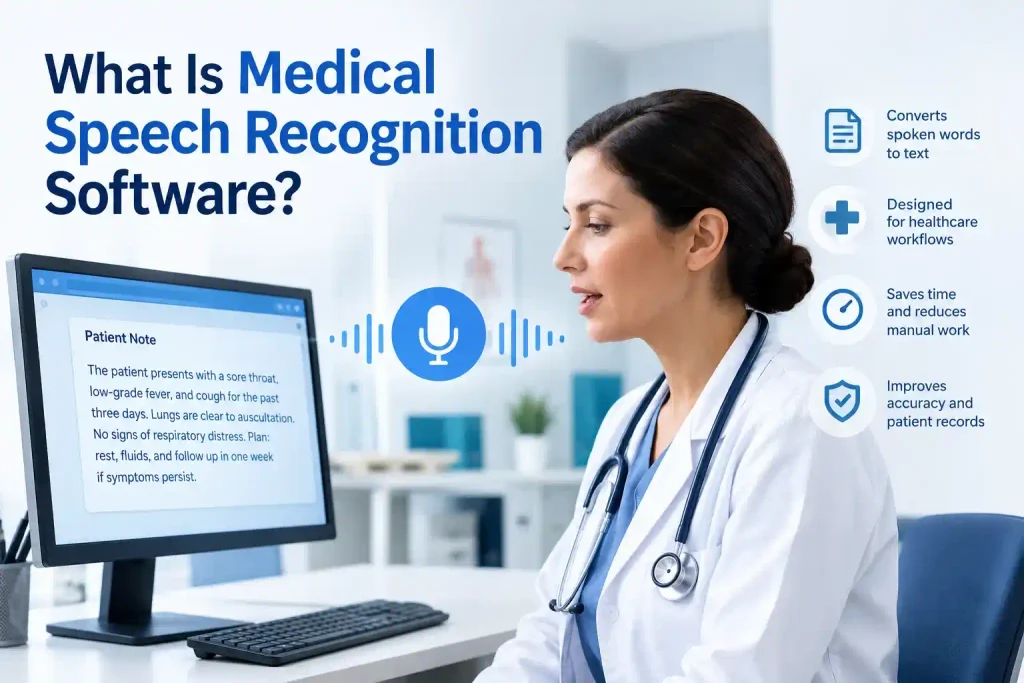
Medically oriented speech recognition software is used to transcribe clinical speech to text by considering the vocabulary, syntax, and procedures involved in medicine. While a general ASR tool focuses on transcribing regular speech, a medical application should perform more than that and be able to recognize terms like:
- Medication names and generic drug names.
- Dosages, units, and frequencies.
- Anatomical terminology.
- Medical abbreviations.
- Procedures and diagnoses.
- Laboratory values.
- Specialty-specific vocabulary.
- Names of diseases and conditions.
- Clinical shorthand.
- Multiple speakers in patient encounters.
It becomes especially critical to differentiate the two when using speech recognition as an aspect of an EHR ambient scribe. The ambient scribe does not work with isolated dictation. It may listen to a natural conversation involving a physician, a patient, caregivers, and other parties involved. This task requires speaker identification, understanding of the context, recognition of the medical terminology, and converting the conversation into documentation.
Comparison of the performance of general-purpose ASR and medical conversation ASR models has revealed WERs from 8.8% to 10.5% in a controlled experiment, which shows that there is still a lot of work to do with even medical models. (PubMed Central) This lesson is extremely important: clinical speech recognition can’t be solved by choosing more advanced general-purpose ASR models.
Why Generic ASR Struggles With Clinical Vocabulary?
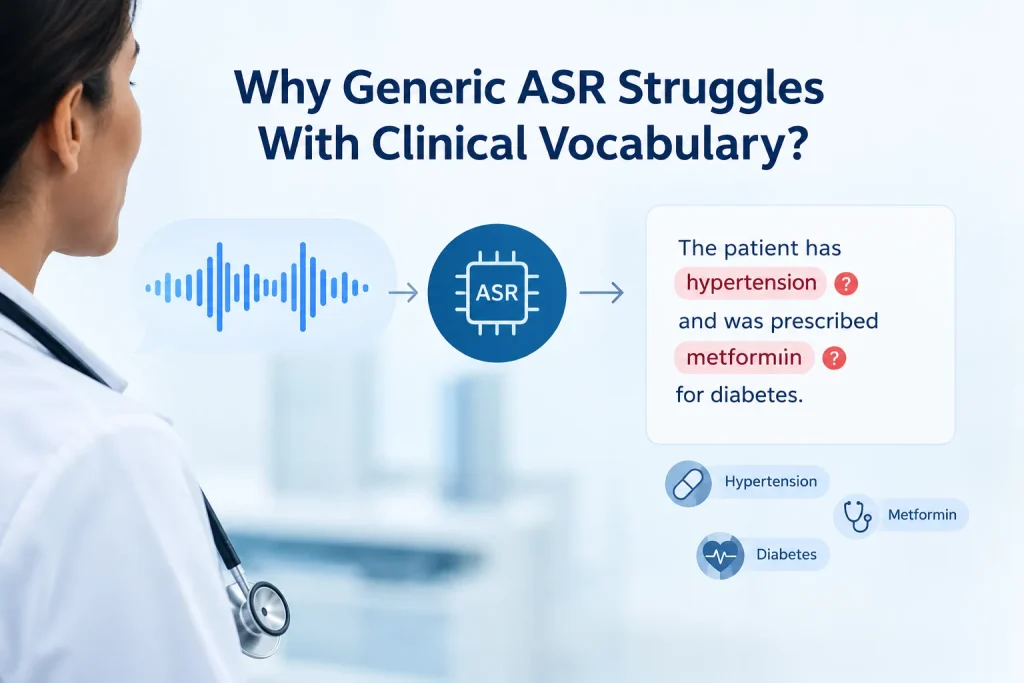
While generic ASR systems are generally built on large speech datasets which can accommodate normal speech, clinical communication is a completely different matter. Medical practitioners use technical terms, drug names, abbreviations, doses, and other phrases that are not so common in normal speech datasets.
Take for example when a doctor says:
“Continue metoprolol succinate 50 milligrams twice daily.”
For a physician, the task is straightforward. However, in the case of an automatic speech recognition system working in general, metoprolol succinate becomes an unusual sound combination. It should be capable of differentiating between similar-sounding words but also identify that the phrase belongs to the medical vocabulary.
There are a few issues associated with the task of transcribing accurately in this regard.
1. Drug Names Are Difficult to Recognize
Names of medications pose a particular challenge since they often use rare phonetic combinations and lack representation in common-speech training sets. One mistake in the transcription of a medication name could result in the creation of a completely new word, or a well-formed sentence whose meaning differs significantly from the original.
A recent study evaluating artificial intelligence-assisted clinical documentation has shown that medication names such as metoprolol succinate are considered to be difficult for transcribing by speech recognition systems. This is when the global Word Error Rate (WER) becomes irrelevant.
A system capable of transcribing 98 out of 100 words may seem very reliable. Yet, the significance of these two errors will largely depend on what words have been transcribed incorrectly. Errors in casual conversations might not bear much weight. Yet, the mistakes in the names of medications, dosages or instructions can be much more serious.
For clinical speech recognition software, the measurement of accuracy should go beyond the global WER. Clinical organizations should also consider the accuracy of medication names, dosages and numbers, terminology recognition, and preservation of clinical meaning.
WER Is Useful, But Clinical WER Matters More
Word error rate (WER) is one of the standard metrics used to evaluate speech recognition. It is commonly calculated from substitutions, deletions, and insertions:
WER = (Substitutions + Deletions + Insertions) / Total Words
For general transcription, this provides a useful measure of overall recognition performance. Healthcare requires a more granular approach.
A clinical speech recognition evaluation should also ask:
| Metric | What it measures | Why it matters clinically |
|---|---|---|
| Overall WER | General transcription accuracy | Shows baseline ASR performance |
| Clinical-term WER | Errors involving medical vocabulary | Reveals failures hidden by overall WER |
| Medication WER | Drug-name recognition | Helps identify medication safety risks |
| Numeric accuracy | Dosages, dates, measurements | Prevents clinically significant number errors |
| Speaker accuracy | Correct attribution of speech | Important for ambient encounters |
| Concept recall | Whether important clinical concepts were captured | Measures documentation completeness |
| Specialty WER | Performance within a specific medical specialty | Identifies domain-specific weaknesses |
This approach is more meaningful than simply asking whether a model has a low overall WER.
A systematic review of clinical speech recognition research found that reported WER varied widely depending on the environment and evaluation methodology, ranging from controlled dictation settings to conversational and multi-speaker scenarios with much higher error rates. (PubMed)
In other words, benchmarking has to resemble the environment where the system will actually be used.
Medical Vocabulary Is Only One Part of the Problem
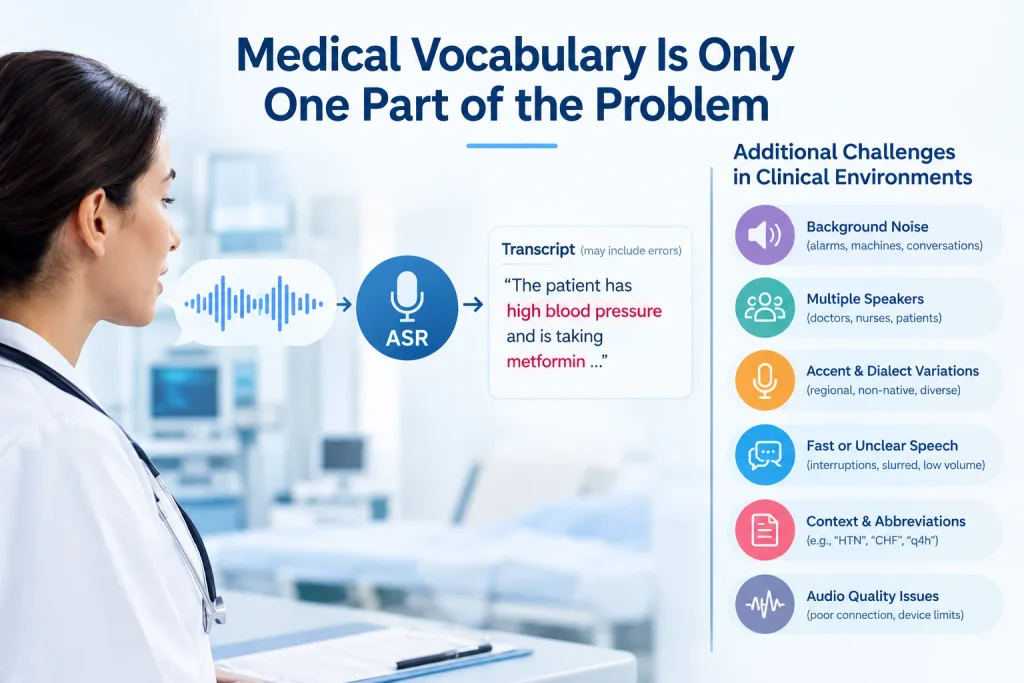
Medical terminology is only one challenge in clinical speech recognition. Real-world healthcare environments introduce several additional factors that generic ASR systems may struggle to handle accurately.
1. Accents and Pronunciation
Healthcare organizations operate with multilingual and geographically diverse workforces.
Physicians and patients may have different accents, speech patterns, pronunciation styles, or levels of fluency. A model optimized primarily for standard conversational speech can perform differently when exposed to these variations.
2. Abbreviations
Clinical communication is filled with abbreviations:
- BP
- HR
- CBC
- MRI
- ECG
- COPD
- BID
- PRN
- NPO
A generic model may interpret an abbreviation phonetically rather than clinically.
The correct output depends on understanding the healthcare context surrounding it.
3. Numbers and Dosages
Numbers are particularly sensitive.
Consider:
“Take 15 milligrams.”
versus:
“Take 50 milligrams.”
The words are simple, but the difference is clinically significant.
The same applies to:
- Blood pressure readings
- Laboratory values
- Heart rate
- Oxygen saturation
- Medication strengths
- Frequencies
- Dates
- Ages
- Measurements
A robust medical speech recognition system therefore needs dedicated handling for numerical and structured clinical information.
4. pecialty-Specific Language
A cardiologist, radiologist, neurologist, surgeon, and dermatologist do not speak the same clinical language. A model that performs well in primary care may not perform equally well in oncology or emergency medicine. This is why medical ASR should be evaluated against the actual specialties and workflows where it will be deployed.
Why Ambient AI Scribes Raise the Accuracy Bar?
Traditional clinical dictation is relatively controlled. A physician deliberately speaks into a microphone to document specific information. Ambient documentation is different. The system listens to a natural conversation involving physicians, patients, caregivers, and other participants. The ASR layer must therefore handle:
Patient speech → clinician speech → interruptions → medical terminology → background noise → speaker changes → structured documentation
An EHR ambient scribe combines speech recognition with speaker diarization, natural-language processing, summarization, and clinical documentation. This means an error in transcription can affect the stages that follow. One study of ambient clinical documentation reported WERs of 11.8% for Google ASR and 12.8% for Amazon ASR, with higher error rates for some conversational sounds.
More recent research also found omissions, hallucinations, and accidental inclusions in AI-generated clinical notes, reinforcing the need for clinician review. An ambient scribe therefore needs to do more than produce a fluent transcript. It must preserve the clinical meaning of the conversation.
From Speech Recognition to Clinical Documentation Automation
This is where the distinction between ASR and clinical documentation automation becomes important.
ASR answers:
“What words were spoken?”
Clinical documentation automation asks:
“What clinically relevant information was communicated, and how should it appear in the medical record?”
Those are different problems.
A typical workflow may look like this:
Conversation → Speech recognition → Speaker identification → Clinical terminology recognition → Information extraction → Note generation → EHR integration → Clinician review
Each stage can introduce errors.
For example, if ASR incorrectly recognizes a medication name, the downstream documentation model may treat that incorrect transcription as factual input.
This is sometimes called error propagation.
The better the initial speech layer, the stronger the foundation for every downstream clinical AI task.
What a Clinical-Grade Speech Recognition Architecture Should Include
A production-grade clinical speech recognition system should not depend on a generic ASR model alone. It needs multiple layers working together to improve accuracy, validate clinical information, and reduce the risk of transcription errors.
1. Clinical Vocabulary Adaptation
The system should be adapted to approved medical terminology, medication names, abbreviations, specialty-specific terms, and organization-specific language. This helps improve recognition of words that generic speech models may frequently misinterpret.
2. Context-Aware Recognition
Clinical speech depends heavily on context. The same sound can have different meanings depending on the specialty, patient history, or surrounding conversation. Context-aware language models can use these signals to improve recognition and reduce ambiguous results.
3. Speaker Diarization
Ambient clinical encounters involve multiple speakers, including physicians, patients, caregivers, and other staff. Speaker diarization should identify and separate these voices so that information is correctly attributed to the appropriate speaker.
4. Medical Entity Validation
Recognized medications, diagnoses, procedures, dosages, measurements, and other clinical entities should be validated against approved medical vocabularies and defined rules. This provides an additional layer of protection against clinically significant transcription errors.
5. Confidence Scoring
The system should assign confidence scores to recognized terms and flag uncertain results for review rather than silently inserting potentially incorrect information into the medical record.
6. Human Review
Clinicians should remain responsible for reviewing and approving the final documentation. AI can accelerate transcription and documentation, but clinical judgment should remain the final checkpoint before information becomes part of the patient record.
A clinical-grade architecture therefore treats speech recognition as a multi-layer clinical processing pipeline, not simply a one-step conversion of audio into text. This approach improves accuracy, traceability, and safety while making the technology more practical for real-world healthcare environments.
HIPAA-Compliant Transcription Is More Than Encryption
Accuracy is only half of the problem. Clinical speech contains protected health information, which means organizations also need to consider how recordings, transcripts, and generated notes are processed and stored. The HIPAA Security Rule requires covered entities and business associates to implement appropriate administrative, physical, and technical safeguards to protect the confidentiality, integrity, and availability of electronic protected health information.
That means a healthcare organization evaluating HIPAA compliant transcription should look beyond a vendor’s marketing claim.
Important questions include:
- Where is audio processed?
- Is PHI encrypted during transmission and storage?
- Who can access transcripts?
- Are access events logged?
- How long is audio retained?
- Is audio deleted after processing?
- How are model providers and subprocessors managed?
- Are appropriate business associate arrangements in place?
- Can the organization audit the system?
Security also needs to protect data integrity, not just confidentiality. A transcription system that securely stores an incorrect clinical statement is still a clinical risk.
Generic ASR vs. Medical Speech Recognition
The difference becomes clearer when the technologies are evaluated against real clinical requirements.
| Capability | Generic ASR | Medical Speech Recognition |
|---|---|---|
| Everyday conversation | Strong | Strong |
| General dictation | Strong | Strong |
| Medical terminology | Variable | Optimized |
| Drug names | Often challenging | Specialized handling |
| Medical abbreviations | Variable | Clinical vocabulary support |
| Dosage recognition | General numeric recognition | Clinical-aware validation |
| Specialty vocabulary | Limited adaptation | Specialty-specific tuning |
| Speaker diarization | Available in some systems | Important for ambient workflows |
| EHR integration | Usually external | Designed around clinical workflows |
| Clinical entity validation | Limited | Can be integrated |
| HIPAA-focused deployment | Depends on provider | Designed around healthcare requirements |
| Clinical WER benchmarking | Usually broad | Should include clinical categories |
| Ambient documentation | Not necessarily optimized | Core use case |
The important point is not that generic ASR is inherently bad. Generic models can provide excellent baseline speech recognition. The problem is that clinical environments require a much narrower definition of accuracy.
How to Benchmark Medical Speech Recognition Properly
Healthcare organizations should avoid choosing a system based on a single advertised accuracy percentage. Instead, testing should use representative clinical data and workflows.
A practical word error rate benchmarking framework can include:
1. Test real clinical vocabulary
Build a test set containing medications, procedures, diagnoses, abbreviations, anatomical terms, measurements, and specialty-specific phrases.
2. Measure critical-term accuracy separately
Do not allow common conversational words to hide poor medication or dosage recognition.
3. Test multiple specialties
Primary care, emergency medicine, cardiology, oncology, radiology, and other specialties can produce very different language patterns.
4. Test realistic conversations
Include interruptions, overlapping speech, patient questions, background noise, and different speakers.
5. Measure downstream documentation quality
The final question is not only whether the transcript is accurate. It is whether the generated clinical note preserves the important facts.
6. Keep clinician review in the loop
A production evaluation should measure how much editing clinicians actually need to perform.
This matters because a system that produces a technically impressive transcript but requires extensive correction may simply move documentation work from typing to editing.
Why Medical Speech Recognition Is Becoming a Core Healthcare Technology
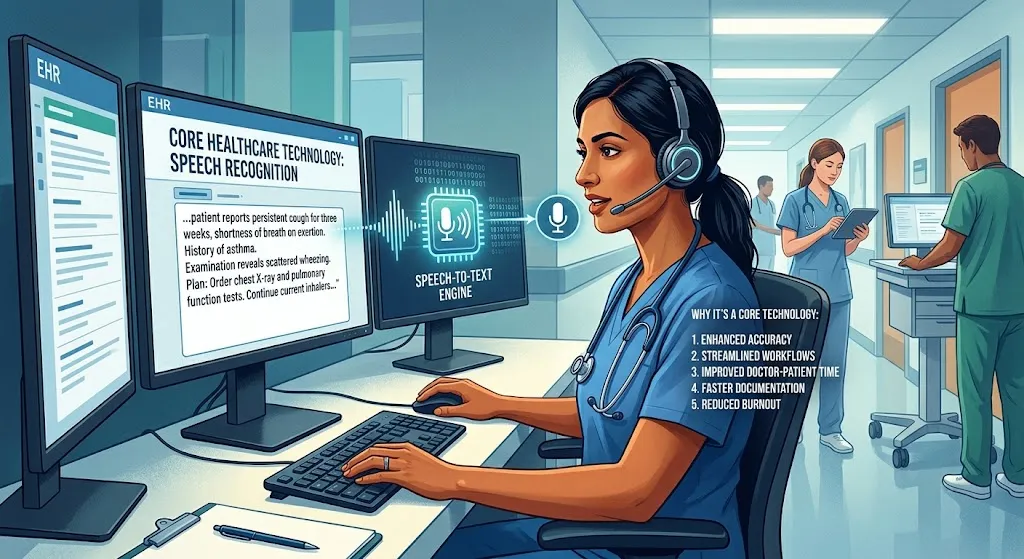
The growth of ambient documentation shows that clinicians are willing to adopt voice-based systems when they meaningfully reduce documentation burden. At The Permanente Medical Group, ambient AI expanded to millions of encounters, while other health systems have reported reductions in after-hours documentation and burnout measures. American Medical Association
But adoption will increasingly depend on trust. Clinicians will not judge a medical speech recognition system by how impressive its demo sounds. They will judge it by whether it correctly captures the medication, dosage, diagnosis, symptom, and clinical decision that matter in a real encounter. That changes the technology requirements.
The winning systems will combine:
Accurate ASR + medical vocabulary + clinical context + secure processing + EHR integration + validation + human review
Organizations exploring this approach can also look at broader AI healthcare solutions that connect speech technologies with clinical workflows, data systems, and healthcare automation.
For teams building or evaluating specialized solutions, Speech Recognition can provide the foundation for voice-enabled clinical documentation, EHR workflows, and medical transcription.
Final Takeaway
Generic ASR is built to recognize everyday language, while medical speech recognition software must accurately interpret language within complex clinical environments. Drug names, dosages, abbreviations, specialty-specific terminology, and conversational context can all create errors that affect documentation quality and patient safety. As ambient scribes continue to gain adoption, organizations should evaluate more than overall WER, considering clinical-term accuracy, medication recognition, numerical accuracy, security, speaker attribution, and clinician editing time. Ultimately, the goal is not simply to transcribe speech faster, but to create accurate, secure, and clinically meaningful documentation that reduces administrative burden while supporting physicians and improving healthcare workflows.