

Introduction
As businesses race to adopt artificial intelligence, one question keeps surfacing during strategy meetings and budget discussions. Should you invest in LLM fine-tuning or integrate existing AI models, and which approach delivers better ROI?
Organisations are eager to use large language models (LLMs) for customer support, workflow automation, content generation, data analysis, and internal knowledge management. However, the path to implementation isn’t always clear. Some companies choose to fine-tune a model using their proprietary data, while others integrate existing foundation models through APIs.
Let’s take a look at the real costs behind both options, explore their return on investment, and help you determine which strategy makes the most financial sense for your business.
Understanding LLM Fine-Tuning:
LLM fine-tuning involves taking a pre-trained language model and further training it on your organisation’s specific datasets. This process allows the model to better understand industry terminology, company processes, customer interactions, and specialised use cases.
For example, a healthcare provider might fine-tune an LLM using medical records and clinical documentation, while a legal firm could train a model on contracts and case files.
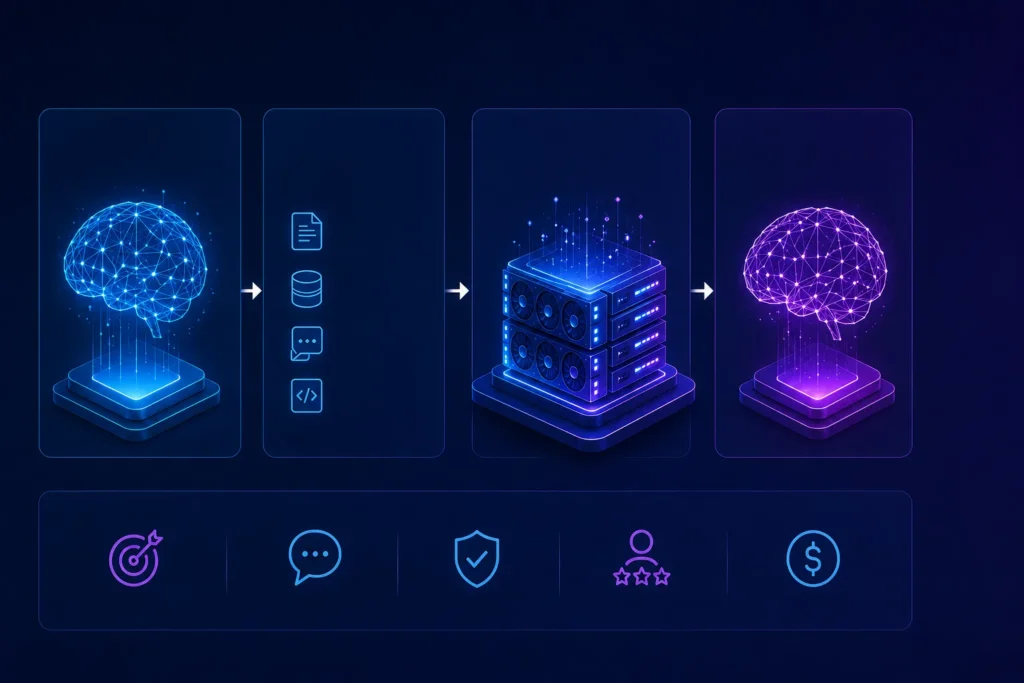
Benefits of Fine-Tuning
- Improved accuracy for niche domains
- Better handling of industry-specific terminology
- Greater control over outputs
- Reduced prompt engineering requirements
- Potential competitive advantage through proprietary intelligence
While these benefits can be significant, they require substantial investment.
The Hidden Reality of GPU Training Costs for LLMs:
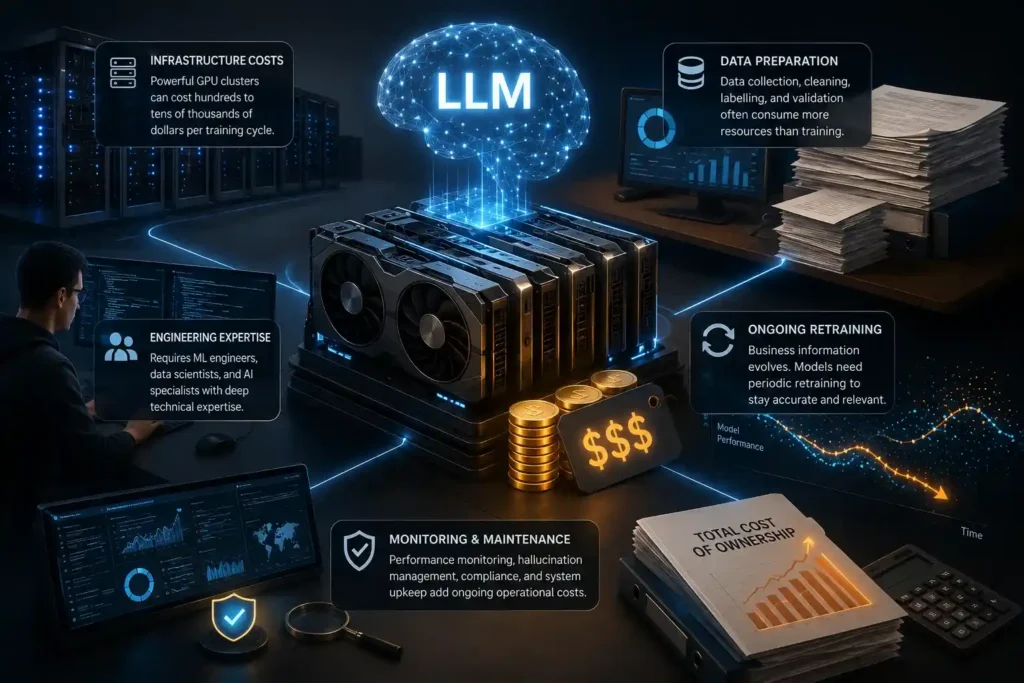
One of the biggest misconceptions about LLM fine-tuning is that it only requires a quality dataset and a few training runs. In reality, the cost extends far beyond model training. Organisations must account for infrastructure, data preparation, specialised talent, and ongoing maintenance, all of which can significantly impact the total cost of ownership and overall ROI.
| Cost Factor | Why It Matters |
|---|---|
| GPU Infrastructure | Fine-tuning large language models requires high-performance GPUs or cloud compute resources. Depending on the model size, dataset, and training duration, a single training cycle can cost anywhere from hundreds to tens of thousands of dollars. |
| Data Preparation | Collecting, cleaning, labelling, validating, and organising high-quality training data is often one of the most time-consuming and expensive stages of the entire project. |
| Engineering Expertise | Successful fine-tuning requires experienced machine learning engineers, data scientists, and AI specialists who can optimise models, evaluate performance, and troubleshoot complex issues. |
| Ongoing Retraining | Business knowledge, customer behaviour, and regulations evolve over time. To maintain accuracy and relevance, fine-tuned models require periodic retraining using updated datasets. |
| Monitoring & Maintenance | Continuous monitoring is essential to detect performance drift, reduce hallucinations, ensure compliance, and maintain consistent model quality in production environments. |
Understanding LLM Integration
LLM integration takes a different approach.
Instead of modifying the model itself, businesses connect existing AI models through APIs and enhance performance using techniques such as:
- Retrieval-Augmented Generation (RAG)
- Prompt engineering
- Knowledge base integration
- Workflow automation
- Context injection
This method enables companies to leverage powerful models without the burden of training and maintaining their own versions.
Many organisations choose custom LLM integration solutions because they enable faster deployment and significantly lower upfront investment than fine-tuning.
OpenAI API Cost Optimization: Why It Matters
When evaluating the ROI of LLM integration, it’s important to look beyond implementation costs. As AI adoption grows, API usage can become one of the largest ongoing operational expenses if it isn’t managed efficiently.
A well-planned cost optimisation strategy helps organisations maximise the value of their AI investment while keeping operational costs under control.
Here are some of the most effective optimisation techniques:
Prompt Optimization
Well-structured prompts reduce unnecessary token usage without compromising response quality. Even small improvements in prompt design can lead to significant cost savings at scale.
Response Caching
Many AI applications receive repeated or similar queries. By storing and reusing previously generated responses where appropriate, businesses can reduce API calls, lower costs, and improve response times.
Choose the Right Model
Not every task requires the most advanced or expensive model. Matching model capabilities to the complexity of each use case helps balance performance with cost, ensuring resources are used efficiently.
Smart Context Management
Sending only the information necessary for a task minimises token consumption, reduces latency, and improves overall efficiency without sacrificing output quality.
Intelligent Workflow Routing
A cost-effective AI architecture routes simple, repetitive tasks to smaller, lower-cost models while reserving premium models for complex reasoning or high-value interactions. This hybrid approach delivers the best balance of performance and cost.
The Business Impact
Organisations that implement these optimisation strategies can significantly reduce API expenses while maintaining high-quality AI performance. As AI usage scales across teams and applications, cost optimisation becomes a critical factor in maximising long-term ROI and ensuring sustainable growth.
LLM Fine Tuning vs Integration Cost: A Direct Comparison
| Initial Investment | High | Low to Moderate |
| Deployment Speed | Weeks to Months | Days to Weeks |
| Infrastructure Requirements | Significant | Minimal |
| Maintenance Costs | High | Moderate |
| Flexibility | Lower | Higher |
| Scalability | More Complex | Easier |
| Technical Expertise Needed | Advanced AI Team | Development Team |
| Upfront ROI Timeline | Longer | Faster |
For most organisations, integration provides a lower-risk path to AI adoption and faster returns. However, there are situations where fine-tuning becomes worthwhile.
When Does Fine-Tuning Become the Better ROI Investment?
Although LLM integration is the most cost-effective option for many organisations, there are situations where fine-tuning delivers significantly greater long-term value. When your business requires deep customisation, exceptional accuracy, or proprietary capabilities, the additional investment can produce a stronger return over time.

1: Highly specialised knowledge
Organisations operating in domains such as healthcare, legal services, engineering, and finance often work with complex terminology, industry-specific workflows, and strict regulatory requirements. Fine-tuning enables a model to better understand this specialised context, resulting in more relevant and reliable outputs.
2: Accuracy Is Non-Negotiable
For applications where mistakes can lead to compliance issues, financial losses, or safety risks, maximising accuracy is critical. In these cases, the improved consistency and precision of a fine-tuned model can justify the higher upfront cost.
3: Large-Scale AI Deployment
Businesses processing millions of AI-powered interactions each month can often recover the initial investment through improved efficiency, reduced manual effort, and optimised performance. At scale, even small improvements in model quality can translate into substantial operational savings.
4: Building a Competitive Advantage
A fine-tuned model is more than a technical enhancement; it can become a strategic business asset. By tailoring a model to proprietary data, unique processes, or specialised expertise, organisations can create AI capabilities that competitors relying on standard models cannot easily replicate.
When Does Integration Deliver Better ROI?
For most organisations, LLM integration provides a stronger return on investment because it enables faster deployment, lower costs, and greater flexibility.
1: Faster Time-to-Value:
Businesses can start realising value within days or weeks instead of waiting months for model training and deployment.
2: Lower Financial Risk:
Integration eliminates the need for significant upfront investments in data preparation, training infrastructure, and specialised AI engineering resources.
3: Continuous Model Improvements:
Leading AI providers regularly release more capable models. With an integration approach, businesses can take advantage of these improvements without retraining or maintaining custom models.
Simpler Scalability
Organisations can expand AI across departments, workflows, or customer touchpoints as demand grows, paying only for the usage they need.
Reduced Operational Complexity
Internal teams can focus on building products and improving business processes instead of managing machine learning pipelines, infrastructure, and model maintenance.
For these reasons, many organisations choose custom LLM integration as their first step. Once they have validated business value and identified highly specialised use cases, they can then evaluate whether fine-tuning is worth the additional investment.
A Practical ROI Example
Consider a customer support organisation handling 50,000 monthly enquiries.
Fine-Tuning Approach
Estimated Costs:
- Data preparation: $15,000
- Training infrastructure: $10,000
- Engineering resources: $20,000
- Ongoing maintenance: $3,000/month
First-Year Investment:
Approximately $81,000+
Integration Approach
Estimated Costs:
- API integration: $8,000
- Knowledge base implementation: $5,000
- API usage: $1,000/month
First-Year Investment:
Approximately $25,000
Unless fine-tuning generates dramatically better performance, integration often produces a faster and more favourable return on investment.
Conclusion
When evaluating LLM fine-tuning vs. integration cost, the answer largely depends on your business objectives, data complexity, and scale. For most organisations, integration delivers faster deployment, lower risk, and stronger short-term ROI. Techniques such as OpenAI API cost optimisation further improve cost efficiency while avoiding the substantial GPU training costs for LLM projects.
Fine-tuning becomes valuable when domain expertise, accuracy requirements, and proprietary intelligence justify the additional investment. In those cases, the long-term ROI of custom AI models can outweigh the upfront costs.
At Techelix, we help businesses implement scalable custom LLM integration solutions that balance performance, cost, and business value, allowing organisations to unlock AI capabilities without unnecessary complexity or infrastructure overhead.