
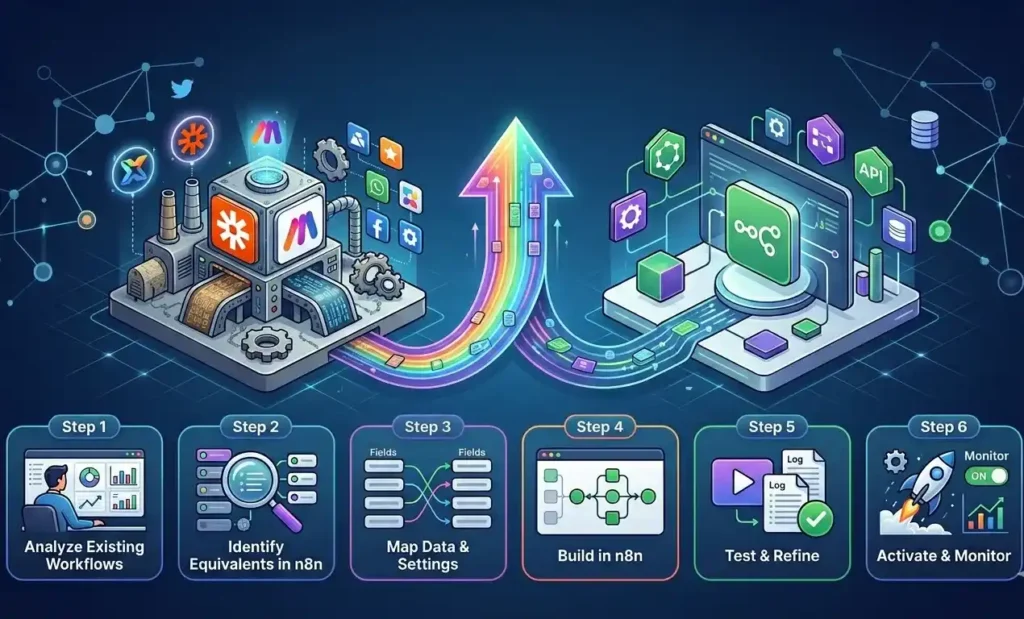
Summary: This blog explains how to migrate from Zapier or Make to n8n. It covers workflow auditing, setup, rebuilding, testing, and deployment. n8n offers more flexibility, better control, AI capabilities, and lower costs at scale. A structured migration process helps avoid downtime, prevent data loss, and create a more scalable automation system.
From Manual Mess to Monthly Profit: 5 n8n Workflows That Scale
Summary: This blog explores five practical n8n workflow examples that help businesses automate operations and reduce manual work. It covers lead management, AI-powered support ticket routing, invoice processing, client onboarding, and KPI reporting. By connecting apps, APIs, AI tools, and internal systems, n8n improves response times, streamlines workflows, and increases operational efficiency. The result is faster processes, fewer bottlenecks, and more scalable business operations.
RPA in Healthcare: Automating Patient Onboarding & Claims Processing
Summary: RPA is helping healthcare organizations automate patient onboarding, insurance verification, claims processing, and other administrative tasks. By reducing manual work, improving accuracy, and speeding up workflows, RPA enables healthcare providers to lower costs, process claims faster, and enhance patient experiences. As healthcare becomes more digital, automation is playing a key role in building more efficient and scalable operations.
Legacy System No More: How RPA Bridges the Gap Between Old & New Tech
Summary: RPA helps businesses connect legacy systems with modern technologies without expensive replacements. By automating data transfer, workflows, transactions, and document processing, RPA improves efficiency, reduces manual work, and supports digital transformation. It acts as a bridge between old and new systems, enabling organizations to modernize operations while continuing to use critical legacy infrastructure.
The Zero-Error Office: Automating Invoice Processing & AP with RPA
Summary: RPA is transforming accounts payable by automating invoice processing, data extraction, validation, approval routing, and ERP updates. By replacing manual, paper-based workflows with intelligent automation, businesses can reduce processing times from weeks to days, lower costs, minimize errors, and improve productivity. Using technologies like OCR and AI, RPA bots handle repetitive AP tasks with greater speed and accuracy, allowing finance teams to focus on strategic work. Organizations that implement AP automation often achieve ROI within 6–12 months while improving vendor relationships through faster, more reliable payments. As invoice volumes grow, RPA is becoming an essential tool for scalable and efficient finance operations.
Beyond Rule-Based: Scaling Your Business with Agentic RPA Bots
Summary: Agentic RPA goes beyond traditional rule-based automation by combining RPA with AI technologies such as machine learning, OCR, NLP, and autonomous agents. These intelligent bots can understand data, make decisions, adapt to changing situations, and continuously improve over time. Businesses are using Agentic RPA across healthcare, banking, customer support, logistics, and HR to automate complex workflows, improve efficiency, and reduce manual effort. As AI capabilities continue to advance, Agentic RPA is becoming a key driver of intelligent automation, helping organizations scale operations, lower costs, and create more flexible and autonomous business processes.
The Automation Center of Excellence (CoE): Scaling from 1 to 100 Bots without Technical Debt
Summary: As organizations scale automation from a few bots to hundreds, managing technical debt, governance, and maintenance becomes critical. An Automation Center of Excellence (CoE) provides the structure needed to standardize tools, processes, and security while enabling business teams to innovate safely. By using reusable components, clear bot lifecycle management, performance monitoring, and strong governance, companies can scale their digital workforce efficiently without creating fragile automation systems. A well-designed CoE helps organizations maximize ROI, reduce maintenance costs, empower citizen developers, and transform automation from isolated projects into a sustainable enterprise-wide capability.
Enterprise-Grade Zapier: Security, SSO, and Governance for Big Teams
Summary: Enterprise-grade Zapier requires strong governance, security, and visibility to prevent Shadow IT, data leaks, and unmanaged automation at scale. Key practices include SSO and SAML for centralized authentication, SCIM for automated user management, app restrictions, custom data retention policies, SIEM integrations, and audit logging. Organizations should use shared ownership models, departmental quotas, and regular “Zombie Zap” audits to reduce risk and control costs. With proper governance, Zapier evolves from a simple productivity tool into a secure, enterprise-wide automation platform.
Securing the Bot: Zero-Trust Governance for Enterprise RPA
Summary: As enterprises scale robotic process automation (RPA), security and governance become essential. This guide explains how Zero-Trust principles, least-privilege access, credential vaults, bot identity management, behavioral monitoring, immutable audit trails, and hardened infrastructure protect enterprise bots from cyber threats. By treating bots as high-risk non-human identities and enforcing strong governance, organizations can build secure, compliant, and scalable automation environments that support long-term business growth.
Automate Your Marketing Stack: From Content Creation to Social Distribution
Summary: This blog explains how businesses can automate their entire marketing workflow, from content creation to multi-channel social distribution, using AI and automation tools. By combining AI-generated content, platform-specific formatting, automated publishing, human approval workflows, trend monitoring, and real-time analytics, organizations can create an always-on marketing engine. The approach helps teams save time, maintain content quality, improve audience engagement, and accurately measure ROI. Rather than replacing marketers, automation handles repetitive tasks, allowing teams to focus on strategy, creativity, and growth while scaling content production efficiently across multiple channels.