Summary: This blog explores how Zapier Central enables businesses to build AI-powered orchestrators that go beyond traditional automation. These intelligent AI agents can understand requests, retrieve internal knowledge, coordinate tasks across multiple systems, and automate complex workflows directly within Slack. By combining AI reasoning, workflow automation, and integrations with tools like CRMs, knowledge bases, and project management platforms, Zapier Central helps organizations reduce manual work, improve response times, and scale operations efficiently. The article also covers AI agent training, workflow setup, best practices, and the advantages of AI orchestration over traditional chatbots for modern business operations.

Cutting Costs: 10 Zaps That Save 20+ Hours of Admin Every Week
Summary: This blog explains how Zapier helps businesses save over 20 hours per week by automating repetitive admin tasks such as CRM updates, invoice processing, meeting scheduling, onboarding, reporting, and task management. By reducing manual work, errors, and operational delays, Zapier improves productivity, lowers costs, and allows teams to focus on strategic, revenue-generating activities.
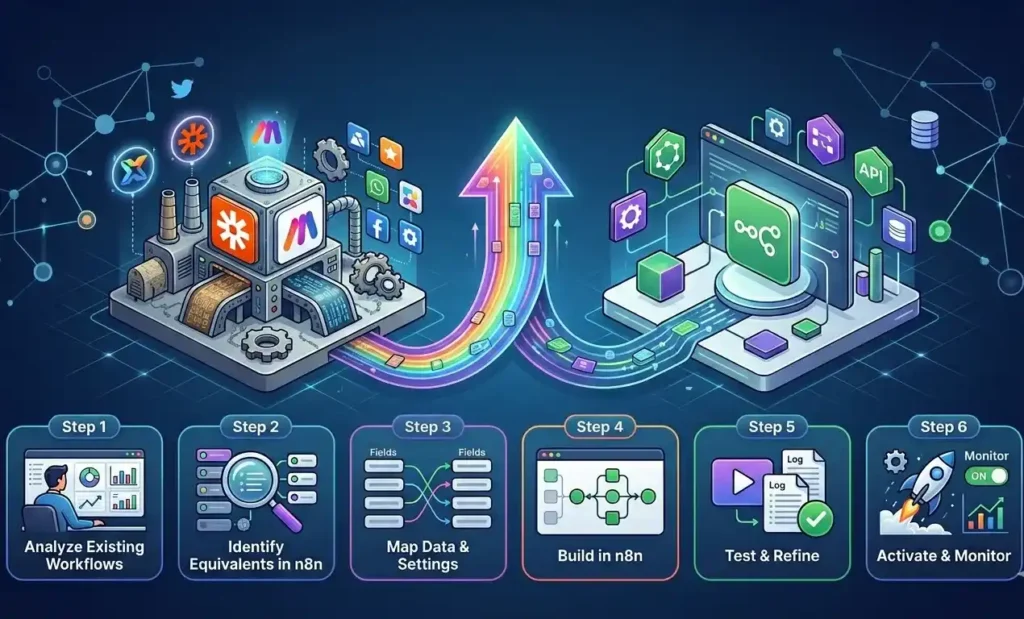
The Great Migration: Step-by-Step Guide: Zapier/Make to n8n
Summary: This blog explains how to migrate from Zapier or Make to n8n. It covers workflow auditing, setup, rebuilding, testing, and deployment. n8n offers more flexibility, better control, AI capabilities, and lower costs at scale. A structured migration process helps avoid downtime, prevent data loss, and create a more scalable automation system.
From Manual Mess to Monthly Profit: 5 n8n Workflows That Scale
Summary: This blog explores five practical n8n workflow examples that help businesses automate operations and reduce manual work. It covers lead management, AI-powered support ticket routing, invoice processing, client onboarding, and KPI reporting. By connecting apps, APIs, AI tools, and internal systems, n8n improves response times, streamlines workflows, and increases operational efficiency. The result is faster processes, fewer bottlenecks, and more scalable business operations.
Hyperautomation 2026: Combining RPA, AI, and Process Mining
Summary: Hyperautomation is transforming enterprise operations in 2026 by combining AI, RPA, process mining, analytics, and workflow automation into a unified system that automates entire business processes rather than isolated tasks. Successful implementation begins with understanding existing workflows, followed by designing, testing, deploying, and continuously optimizing automation solutions. While it requires strategic investment, organizations can achieve significant efficiency gains, reduced costs, fewer errors, and ROI of 200–400% over time. The key to success is focusing on process visibility, governance, scalability, and measurable outcomes rather than simply deploying bots or AI tools without a clear automation strategy.
RPA in Healthcare: Automating Patient Onboarding & Claims Processing
Summary: RPA is helping healthcare organizations automate patient onboarding, insurance verification, claims processing, and other administrative tasks. By reducing manual work, improving accuracy, and speeding up workflows, RPA enables healthcare providers to lower costs, process claims faster, and enhance patient experiences. As healthcare becomes more digital, automation is playing a key role in building more efficient and scalable operations.
Legacy System No More: How RPA Bridges the Gap Between Old & New Tech
Summary: RPA helps businesses connect legacy systems with modern technologies without expensive replacements. By automating data transfer, workflows, transactions, and document processing, RPA improves efficiency, reduces manual work, and supports digital transformation. It acts as a bridge between old and new systems, enabling organizations to modernize operations while continuing to use critical legacy infrastructure.
The Zero-Error Office: Automating Invoice Processing & AP with RPA
Summary: RPA is transforming accounts payable by automating invoice processing, data extraction, validation, approval routing, and ERP updates. By replacing manual, paper-based workflows with intelligent automation, businesses can reduce processing times from weeks to days, lower costs, minimize errors, and improve productivity. Using technologies like OCR and AI, RPA bots handle repetitive AP tasks with greater speed and accuracy, allowing finance teams to focus on strategic work. Organizations that implement AP automation often achieve ROI within 6–12 months while improving vendor relationships through faster, more reliable payments. As invoice volumes grow, RPA is becoming an essential tool for scalable and efficient finance operations.
Beyond Rule-Based: Scaling Your Business with Agentic RPA Bots
Summary: Agentic RPA goes beyond traditional rule-based automation by combining RPA with AI technologies such as machine learning, OCR, NLP, and autonomous agents. These intelligent bots can understand data, make decisions, adapt to changing situations, and continuously improve over time. Businesses are using Agentic RPA across healthcare, banking, customer support, logistics, and HR to automate complex workflows, improve efficiency, and reduce manual effort. As AI capabilities continue to advance, Agentic RPA is becoming a key driver of intelligent automation, helping organizations scale operations, lower costs, and create more flexible and autonomous business processes.