

Most automation projects fail for one simple reason: businesses automate tasks without understanding the process behind them. A few bots here. A workflow tool there. Maybe an AI assistant layered on top. But disconnected automation does not create an intelligent business. It creates more complexity.
That is why hyperautomation implementation is among the biggest enterprise technology shifts of 2026.
Hyperautomation combines AI, RPA, process mining, analytics, and integrations into one connected system. It helps businesses automate and optimize operations from end to end. However, the successful hyperautomation requires more than deploying bots. Organizations first need visibility into how work actually happens.
This guide breaks down how modern hyperautomation actually works. You will learn how AI, RPA, and process mining connect to create scalable automation systems. We will also explore implementation, investment, ROI, and the common mistakes that prevent automation initiatives from succeeding.
What is Hyperautomation?
Most businesses are automating tasks. Very few are automating how the business actually operates. That’s what hyperautomation is. AI, RPA, process mining, intelligent document processing, workflows, and integrations all work together to automate operations from start to finish rather than simply individual activities.
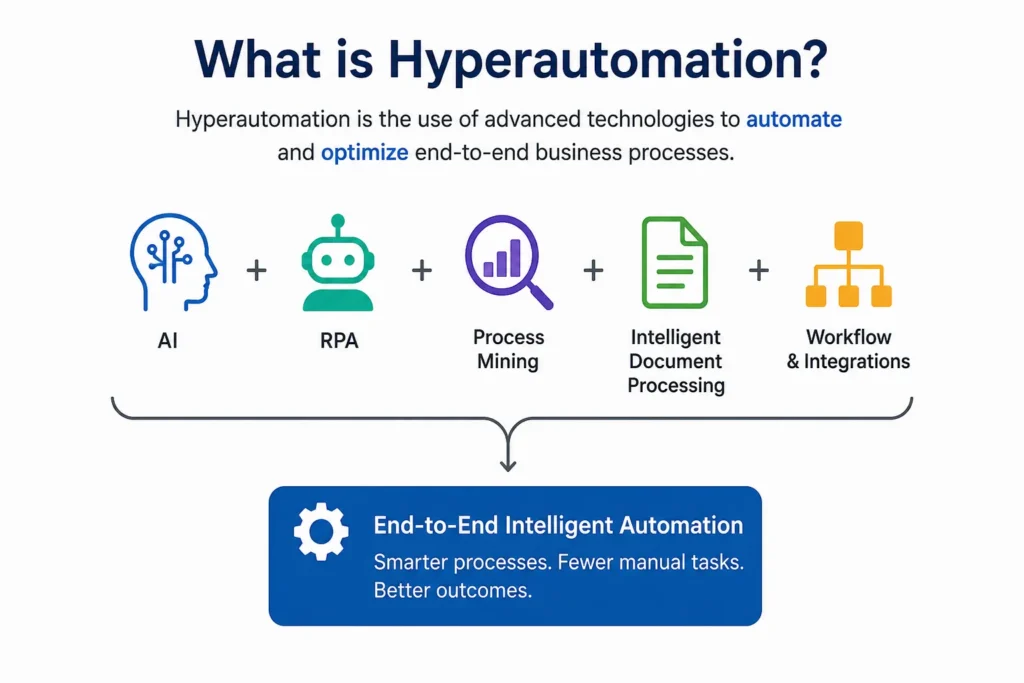
Time savings is not the only goal. It’s making a company that operates more intelligently, and with fewer manual bottlenecks. That’s why hyperautomation is becoming a major priority for organizations worldwide. Companies are becoming aware that outdated procedures and mismatched systems can’t keep up with the pace modern enterprises demand.
Hyperautomation is not just one tool. It’s a move toward intelligent, fully connected processes. It is the systematic use of:
- RPA for routine tasks based on rules.
- Predictions, choices, and unstructured data using AI and machine learning.
- Process mining to identify opportunities for automation and inefficiencies.
- Low-code systems for quicker implementation.
- Tools for monitoring and analytics for ongoing optimization.
Instead of separate bots, these technologies work together to form an automation ecosystem.
The Hyperautomation Implementation Roadmap
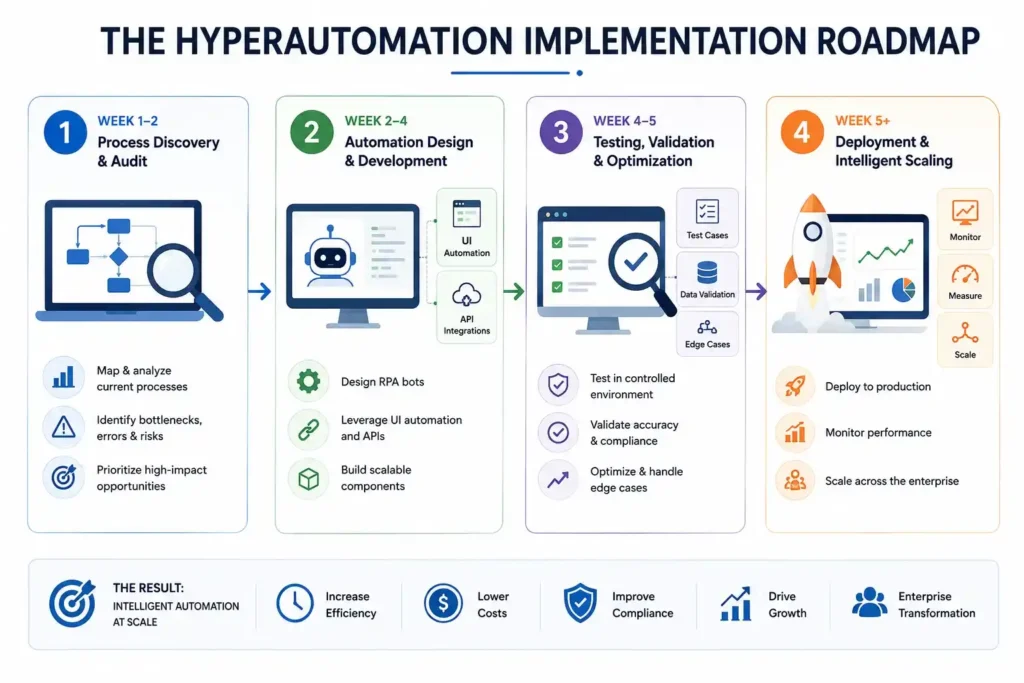
Successful hyperautomation initiatives are built in phases, combining process mining, RPA, and AI to create scalable, data-driven automation systems. Following is a tried-and-true four-step method:
Week 1–2: Process Discovery & Audit
Understanding how work truly moves around the company is the first step. To find the most time-consuming, repetitive, and error-prone procedures, teams examine current workflows. Businesses can measure operational errors, manual labor, bottlenecks, and compliance concerns in real time by using process mining insights.
The focus should continue to be on high-volume, rule-based procedures where automation may improve operations and yield an instant return on investment.
Week 2–4: Automation Design & Development
Engineers create RPA bots tailored to the company’s current systems and workflows after opportunities are identified. When direct integrations are not accessible, modern automation solutions rely on UI automation and interact via APIs whenever possible.
With this method, businesses can automate procedures without changing their existing software stack or interfering with day-to-day operations.
Week 4–5: Testing, Validation & Optimization
Automation workflows operate alongside human teams in a restricted testing environment prior to full deployment. To guarantee accuracy, compliance, and dependability, each output is verified against actual business data.
Before expanding further, this stage helps firms reduce deployment risks, spot edge cases early, and build greater confidence in their automation systems.
Week 5+: Deployment & Intelligent Scaling
Bots enter live production with ongoing monitoring and performance tracking following validation. Every month, companies start streamlining their processes and extending automation to other departments and business operations.
Hyperautomation develops from isolated task automation into a scalable enterprise-wide transformation plan as quantifiable ROI becomes apparent.
Hyperautomation Investment & ROI Expectations;
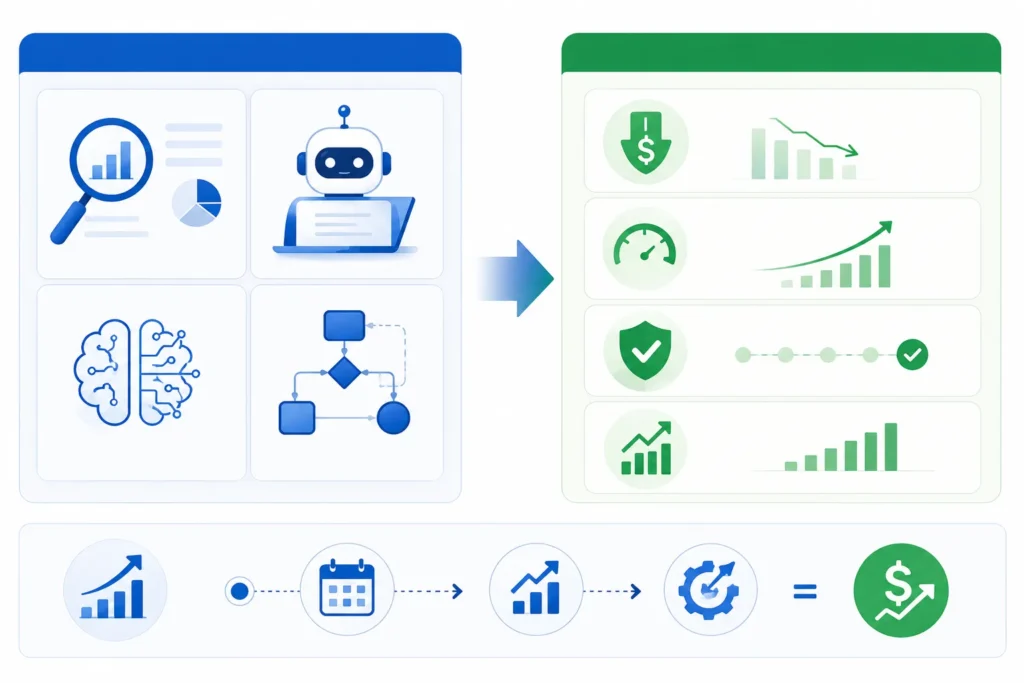
Hyperautomation requires strategic investment in process mining, RPA, AI, and workflow integration to create scalable automation systems across the business. When implemented correctly, organizations can reduce operational costs, improve efficiency, minimize errors, and achieve measurable ROI within months.
| Phase | Estimated Investment | Key Inclusions | Expected Outcome |
| Year 1 (Foundation) | $500K – $2M | Infrastructure setup, process mining licenses, RPA platform, AI/IDP capabilities, CoE team (5–10 FTEs), and initial automation use cases. | Increased CoE capacity, embedded business-unit developers, expanded platform licensing, advanced AI capabilities, and more extensive workflow automation. |
| Year 2 (Scale) | $1M – $3M | Increased CoE capacity, embedded business-unit developers, expanded platform licensing, advanced AI capabilities, and more extensive workflow automation. | Expand departmental automation and boost operational effect. |
| Year 3+ (Optimization) | Investment stabilizes | Continuous optimization, AI enhancements, maintenance, and automation expansion funded by generated savings. | Self-sustaining automation ecosystem with long-term efficiency gains |
| Enterprise ROI | 200–400% ROI reported by mature programs | Adoption of enterprise-wide hyperautomation offers high returns for Fortune 500 companies. | Typical payback period achieved within 18–24 months |
What Stops Hyperautomation Projects from Succeeding?
Many hyperautomation projects fail because businesses automate broken processes without proper planning or process visibility. Poor integration, unclear goals, and lack of scalability often prevent long-term success.
| Failure Mode | Root Cause | Fix |
| AI pilots that never scale | Absence of assessment harness and production deployment governance | Create a production checklist before pilot approval. |
| ROI measurement failure | Absence of baseline KPIs prior to automation introduction | As an intake gate, mandate baseline measurement |
| RPA bot maintenance debt | Bots with unreliable APIs and weak UI selectors | Standardize bot structure and give priority to API-first integrations. |
| Process mining insights ignored | The operations and mining teams work independently. | Process analysts should be included in business unit improvement sprints. |
| Shadow automation | Without IT supervision, business units create automations. | Create a program for citizen developers with defined boundaries |
Final Thoughts:
The future of enterprise automation is no longer about using a few bots to save time. It is about building connected operations where processes, systems, data, and decisions work together seamlessly.
A successful hyperautomation implementation is not just about deploying bots or adding AI to existing processes. By combining AI, RPA, process mining, analytics, and intelligent workflows, organizations can move beyond fragmented automation and create systems that continuously improve over time.
But sustainable automation does not begin with technology alone. It starts with understanding how work actually happens across the business. Organizations that focus on process visibility, governance, scalability, and measurable ROI are far more likely to succeed.
As businesses continue to scale digital operations, hyperautomation will become a competitive advantage rather than an optional innovation. The companies leading in 2026 will not just automate repetitive tasks. They will build intelligent operations that can adapt, optimize, and grow continuously.