
The Trust Gap: Why Agriculture is Under Pressure in 2026
In 2026, the bond between the person who grows the food and the person who eats it has been stretched thin. For the modern consumer, a label that simply says “Organic” or “Sustainably Sourced” has become white noise—it’s just a word on a box unless there is a way to verify it. People are no longer satisfied with “taking your word for it”; they want to see the evidence.
Unfortunately, the agricultural supply chain has historically been one of the most opaque industries in the world. It is a world of paper invoices, manual logs, and “data silos” where information is trapped in one department and never reaches the next. This lack of visibility isn’t just a marketing headache—it’s a massive liability. When a food safety incident occurs, traditional systems are often too slow. It can take weeks to trace a contaminated batch back to its source, leading to widespread health risks and millions of dollars in wasted produce.
Blockchain in Agriculture acts as the definitive bridge across this gap. By creating an unchangeable record of every event in a product’s life, we are moving from a system based on “hope” to one based on “hard data”.
Explore our Blockchain Development Services at Techelix.
The Digital Identity: Tracking the Journey from Seed to Shelf
The true power of this technology lies in its ability to give every single batch of produce a “Digital Identity”. Think of it as a digital birth certificate that follows the crop from the moment it is a seed in the ground to the moment it sits in a grocery store basket.
In 2026, we are pushing this further by integrating blockchain with IoT (Internet of Things) sensors. This means the record isn’t just updated by a person typing on a keyboard—it’s updated by the environment itself.
In the Field: Sensors can automatically log soil health, moisture levels, and the exact time of harvest directly onto the ledger.
In Transit: GPS-enabled trackers on trucks can log the temperature of the cargo every ten minutes. If a cooling system fails for an hour, that data is permanently “written” to the blockchain.
For a retailer, this is a game-changer. It means they can prove to their customers that the “fresh” produce on their shelves was kept at the perfect temperature and harvested only 48 hours ago. Because this data is immutable, it cannot be altered or faked to hide a mistake, ensuring that quality is always guaranteed.
The “Smart” Handshake: Fixing Farm Finance with Smart Contracts
We need to talk about the people at the very beginning of the chain: the farmers. For too long, the agricultural sector has been plagued by a “power imbalance.” Small-scale producers often deal with predatory middlemen and “payment lag,” where they wait 30, 60, or even 90 days to get paid for a crop they’ve already delivered.
This is where Smart Contracts come in. A smart contract is a piece of code that lives on the blockchain and executes itself when certain conditions are met.
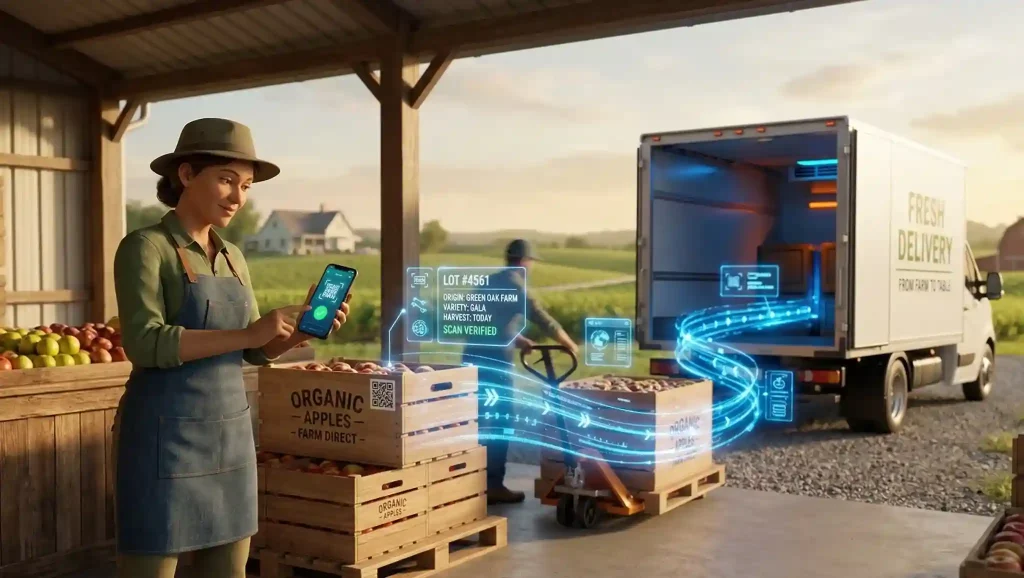
Instant Payments: Imagine a scenario where the moment a delivery truck is scanned and verified at a warehouse, the smart contract triggers an immediate payment to the farmer’s bank account.
No Middlemen: By automating the verification and payment process, we remove the need for expensive intermediaries who often take a large cut of the profit just for “handling the paperwork”.
By 2026, these automated systems are expected to cut administrative costs by up to 41%, putting more money back into the pockets of the people actually growing our food. This isn’t just about efficiency; it’s about creating a fairer, more sustainable financial ecosystem for the entire agricultural world.
Reducing Food Waste: The Power of Real-Time Freshness Data
One of the quietest tragedies in agriculture is that nearly one-third of all food produced globally is wasted before it ever reaches a dinner plate. In 2026, we are finally seeing a shift where retailers and suppliers are using blockchain to fight this “expiry date” crisis.
When produce is tracked on a ledger, its “freshness life” becomes a visible data point rather than a guess. By integrating AI and Machine Learning with blockchain, we can now predict spoilage with incredible accuracy. For instance, if a shipment of berries was held at a slightly higher temperature during transport—a fact recorded immutably on the chain—AI models can flag that specific batch for immediate sale or discount.
This isn’t just about saving money; it’s about optimizing the entire inventory flow. According to the OECD’s 2025 report on food waste, achieving real-time transparency in the supply chain could help reduce the 1 billion meals wasted daily worldwide, lifting millions out of hunger while significantly cutting carbon emissions.
Compliance and Sustainability: Meeting New Global Standards
The year 2026 has brought a massive wave of new regulations, most notably the EU Deforestation Regulation (EUDR). Large and medium-sized companies doing business in Europe must now prove that their products—like coffee, soy, and beef—do not come from recently deforested land.
This is where the “Audit-Ready” nature of blockchain becomes a business lifesaver. Manual reporting for these laws is a nightmare of paperwork and potential fines. However, with a blockchain-based system, a company can provide a “Digital Passport” for every shipment that includes:
Geolocation Data: Precise GPS coordinates of the plot of land where the crop was grown.
Time-Stamped Transactions: A clear “Chain of Custody” showing every hand the product touched.
This level of detail is becoming the gold standard for European Commission sustainability compliance, ensuring that businesses can enter major markets without the risk of their shipments being blocked at the border. For Techelix, building these compliance engines is about more than just checking a box; it’s about protecting the long-term viability of the agricultural brands we partner with.
Scaling the Harvest: A 3-Step Strategy for Tech Integration
Moving your operation into the digital era doesn’t have to happen all at once. In 2026, we’ve found that the most successful integrations follow a disciplined, three-step journey.
Step 1: The Digital Audit
You can’t fix what you can’t see. We start by identifying where your current supply chain is “leaking” data. Are your drivers still using clipboards? Are your warehouse logs stored in local spreadsheets? We map these gaps to see where blockchain will have the highest immediate ROI.
Step 2: Modular Architecture
Don’t try to boil the ocean. We recommend starting with a “pilot batch”—one specific crop or one specific shipping route. By building a modular system, we can prove the tech works in a small, controlled environment before scaling it to your entire global operation.
Step 3: Ecosystem Collaboration
Blockchain is a team sport. The final step is connecting your farmers, your logistics partners, and your retail buyers on a single, secure platform. When everyone is looking at the same “single source of truth,” disputes vanish, payments speed up, and the entire ecosystem becomes more resilient.
Beyond the Ledger: The Future of “Visible” Agriculture
As we move deeper into 2026, the conversation is shifting from simple data storage to Supply Chain Orchestration. We are entering the era of “Agentic” supply chains, where the system doesn’t just record what happened—it acts on it.
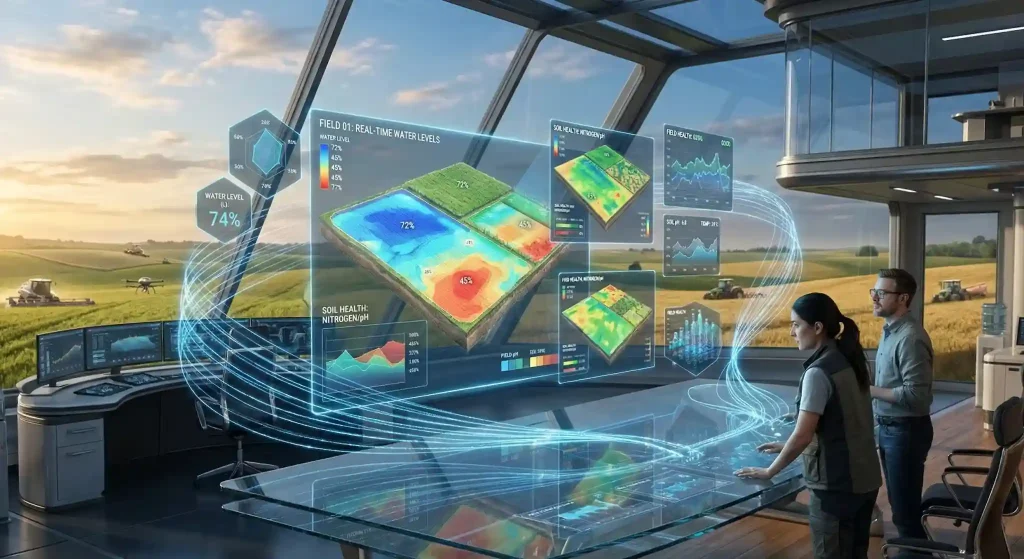
Imagine an AI Agent integrated into your blockchain network. If a satellite sensor detects a sudden heatwave over your fields, the agent doesn’t just alert you; it cross-references the blockchain for your current water rights, checks the market price for electricity, and autonomously triggers a smart contract to start the irrigation system at the most cost-effective time.
This level of “Ambient Intelligence” turns transparency from a chore into a massive competitive advantage. When you can prove your carbon footprint and water usage with absolute certainty, you aren’t just selling a product; you are selling Trust. In today’s market, this “Resilience Premium” allows farmers to bypass low-margin commodity markets and command premium prices from retailers who are desperate for verifiable, high-quality sourcing.
Summary: Reconnecting the Farmer and the Consumer
At its heart, Blockchain in Agriculture is about more than just blocks of code and IoT sensors. It is about closing the distance between the person who sows the seed and the person who sits down at the dinner table.
In 2026, transparency has become the new global standard for business. The agricultural brands that will flourish are those that embrace this digital transformation—moving away from the “firefighting” mode of the past and toward a future of proactive, data-driven growth. By securing your supply chain today, you aren’t just meeting a regulation; you are building a brand that customers can finally trust without reservation.
Ready to start your digital harvest?
Consult with our Blockchain Experts to map out your traceability roadmap.
Explore our AI Solutions for predictive crop and supply chain management.
Build custom AI solutions that deliver real business value
From strategy to deployment, we help you design, develop, and scale AI-powered software that solves complex problems and drives measurable outcomes.