

Automation is quickly becoming a standard in healthcare. Precedence Research reports that the RPA in healthcare will grow from $4.29 billion in 2024 to $33.93 billion by 2032, with a 29.5% annual growth rate. This shows the need for faster, more efficient healthcare operations.
The COVID-19 pandemic accelerated this shift. Healthcare systems faced increased patient volumes, staff burnout, document backlogs, and slower response times. As a result, organizations sought digital solutions to manage operations and reduce pressure.
RPA has enabled organizations to reduce costs, enhance customer service, and streamline testing and reporting. The move to remote and digital workplaces has further increased the need for automation across industries.
Now, healthcare providers use RPA to work more efficiently, reduce errors, process claims faster, and improve patient experiences. As the industry evolves, automation is becoming increasingly important for long-term growth and stability.
Why Healthcare Organizations Invest in RPA?
Every day, healthcare organizations manage thousands of repetitive tasks like patient onboarding, appointment scheduling, claims processing, and data management. Doing these tasks by hand takes time, increases costs, and can lead to delays or mistakes.
Robotic Process Automation (RPA) enables healthcare providers to use software bots for routine, rule-based tasks. This allows staff to focus more on patient care rather than administrative work.
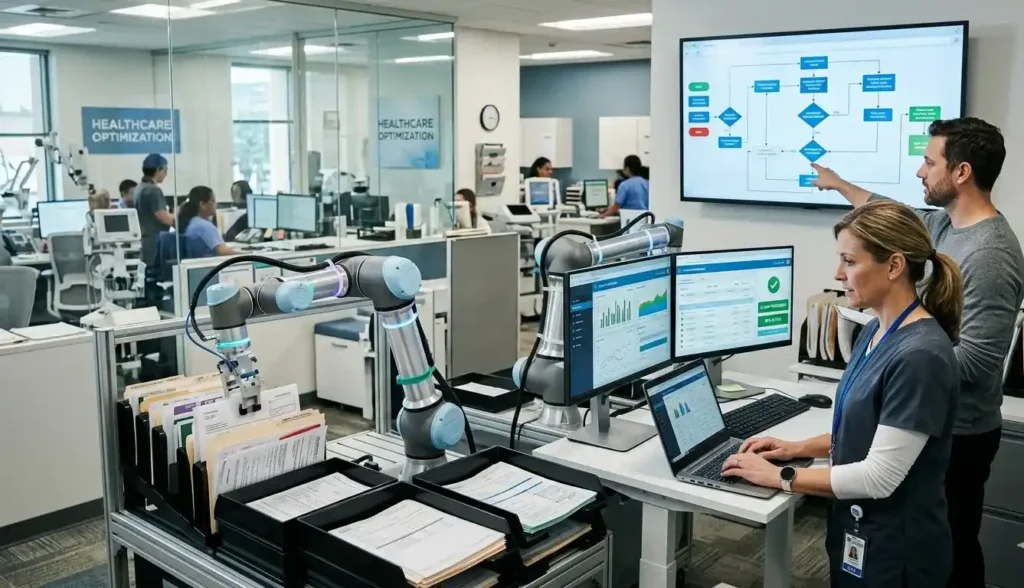
Today, healthcare organizations use RPA to automate tasks such as:
- Patient registration and onboarding
- Insurance verification
- Claims processing and billing
- EHR data updates
- Document management
- Compliance reporting
- Appointment scheduling
It makes operations more efficient by reducing errors, speeding up workflows, and helping providers get reimbursed faster. It also supports compliance and improves data accuracy across different systems.
Deloitte reports that organizations using RPA save significant time on routine processes and improve the accuracy of their reports. As healthcare systems modernize, RPA is becoming an important part of digital strategies to improve efficiency, reduce costs, and enhance patient care.
RPA in Healthcare for Patient Onboarding;
In the healthcare industry, RPA automates patient data entry, verification, and collection. It automatically collects data from papers, portals, and forms.
This reduces errors and lowers the need for manual data entry. Additionally, it increases data accuracy from the initial interaction and expedites patient registration. Patient onboarding involves multiple administrative steps that consume valuable staff time.

These tasks often include:
- Collecting patient information
- Verifying insurance eligibility
- Creating EHR records
- Uploading identification documents
- Scheduling appointments
- Processing consent forms
- Updating billing systems
During periods of high patient demand, manual onboarding causes delays. By collecting data from digital forms, verifying information, and updating multiple systems simultaneously, RPA bots automate these operations.
How Automated Patient Onboarding Works?
This is a basic example of a workflow for automated patient onboarding. Let’s see how RPA speeds up the onboarding process, increases accuracy, and minimizes manual labor.
- Online onboarding forms are submitted by a patient.
- RPA bots use Intelligent Document Processing (IDP) to extract data.
- Insurance cards and identity documents are read using computer vision (OCR).
- Bots use payer interfaces to verify insurance eligibility.
- EHR and billing systems automatically receive information.
- Appointment confirmations are sent automatically.
This reduces onboarding time from hours to minutes while minimizing data entry errors.
RPA in Healthcare for Claims Processing;
Healthcare providers can automate repetitive claims management procedures using robotic process automation (RPA). Verification of eligibility, submission of claims, handling denials, payment reconciliation, and status monitoring are among these tasks. When combined with AI, RPA improves accuracy, reduces manual work.
Organizations are increasingly adopting RPA to streamline claims processing and reduce administrative overhead. The following comparison shows how intelligent automation enhances speed, accuracy, and operational efficiency. whereas manual operations result in delays, mistakes, and increased administrative expenses.
| Aspect | Traditional Processing | RPA-Enhanced Processing |
| Claim Verification Time | 16 minutes | 2 minutes |
| Administrative Costs | High | Low |
| Denial Rate | 20% | 5% |
| Compliance Risk | Moderate | Low |
What Should a Claims Process Automation Solution Have?
Choosing the right claims process automation solution is important for improving efficiency and reducing administrative workload in healthcare operations. The following are important points to consider.
- End-to-end automation: The entire claims lifecycle, including eligibility checks, filing, tracking, denials, and payments.
- Integration capabilities: Easily integrates with payer portals, billing systems, and EHRs (supports HL7, FHIR, and EDI).
- Innovative denial management, automatically generated appeal letters, and predictive analytics are made possible by AI and ML support.
- Scalability and speed: Manages large quantities quickly, particularly during periods of high claim activity.
- Security and compliance: complete audit trails, strong data protection, and HIPAA compliance.
- Low-code/no-code interfaces make configuration and updating easier.
- Select a platform that will enable your team to work more intelligently rather than more laboriously.
Conclusion:
Automation is now more than a competitive advantage in the evolving healthcare industry. RPA enables healthcare organizations to lower administrative costs, increase accuracy, accelerate workflows, and improve patient experiences from onboarding to claims processing.
With smart automation, tasks that once required hours of manual labor can now be completed in minutes. This allows medical staff to focus more on patient care and less on paperwork.
The growing use of RPA reflects a broader trend toward more intelligent and interconnected healthcare systems. Organizations investing in automation today are building more robust and resilient operations for the future.