

For decades, many law firms operated under the “Digital Screen Door” policy: a basic firewall, a standard VPN, and the hope that they weren’t interesting enough to be hacked. But in 2026, that era has officially ended. Cybercrime groups now operate like sophisticated business organizations, utilizing Ransomware as a Service (RaaS) to target the legal sector specifically because of the high-value data you hold—merger details, trade secrets, and sensitive client communications.
Beyond the threat of hackers, there is a rising tide of regulatory pressure. The ABA Model Rule 1.1 now explicitly states that “technological competence” is no longer optional; it is a fundamental ethical duty. Failing to secure your firm’s infrastructure is no longer just an IT mistake—it can be a breach of your professional ethics that leads to malpractice allegations and six-figure fines.
The Ransomware Reality: Why Hackers Love Law Firms
In the past year, cyberattacks on law firms have surged by 300%. Hackers aren’t just looking to lock your files anymore; they are practicing “Double Extortion.” They encrypt your case files to stop your work, but they also steal a copy of the data and threaten to leak it publicly unless a second ransom is paid. For a law firm, the public leak of attorney-client privileged data is the ultimate “death sentence” for your reputation.
The average cost of a data breach in the professional services sector has now climbed to $4.56 million. Most of these breaches don’t happen through complex “Mission Impossible” style hacks. They happen because of:
AI-Enhanced Phishing: Hackers use Generative AI to mimic the writing style of a Senior Partner, tricking associates into clicking malicious links.
Weak Supply Chains: Your firm is only as safe as the smallest e-discovery or cloud storage vendor you use.
Legacy Servers: Old office servers are full of unpatched vulnerabilities that modern automated tools can find in seconds.
Zero Trust: The Gold Standard for Client Privilege
If the “Castle and Moat” model of security is dead, what replaces it? The answer is Zero Trust Architecture. In a traditional setup, once someone is “inside” your network via a VPN or an office Wi-Fi, they are trusted to go anywhere. In a Zero Trust model, the system assumes that a breach is inevitable or has already happened.
The philosophy is simple: Never Trust, Always Verify.
Identity as the Perimeter: Every time an associate tries to access a matter file—even if they are sitting in their own office—the system checks their identity, their device health, and their location.
Microsegmentation: We divide your firm’s data into isolated “vaults.” This means that even if a hacker manages to steal a paralegal’s login, they are trapped in that one small segment. They cannot “move laterally” to access your high-stakes M&A files or the firm’s financial records.
Frictionless Experience: Modern Zero Trust doesn’t mean more passwords; it actually moves us toward Passwordless Authentication using hardware keys (like YubiKeys) or biometrics, making your team’s life easier while making the hacker’s life impossible.

DevOps & Automation: Making Compliance “Invisible”
The term “DevOps” might sound like it belongs in a Silicon Valley startup, but for a law firm, it is the secret to “Invisible Compliance”. Traditionally, compliance meant a paralegal checking a manual list of folders every month. In 2026, we use Policy-as-Code to automate those guardrails.
By embedding security rules directly into your firm’s digital “plumbing,” we can ensure that:
Automated Classification: Every new document is automatically tagged based on its sensitivity (e.g., “Privileged” or “Confidential”) and moved to the correct secure folder without human intervention.
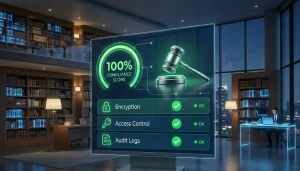
Instant Audit Trails: Every time a document is opened, edited, or shared, a permanent, unchangeable log is created. When it’s time for your annual security review, you don’t have to “find” the proof—it’s already compiled into an ABA-compliant audit report.
Human Error Prevention: If an associate tries to upload a sensitive case file to an unvetted personal cloud storage site, the system recognizes the “Policy Violation” and blocks the transfer instantly.
The Rise of the “Agentic” Legal Assistant
We are moving past simple chatbots. In 2026, law firms are utilizing AI Agents to handle the heavy lifting of matter intake and initial document triage. These agents can read through thousands of pages of discovery in seconds to flag key dates, witnesses, and potential conflicts of interest.
However, this power comes with a new responsibility: LLM Observability. It is critical that your firm’s AI isn’t just “smart,” but also accurate and unbiased. By building these agents within your own secure cloud infrastructure—rather than using public, unvetted tools—you ensure that your firm’s intellectual property and client secrets are never used to “train” a public AI model.
A 3-Step Roadmap for Firm Partners
Modernizing a law firm’s infrastructure is a marathon, not a sprint. In 2026, the most successful firms aren’t trying to change everything overnight; they are following a structured 90-to-180-day roadmap to ensure zero downtime and maximum security.
Step 1: The 90-Day Vulnerability Audit & Data Map You cannot protect what you haven’t accounted for. Start by conducting a comprehensive inventory of all software, PCs, mobile devices, and third-party SaaS tools used by your staff. Use this audit to map exactly where “Privileged” data lives. This initial phase identifies the “low-hanging fruit”—such as unpatched servers or staff using personal Dropbox accounts—that can be secured immediately.
Step 2: Roll out Phishing-Resistant MFA and EDR The second phase is about hardening your human firewall. In 2026, standard text-message (SMS) codes are no longer considered secure for legal professionals. Transition your team to hardware-based MFA (like YubiKeys) and deploy Endpoint Detection and Response (EDR) tools. These AI-driven systems monitor every laptop and phone in real-time, flagging “anomaly” behaviors—like an associate’s account suddenly downloading 5,000 files at 2:00 AM—before a breach can spread.
Step 3: Establish a “Security Committee” Cybersecurity is a management issue, not just an IT task. Form a small committee involving at least one Senior Partner, your IT lead, and your Finance Director. Their job is to meet quarterly to review the firm’s “Risk Scorecard,” update the Incident Response Plan (IRP), and ensure that vendor contracts are being vetted for strict data-handling clauses.

Summary: Future-Proofing Your Reputation
In the competitive landscape of 2026, cybersecurity has evolved from a back-office expense into a core business driver. When a client chooses a law firm today, they aren’t just looking for the best litigator; they are looking for the partner they can trust with their most sensitive trade secrets and personal data.
Firms that embrace modern cloud infrastructure and Zero Trust protocols are finding that they are more than just “secure”—they are more efficient, more agile, and more attractive to high-value clients. By closing the security gap today, you are doing more than just preventing a hack; you are ensuring that your firm’s reputation remains as unbreakable as the encryption protecting it.
Is your firm’s infrastructure a bridge or a barrier?
Book an Infrastructure Audit with our legal tech specialists.
Explore our Zero Trust Solutions designed specifically for the 2026 regulatory landscape.
Build custom AI solutions that deliver real business value
From strategy to deployment, we help you design, develop, and scale AI-powered software that solves complex problems and drives measurable outcomes.