
Intelligent Document Processing (IDP) with AI and RPA: A Complete Implementation Guide for 2026

By Techelix editorial team

A global group of technologists, strategists, and creatives bringing the latest insights in AI, technology, healthcare, fintech, and more to shape the future of industries.

Contents

The “Paper Ceiling”: Why Traditional OCR is Failing in 2026

A conceptual 3D render showing a dramatic split-level scene. The lower half is a dark, underground archive filled with stacks of dusty, yellowed paper files. Separating it from the upper level is a thick glass floor that is shattering upward. Through the breach, physical documents are disintegrating and transforming into glowing blue digital data streams. The upper level is a sleek, brightly lit futuristic corporate office with floor-to-ceiling windows, high-tech servers, and professionals working in a clean, modern environment.

Here is the truth: Optical Character Recognition (OCR) is no longer enough. In 2026, simply “reading” text is a commodity; the real value lies in understanding it. Traditional OCR is a “dumb” tool—it sees a string of numbers and letters but has no idea if it’s looking at an invoice total, a social security number, or a shipping date.

When your business relies on basic OCR, you are hitting the “Paper Ceiling.” This is the point where your growth is limited by the number of humans you have manually fixing the mistakes the machine made. The hidden costs of manual validation—correcting typos, re-keying data, and chasing missing fields—are a massive drain on enterprise ROI.

Intelligent Document Processing (IDP) is the hammer that breaks this ceiling. It acts as the critical bridge, turning your physical past (paper and PDFs) into your digital future (structured, actionable data). By moving beyond simple character recognition, you enable a truly data-driven enterprise where information moves at the speed of thought, not the speed of a scanner.

Explore our Robotic Automation Services to see how we bridge the gap between paper and profit.


What is IDP? The Convergence of AI, ML, and RPA


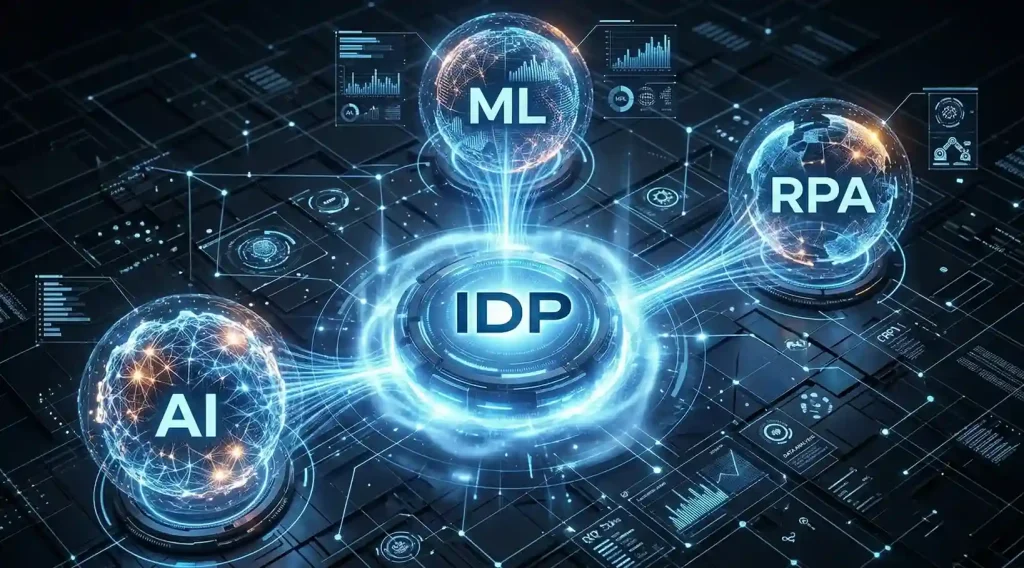
Intelligent Document Processing isn’t just one piece of software; it is a symphony of three powerhouse technologies: Artificial Intelligence (AI), Machine Learning (ML), and Robotic Process Automation (RPA). Think of it this way:

  • AI and NLP (Natural Language Processing) are the “Brain”. They provide the context, understanding whether a document is a legal contract or a pizza receipt, and knowing exactly where the “Total Amount Due” is located regardless of the layout.

  • Machine Learning is the “Experience”. The more documents the system sees, the smarter it gets. It learns from human corrections, constantly refining its accuracy.

  • RPA is the “Hands”. Once the AI understands the data, the RPA bot picks it up and carries it into your ERP, CRM, or accounting software without a single human click.

In 2026, we are moving away from rigid, template-based systems that break if a logo moves an inch. Modern IDP is “Agentic”—it uses Large Language Models (LLMs) to reason over the document just like a human would, allowing it to handle complex, unstructured forms with ease.


The Multi-Stage IDP Workflow: From Raw Image to ROI


A professional IDP implementation isn’t a “one-click” wonder; it’s a disciplined, multi-stage pipeline designed for 99% accuracy.

  1. Ingestion & Pre-processing: Before the AI can read, the image must be “cleaned.” This involves binarization (turning it into sharp black and white), de-skewing (straightening tilted scans), and noise reduction. A clean image is the difference between a successful extraction and a “read error.”

  2. Classification: The system automatically sorts the incoming mailroom. It identifies that “Doc A” is a utility bill and “Doc B” is a new employee contract. This ensures the right AI models are applied to the right documents.

  3. Extraction: This is the heavy lifting. Using a combination of AI and Intelligent Character Recognition (ICR), the system pulls specific data points—dates, names, currency, and line items—even from messy handwriting or complex tables.

  4. Validation: The system checks its own work. It runs “Fuzzy Matching” against your existing database to ensure the “Vendor Name” on the invoice matches a vendor in your system. If the confidence score is low, it flags it for a quick human review.


Why RPA is the Essential “Messenger” for IDP


Extraction is only half the battle. Once your AI has understood the document, the data needs a way to get into your systems—this is the “Last Mile” problem.

In a technical environment, many legacy systems lack modern APIs or integration points. RPA acts as the perfect messenger because it doesn’t need a back-end door; it simply uses the front-end user interface to “key in” the data exactly as a human would.

  • API Bridging: RPA serves as a universal connector for legacy applications that aren’t API-enabled.

  • Standardized Delivery: Bots ensure that data is moved consistently across CRM, ERP, and accounting platforms without human error.

  • Automated Triggers: Once IDP validates a document, RPA can instantly trigger downstream actions like sending payment notifications or updating shipment status.

Discover how our Robotic Automation services handle the “Last Mile” of your data journey.


Implementation Step 1: The Process Audit & Value Discovery


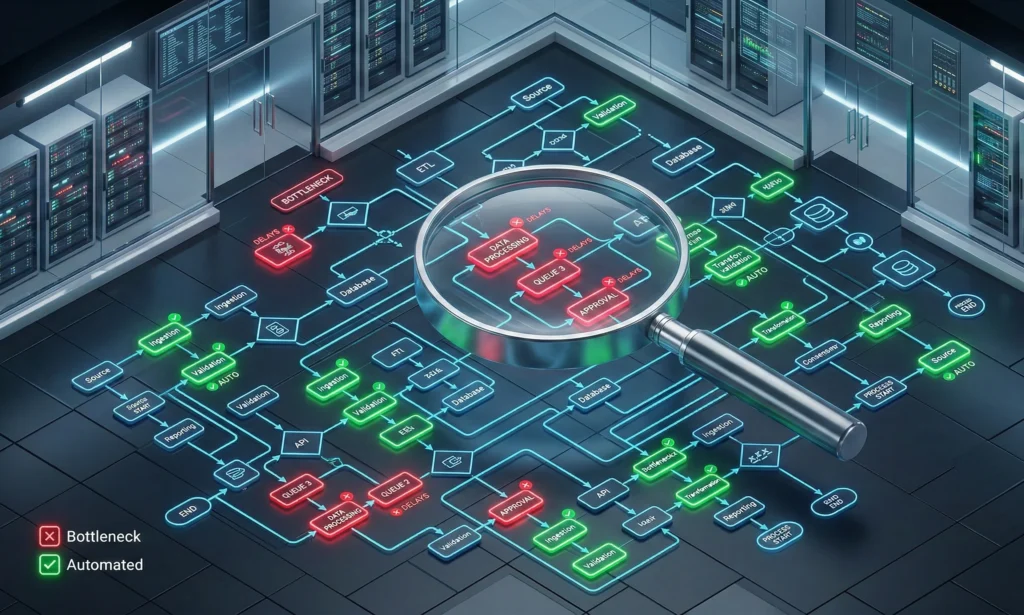
A professional 3D isometric view of a high-tech server room floor. A large, metallic magnifying glass hovers over a complex digital flowchart projected onto the floor. The flowchart consists of glowing lines and nodes; several nodes are highlighted in bright red with "Bottleneck" labels, while others glow vibrant green with "Automated" labels. A legend in the bottom left corner clarifies the color-coding, creating a clean, analytical, and strategic aesthetic.Success begins with honesty about your current bottlenecks. You cannot automate what you do not understand.

The first stage of implementation is a thorough Process Audit. This involves mapping your existing document workflows to identify high-volume, repetitive tasks that are prone to human error. Look for “swivel-chair” processes where employees spend hours copying data from PDFs into spreadsheets.

  • Establish a Baseline: Measure your current processing speed, error rates, and manual work hours for an accurate comparison.

  • Identify Priority Projects: Start small with a pilot program—focus on one department or document type where you know the exact costs and time investment.

  • Calculate ROI: Use a realistic time frame (typically 12–18 months) to compare the investment in software and training against the savings in operational costs and reduced downtime.
 

Implementation Step 2: Selecting the Tech Stack (Cloud vs. On-Prem)


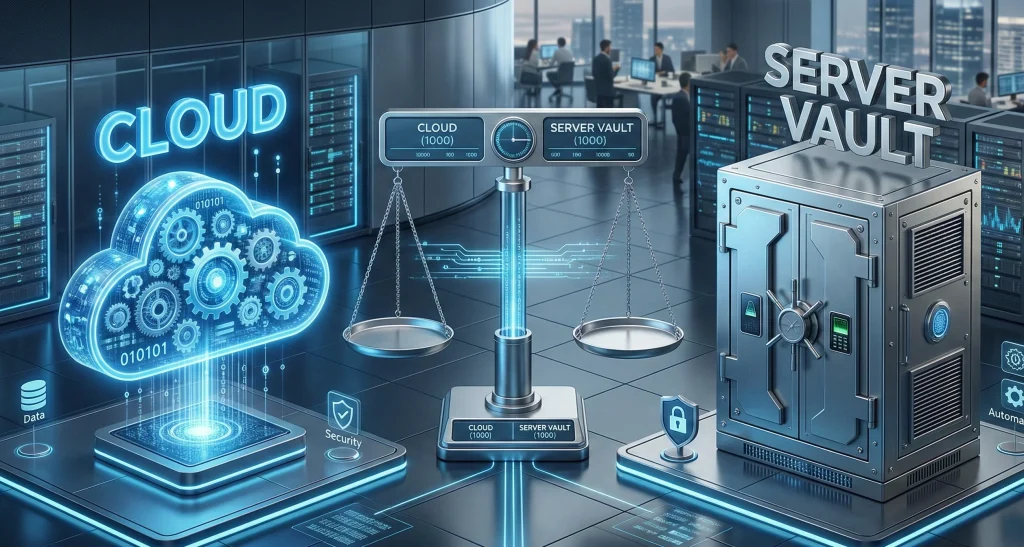
A high-tech 3D comparison visual set in a modern data center. On the left, a glowing blue holographic cloud filled with rotating digital gears represents "Cloud" services. On the right, a heavy, brushed-metal "Server Vault" with a secure locking mechanism represents on-premise security. In the center, a sleek digital scale is perfectly balanced between the two, symbolizing a harmonious hybrid infrastructure. The scene uses a professional palette of deep blues, silver, and slate grey.In 2026, choosing your infrastructure is no longer just a technical debate—it is a business strategy decision.

  • Cloud-Native IDP: Providers like Google Document AI and AWS IDP (Textract) offer rapid innovation, elastic scalability, and pay-per-page pricing. This is ideal for global deployments and unpredictable workloads.

  • On-Premise/Hybrid IDP: For industries with strict data sovereignty or regulatory requirements (like Banking or Healthcare), on-premise solutions offer full infrastructure control.

  • Enterprise Platforms: Leaders like UiPath IXP and Automation Anywhere provide agentic automation that stitches document intake directly into end-to-end RPA workflows.

When selecting your stack, prioritize Product-Problem Alignment. Does the tool support your specific document types (e.g., handwritten forms or complex tables) without requiring constant re-architecting?
 

Implementation Step 3: Training Models & Data Governance


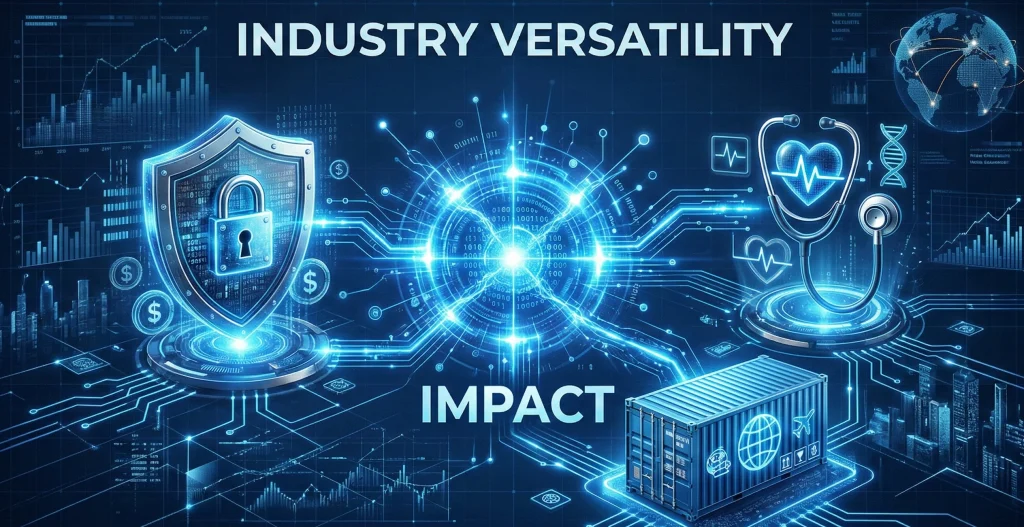
A professional 3D digital collage on a dark blue tech-themed background. In the center, a bright, pulsing blue circular data core radiates energy. Three distinct symbols are connected to this core via glowing circuit lines: a shimmering digital shield with a padlock (representing Banking and Security), a glowing holographic stethoscope and heart rhythm (representing Healthcare), and a detailed blue shipping container (representing Logistics). The words "INDUSTRY VERSATILITY" and "IMPACT" are displayed in clean, bold typography, illustrating how technology connects diverse sectors.In 2026, a successful IDP deployment is not a “set and forget” project; it is a continuous learning cycle fueled by Human-in-the-Loop (HITL) interaction. This collaborative approach ensures that while AI handles the heavy lifting, human experts intervene at critical decision points to maintain 99%+ accuracy.

  • Establishing Confidence Thresholds: Systems use confidence-based routing to filter the workload. High-confidence extractions are automated, while less certain cases—such as blurry scans or complex tables—are flagged for human review.

  • Active Learning Loops: When a human corrects a field, the system doesn’t just fix the one document; it ingests that correction to update its parameters and better handle similar cases in the future.

  • Managing Data Drift: Document layouts and business terminologies evolve. Continuous monitoring is essential to catch “Data Drift,” where model performance degrades as real-world inputs shift away from the original training set.

  • Robust Governance & Compliance: For regulated industries like finance and healthcare, IDP provides a transparent audit trail, logging every manual override and automated decision to meet GDPR or HIPAA standards.
 

2026 Industry Use Cases: IDP in Action


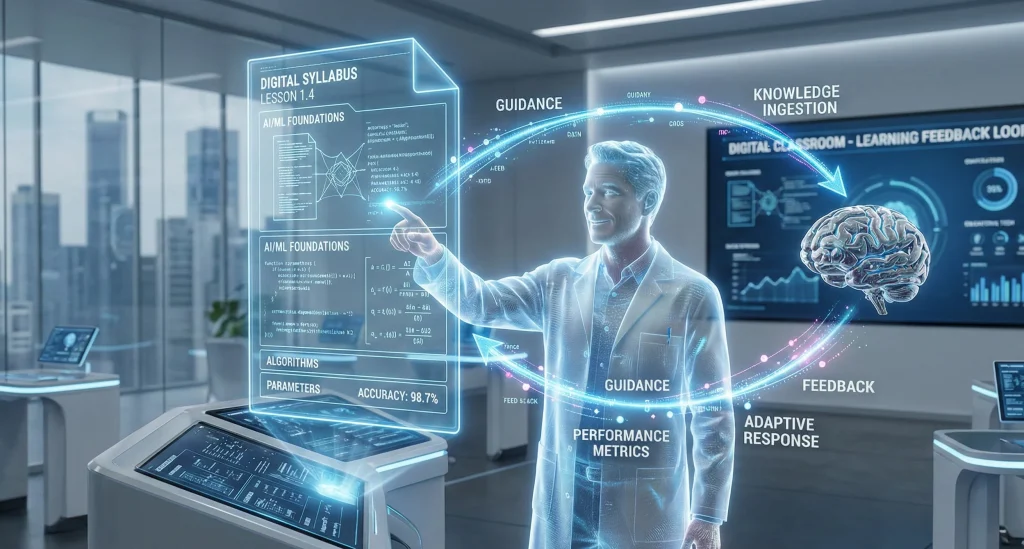
A clean, futuristic 3D visual of a "Digital Classroom" inside a high-end office with city views. A translucent, glowing blue human figure stands at a console, pointing toward a floating holographic document titled "Digital Syllabus." To the right, a glowing robotic brain icon receives information. Circular lines of light and data particles labeled "Guidance," "Feedback," and "Adaptive Response" flow between the human and the robotic brain, illustrating a continuous learning feedback loop between human intelligence and AI.IDP has become a critical transformation tool for document-heavy sectors, slashing processing times by up to 80%.

  • Banking & Finance: IDP extracts and verifies data from identity documents in real-time for KYC (Know Your Customer) and speeds up loan approvals by automating the extraction of financial statements.

  • Logistics & Supply Chain: Companies use IDP to automate Bill of Lading (BOL) and customs documentation, reducing manual entry errors and accelerating shipment tracking.

  • Healthcare: IDP digitizes patient intake forms and extracts diagnosis codes from physician notes, facilitating faster insurance claims adjudication and reducing retrieval time from 20 minutes to under 5 seconds.

  • Legal & HR: Law firms use IDP for e-discovery to categorize thousands of pages, while HR departments automate employee onboarding by seamlessly parsing resumes and tax forms.

 

Common Pitfalls: Why 40% of IDP Projects Stall


Even with the best technology, many implementations fail due to a lack of strategic alignment.

  • The “Perfect Accuracy” Trap: Expecting 100% straight-through processing (STP) from day one is unrealistic. Over-engineering for rare edge cases is often more expensive than simply using an efficient HITL process.

  • Neglecting Change Management: If the end-users who review the flagged documents find the interface confusing or feel threatened by the AI, adoption will fail.

  • Poor Data Quality: IDP is not magic; low-resolution scans, faxed documents, or handwritten notes with significant noise can lead to high error rates if not addressed during the pre-processing stage.

  • Vendor Dependency: Relying on external black-box models without in-house customization capabilities can lead to high costs and limited control over your data operations.


The 2026 Competitive Edge: Moving Toward Agentic IDP


The future of document processing is shifting from static pipelines to Agentic AI. These next-generation systems don’t just extract text; they reason over it. An “AI Agent” can autonomously resolve discrepancies—such as an invoice total not matching a purchase order—by checking multiple systems before ever involving a human.

Ready to evolve beyond manual entry? Consult our AI/ML Experts to build your custom Agentic IDP roadmap.


Final Word: Moving From Paper-Heavy to Data-Driven


Intelligent Document Processing is the final bridge between your physical past and your digital future. In a world where data is the most valuable currency, letting it stay trapped in static PDFs and paper forms is no longer an option. By combining the cognitive power of AI with the mechanical reliability of RPA, you transform a back-office burden into a strategic asset.

Build custom AI solutions that deliver real business value

From strategy to deployment, we help you design, develop, and scale AI-powered software that solves complex problems and drives measurable outcomes.

Facebook
Twitter
LinkedIn

Recent Post

Your journey to innovation starts here

Let’s bring your vision to life with our expertise in AI and custom development. Reach out to us to discuss your project today!