

The Liability of the Shared Cloud
In 2022, “Cloud First” was the mantra. In 2026, it is “Privacy First”. For years, businesses treated automation platforms like Zapier or Make as “invisible pipes.” You sent data in, something happened, and the data came out. But those pipes aren’t invisible—they are owned by third parties who store your API credentials, your customer emails, and your proprietary business logic on their servers.
If you are in the Healthcare or Legal space, this is no longer just a “privacy concern”—it is a major liability. A single data breach at a third-party automation provider can expose your entire client base and result in millions in fines under 2026’s updated privacy laws.
Self-hosting n8n allows you to take that data off the public internet and put it back where it belongs: inside your own firewall.

What Is n8n Data Sovereignty?
In 2026, Data Sovereignty means more than just where your data is stored; it means who has the right to see it. When you use a SaaS automation tool, you are essentially “renting” your business logic.
By self-hosting n8n on your own VPC (Virtual Private Cloud), you achieve true sovereignty:
-
Zero Credential Exposure: Your API keys for Salesforce, Stripe, or your EHR system never leave your server.
-
Network Isolation: You can configure your n8n instance to only be accessible from your office IP or via a secure VPN.
-
Audit-Ready Infrastructure: You own the logs. You can see every single byte that moves through your workflows, which is essential for SOC 2 or HIPAA audits.
Is n8n HIPAA Compliant? The GDPR & HIPAA Compliance Blueprint
In 2026, compliance is no longer a “checkbox”—it is a continuous technical state. When you self-host n8n, you are responsible for the three pillars of the Security Rule: Confidentiality, Integrity, and Availability.
-
PHI Separation: We design workflows where Protected Health Information (PHI) is never stored in the n8n execution history. By using the
Always Output Datasetting and custom cleanup nodes, we ensure that once a patient record is moved from the EHR to the billing system, no trace remains in the n8n logs. -
The Security Rule never names an algorithm. It’s technology-neutral by design. The AES-256 figure comes from NIST SP 800-111 (data at rest) and FIPS 140-2/140-3 validated modules, which HHS references in its breach-notification safe harbor guidance — that’s the route to “encrypted PHI isn’t a reportable breach,” not a statutory algorithm mandate.
-
The BAA Factor: While you own the server, if you host on AWS or Azure, you still need a Business Associate Agreement (BAA) with the cloud provider. Self-hosting gives you the power to choose “HIPAA-Eligible” regions that meet these legal requirements.
n8n Self-Hosted Security Best Practices: VPC and Docker Hardening
-
Network Isolation: Your n8n instance should never be directly “internet-facing.” We bind the n8n service to
localhost(127.0.0.1) and use a hardened Nginx or Traefik reverse proxy to handle external traffic. -
Non-Root Execution: We configure the n8n Docker image to run as a non-privileged user. If a vulnerability like CVE-2026-21858 is ever exploited, the attacker is trapped inside a low-privilege container and cannot “break out” to your host system.
-
Database Lockdown: Your PostgreSQL database should live in a private subnet with an
ipAllowList: []that only recognizes your n8n worker nodes. No one, not even you, should be able to access the database from the public internet.
Code Snippet: The PII Sanitizer
Instruction: Use this JavaScript in a Code Node to ensure PII (names, emails, SSNs) is removed from your logs while keeping the business logic intact.
// Techelix Security Snippet: PII Masking for Compliance
const sensitiveKeys = ['email', 'ssn', 'patient_name', 'phone'];

for (const item of $input.all()) {
  for (const key of sensitiveKeys) {
    if (item.json[key]) {
      // Masking: keeps first/last char, replaces middle with ****
      const val = item.json[key].toString();
      item.json[key] = val[0] + "****" + val[val.length - 1];
    }
  }
}
return $input.all();
n8n High Availability: Queue Mode Setup for Self-Hosted Instances
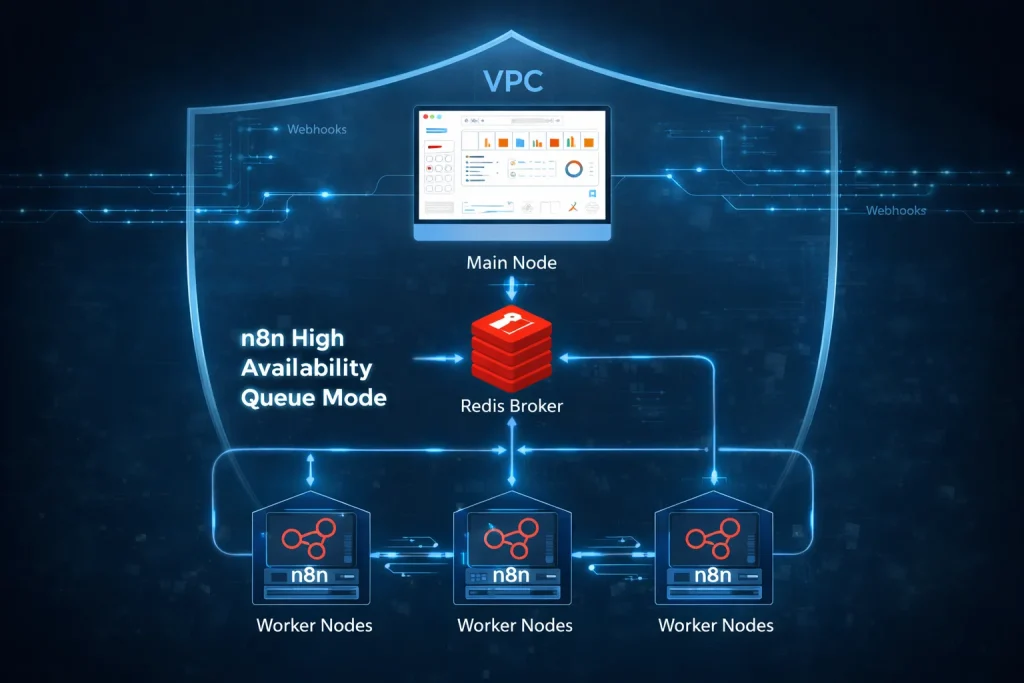
In 2026, a single-server Docker setup is great for an MVP, but it creates a “Single Point of Failure” (SPOF). If your server goes down for an update, your webhooks die. To achieve 99.9% uptime, we implement n8n Queue Mode.
This architecture separates your n8n instance into three distinct roles:
-
The Main Node: This handles the UI where you build workflows. It’s the “Brain.”
-
The Workers: These are stateless containers that do the heavy lifting. You can spin up 1 or 100 workers depending on your load.
-
The Broker (Redis): This acts as the “Waiting Room,” holding all incoming tasks until a Worker is free to grab them.
By decoupling the UI from the execution engine, your system becomes “Anti-Fragile.” If a complex AI task spikes your CPU on one Worker, the Main Node remains snappy, and your other Workers continue processing tasks without a hitch. For high-volume businesses processing 100,000+ daily transactions, this distributed architecture is the only way to ensure reliability.
n8n Self-Hosted Requirements: Monitoring, Updates, and Maintenance
Automation without observability is a “Silent Failure” waiting to happen. In 2026, we treat n8n like a mission-critical banking application.
-
Audit Logging: Every workflow edit, credential access, and user login is piped to a centralized SIEM (like Splunk or ELK). This allows your Compliance Officer to generate a “Who-Did-What” report for auditors in seconds.
-
Automated Patching: We set up Health Check Endpoints (
/healthz) and automated container updates. If n8n becomes unhealthy, the system automatically restarts it; if a new security patch is released, our “Update Workflow” notifies your team via Slack for a 1-click approval.
Explore our DevOps consulting for high-availability, self-healing n8n deployments.
Summary: Is Self-Hosted n8n Worth It for Compliance?
The most trusted brands in 2026 are the ones that can look a customer in the eye and say, “We never sent your data to a third-party cloud”. Self-hosting n8n isn’t just a technical choice; it is a brand promise of Data Sovereignty.
By moving from “Shared Clouds” to a Secure Private Infrastructure, you eliminate vendor risk, slash your execution costs, and ensure that your business logic remains your most valuable—and private—asset.
Ready to reclaim your data?
-
Partner with our engineers for a HIPAA compliant n8n setup
-
Talk to a Security Expert at Techelix. Let’s build your private automation vault today.
Build custom AI solutions that deliver real business value
From strategy to deployment, we help you design, develop, and scale AI-powered software that solves complex problems and drives measurable outcomes.