
Artificial intelligence is evolving into a whole new standard. Rather than employing one LLM for all tasks, companies are developing intelligent systems where many AI agents are collaborating, similar to specialised employees. Imagine how a regular organisation works. The salesperson does not work with legal contracts. The financial analyst does not make a marketing campaign. All departments have their specialists who work together towards the common goal. Enterprise AI is developing in the same manner.
Instead of having one general-purpose AI assistant, organisations are using many independent agents who interact and verify each other’s work, performing a complex workflow automatically without much human involvement. This concept is called enterprise multi-agent LLM orchestration, and it becomes the base for enterprise AI systems very rapidly.
In this guide, we’ll explore how enterprise multi-agent orchestration works, why it’s replacing traditional single-agent AI, the technologies powering modern autonomous workflows, and best practices for implementing production-ready AI teams.
What Is Enterprise Multi-Agent LLM Orchestration?
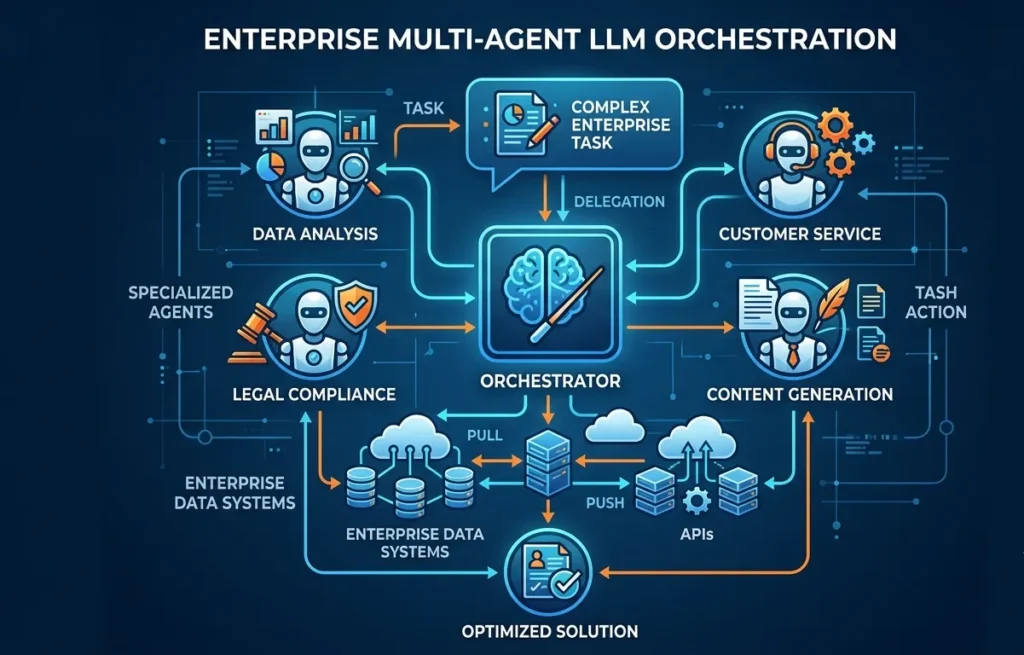
Enterprise multi-agent LLM orchestration is the process of coordinating multiple AI agents, each with a defined responsibility, so they can work together to solve business problems. Instead of one AI trying to perform every task, orchestration assigns specialised responsibilities.
For example:
| Planner Agent | Breaks objectives into tasks |
| Research Agent | Retrieves enterprise knowledge |
| Data Agent | Queries databases and APIs |
| Compliance Agent | Checks regulatory requirements |
| Writer Agent | Creates reports and documentation |
| Reviewer Agent | Validates outputs |
| Decision Agent | Selects the final response |
Every agent performs a focused job before handing work to another agent.
The orchestrator manages:
- Task routing
- Agent communication
- Memory
- Tool usage
- Error handling
- Decision making
- Human approvals
- Workflow completion
Instead of one enormous prompt, the workload becomes an organised collaboration.
Why Single-Agent AI Hits Enterprise Limits?
Single LLM systems are highly effective for simple, isolated tasks such as answering questions, generating content, or summarizing information. However, enterprise workflows are rarely limited to one step. They often involve multiple processes, data sources, business rules, and approval stages that require specialised handling.
It may require:
- Reading internal policies
- Searching contracts
- Validating budgets
- Checking compliance
- Contacting vendors
- Comparing pricing
- Creating purchase documentation
- Getting manager approval
Expecting one prompt to perform all of these reliably often results in hallucinations, inconsistent reasoning, and poor traceability.
Some common limitations include:
| Long prompts | Context overload |
| No specialization | Lower accuracy |
| Limited reasoning | Poor decisions |
| Weak memory | Lost context |
| Difficult debugging | Higher maintenance |
| Limited scalability | Performance bottlenecks |
As workflows grow, the architecture becomes increasingly difficult to maintain.
Why Are Enterprises Moving Toward AI Teams?
As enterprise AI initiatives become more sophisticated, organisations are realising that a single AI model is no longer enough to handle complex business operations. While one LLM can answer questions or generate content, enterprise workflows often involve multiple stages, different data sources, compliance checks, and decision-making processes that require specialised expertise.
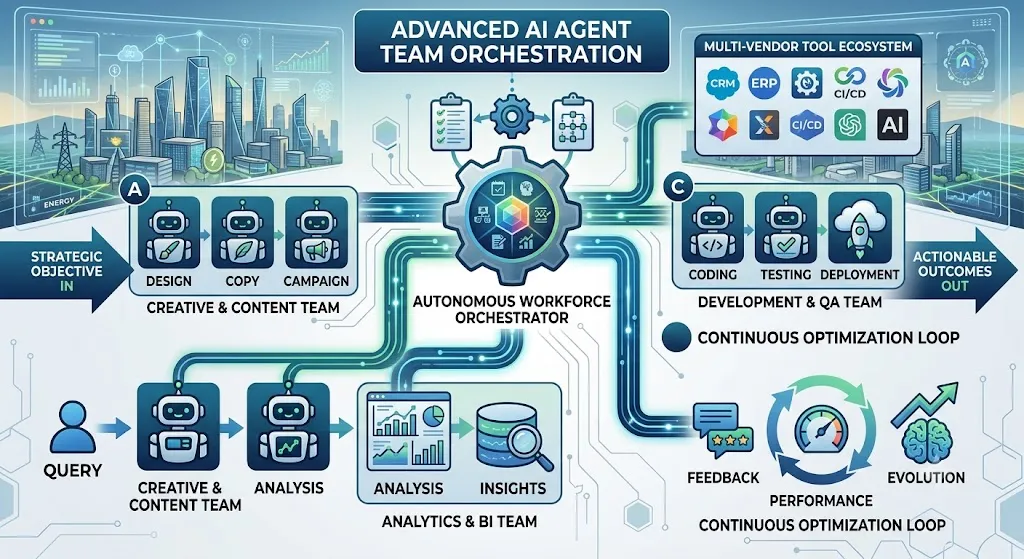
This is why businesses are shifting from single-agent AI to collaborative AI teams, where multiple intelligent agents work together under the guidance of an orchestration layer. The concept closely mirrors how successful organisations operate by assigning specialised responsibilities to experts who collaborate toward a common goal.
Instead of expecting one AI model to perform every task, enterprises distribute work across dedicated agents, each designed for a specific function.
Traditional AI Approach:
One AI Agent
│
▼
Handles Research → Analysis → Writing → Validation → Decision
A single model is responsible for every step, which often leads to context overload, inconsistent reasoning, and lower reliability as workflows become more complex.
Modern Enterprise AI Approach:
Business Request
│
▼
Planning Agent
│
▼
Research Agent
│
▼
Data Analysis Agent
│
▼
Compliance Review Agent
│
▼
Writer Agent
│
▼
Quality Assurance Agent
│
▼
Final Response
Each agent focuses on one responsibility while collaborating with the rest of the team. This structured approach allows AI systems to process information more efficiently and produce more accurate, trustworthy results.
Benefits of Multi-Agent Collaboration:
Adopting AI teams offers several advantages over relying on a single language model.
| Higher Accuracy | Specialized agents perform focused tasks, reducing mistakes and improving output quality. |
| Better Reasoning | Complex problems are solved step by step instead of forcing one model to handle everything at once. |
| Greater Reliability | Validation and review agents catch errors before results reach users. |
| Improved Scalability | Individual agents can be upgraded or expanded without redesigning the entire system. |
| Simpler Maintenance | Modular architectures make debugging and optimization much easier. |
| Lower Operational Costs | Organizations can assign lightweight models to simple tasks and reserve premium LLMs for advanced reasoning, optimizing performance and cost. |
Different Agents Can Use Different Models:
Another major advantage of enterprise multi-agent orchestration is flexibility. Every agent doesn’t need to use the same language model. Organisations can select the most suitable model based on the complexity, speed, cost, or accuracy required for each task.
For example:
| Research Agent | Fast, cost-efficient LLM |
| Data Analysis Agent | High-reasoning model |
| Writer Agent | Large generative LLM |
| Compliance Agent | Domain-specific or fine-tuned model |
| Review Agent | Evaluation or verification model |
This model-routing strategy helps enterprises balance performance and operational costs while ensuring each stage of the workflow is handled by the most capable AI.
How does Enterprise Multi-Agent Orchestration Work?
Enterprise multi-agent orchestration follows a structured workflow where specialised AI agents collaborate under the supervision of an orchestration engine. Instead of one AI model handling everything, each agent focuses on a specific responsibility while sharing information with other agents. This coordinated approach improves accuracy, scalability, and transparency throughout the process.
Step 1: Receive and Interpret the Business Request
Every workflow begins with a business objective submitted by a user or an enterprise application.
Example Request:
“Generate a quarterly financial compliance report for the APAC region.”
The orchestration engine analyses the request to understand:
- The user’s intent.
- Required outputs.
- Priority level
- Available enterprise data sources.
- Security and compliance requirements.
At this stage, the system identifies which specialised agents need to participate in the workflow.
Step 2: Planning and Task Decomposition
A Planning Agent breaks the business objective into smaller, manageable tasks and creates an execution strategy.
The planning agent determines:
- Individual tasks to complete.
- Task dependencies.
- Execution order.
- Required tools and APIs.
- Enterprise knowledge sources.
- Opportunities for parallel execution.
Example Plan
| Retrieve financial records | Finance Agent |
| Search compliance regulations | Compliance Agent |
| Collect supporting documents | Research Agent |
| Draft report | Writer Agent |
| Validate report | Review Agent |
This structured plan ensures every agent has a clearly defined responsibility.
Step 3: Specialized Agents Execute Their Tasks
Once the workflow is planned, multiple AI agents begin working simultaneously or sequentially, depending on task dependencies.
1. Research Agent
Responsible for gathering enterprise knowledge.
Activities include:
- Searching internal documentation.
- Accessing company policies.
- Retrieving information from vector databases.
- Performing Retrieval-Augmented Generation (RAG).
2. Finance Agent
Processes business and financial information by:
- Querying ERP systems.
- Running SQL queries.
- Analyzing revenue and expense data.
- Calculating financial metrics.
3. Compliance Agent
Ensures the workflow meets organisational and regulatory requirements.
Responsibilities include:
- Checking compliance rules.
- Validating governance policies.
- Reviewing audit requirements.
- Identifying regulatory risks.
Transforms collected information into a structured business document by:
- Drafting reports.
- Creating executive summaries.
- Writing recommendations.
- Formatting the final output.
Each agent performs only its specialised task, improving both efficiency and output quality.
Step 4: Validation and Quality Assurance
Before any result reaches the user, a Validation Agent reviews the combined output to ensure accuracy and reliability.
The validation process checks for:
- Missing information.
- Logical inconsistencies.
- Hallucinated content.
- Duplicate or conflicting data.
- Policy violations.
- Confidence scores.
- Source verification.
If issues are detected, the orchestrator can automatically send the task back to the appropriate agent for correction before proceeding.
Step 5: Human Review and Approval (When Required)
Not every workflow should be fully autonomous. For sensitive or high-risk business operations, the orchestration platform introduces a human-in-the-loop approval stage.
Typical approval scenarios include:
- Financial transactions.
- Legal contracts.
- HR decisions.
- Healthcare documentation.
- Customer communications.
- Compliance-sensitive actions.
Human reviewers can approve, reject, or request revisions before the workflow continues, ensuring governance and accountability.
Step 6: Deliver Results and Trigger Business Actions
Once the output has been validated—and approved when necessary—the orchestration engine delivers the final result.
Depending on the workflow, it can:
- Generate a business report.
- Send a customer response.
- Update enterprise databases.
- Trigger downstream workflows.
- Notify relevant teams.
- Store results in enterprise knowledge repositories.
The orchestrator also records execution logs, agent decisions, and workflow history for monitoring, auditing, and future optimisation.
Core Components of Enterprise Multi-Agent Architecture:
A production-ready orchestration platform typically includes:
| LLMs | Reasoning engine |
| Orchestrator | Coordinates agents |
| Vector Database | Enterprise memory |
| Knowledge Retrieval | RAG search |
| State Manager | Tracks workflow progress |
| Tool Layer | APIs and business systems |
| Memory Store | Long-term context |
| Observability Platform | Monitoring and debugging |
| Security Layer | Access control |
Together, these components create reliable autonomous systems rather than isolated chatbots.
LangGraph for Stateful Enterprise Systems
Many enterprise workflows require AI systems to remember previous decisions, maintain context, and manage complex processes over time. This is where langgraph stateful multi-agent systems provide significant value. Unlike linear workflows, LangGraph maintains shared state throughout execution, enabling persistent memory, retry handling, branching logic, human approvals, and coordinated agent collaboration. These capabilities make it ideal for long-running enterprise processes where accuracy, consistency, and workflow visibility are critical.
| Persistent Memory | Maintains workflow context and previous decisions |
| Retry Handling | Recovers from failures without restarting processes |
| Branching Logic | Supports dynamic business workflows |
| Human Approval | Enables controlled decision-making |
| Agent Coordination | Helps multiple AI agents collaborate effectively |
Choosing the Right Agentic AI Development Platform:
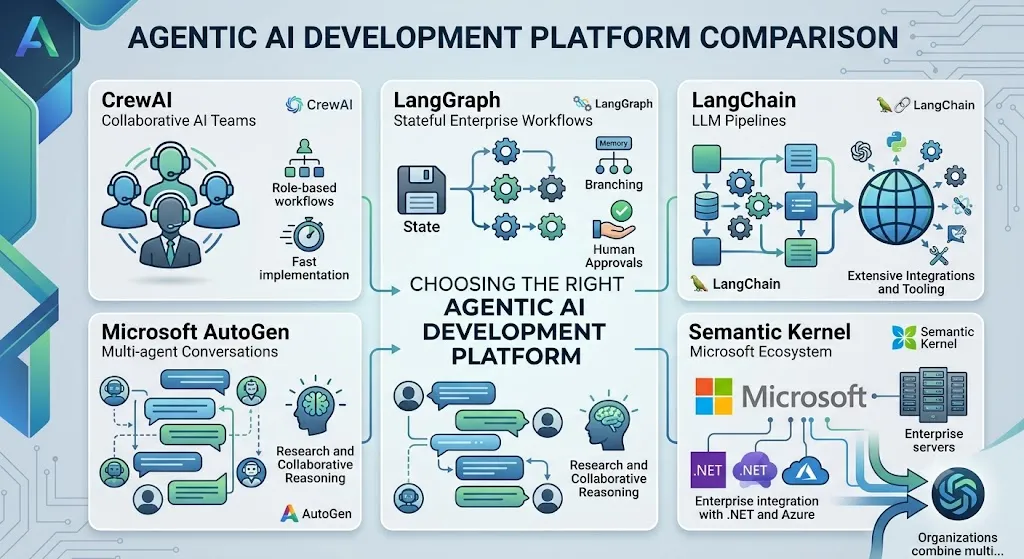
The ecosystem for building autonomous AI systems is expanding rapidly. Selecting the right platform depends on workflow complexity, governance requirements, and existing infrastructure.
Here’s a comparison of some popular agentic AI development platforms:
| CrewAI | Collaborative AI teams | Role-based workflows, fast implementation |
| LangGraph | Stateful enterprise workflows | Memory, branching, human approvals |
| LangChain | LLM pipelines | Extensive integrations and tooling |
| Microsoft AutoGen | Multi-agent conversations | Research and collaborative reasoning |
| Semantic Kernel | Microsoft ecosystem | Enterprise integration with .NET and Azure |
Each platform addresses different orchestration needs, and many organisations combine multiple frameworks within a broader AI architecture.
Why Orchestration Matters More Than Bigger Models?
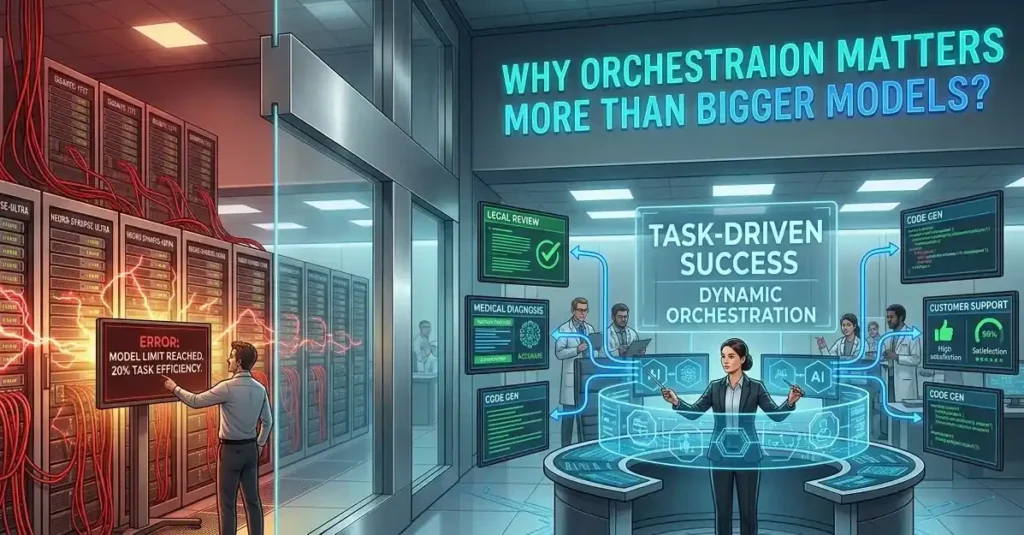
A common misconception is that better results always require a larger language model. In reality, many enterprise AI failures stem from poor workflow design rather than insufficient model capability.
An orchestrated team of specialised agents can often outperform a single large model by:
- Dividing complex tasks into manageable steps.
- Using the right tools at the right time.
- Validating outputs before delivery.
- Maintaining context across long-running workflows.
- Allowing humans to intervene when necessary.
The result is a system that is more transparent, maintainable, and aligned with enterprise governance.
Best Practices for Enterprise Multi-Agent LLM Orchestration
Building an enterprise multi-agent system isn’t just about connecting multiple AI agents; it requires thoughtful architecture, governance, and continuous optimisation. Without clear design principles, even the most advanced models can produce inconsistent results, duplicate work, or create security risks.
The following best practices will help you build reliable, scalable, and production-ready autonomous AI teams.
1. Define Clear Roles and Responsibilities for Every Agent
One of the biggest mistakes organisations make is creating agents with overlapping responsibilities. When multiple agents attempt to solve the same problem, workflows become inefficient, and conflicting outputs are more likely.
Instead, design each agent with a single, well-defined role. For example, one agent should focus on retrieving information, another on analysing data, another on drafting content, and a separate agent on reviewing the final output.
This specialisation improves accuracy, simplifies debugging, and makes it easier to scale your AI system as new business requirements emerge.
2. Connect Agents to Enterprise Knowledge with RAG
Even the most capable LLMs cannot reliably answer questions about your company’s latest policies, customer records, or internal documentation. Relying solely on a model’s training data often leads to outdated or inaccurate responses.
By integrating Retrieval-Augmented Generation (RAG), agents can retrieve real-time information from trusted enterprise sources such as document repositories, knowledge bases, CRMs, or vector databases before generating a response.
This ensures every decision is grounded in current business data rather than assumptions.
Benefits of using RAG include:
- More accurate and context-aware responses.
- Reduced hallucinations.
- Better compliance with internal policies.
- Faster access to organisational knowledge.
- Improved trust in AI-generated outputs.
For enterprise environments, RAG transforms AI agents from generic assistants into knowledgeable business collaborators.
3. Maintain Shared Memory and Workflow Context:
Enterprise workflows often span multiple steps, involve several AI agents, and may even pause for human approval before continuing. Without a shared memory mechanism, agents can lose important context, leading to repeated work or inconsistent decisions. A centralised state management system allows every agent to access the same workflow history, intermediate outputs, and previous decisions.
For example, if a compliance agent flags a policy issue, the writer agent should automatically incorporate those recommendations instead of starting from scratch.
Maintaining shared context enables smoother collaboration, especially in long-running or complex business processes.
4. Keep Humans in the Loop for Critical Decisions:
While autonomous AI can automate many repetitive tasks, some business decisions still require human judgement. Financial approvals, legal reviews, healthcare recommendations, and HR actions should never rely entirely on AI without oversight. Introducing human-in-the-loop (HITL) checkpoints allows experts to review, approve, or modify AI-generated outputs before execution.
This not only reduces business risk but also builds confidence in enterprise AI systems by ensuring accountability and regulatory compliance. Human oversight is particularly valuable when workflows involve sensitive data, high-value transactions, or customer-facing decisions.
5. Monitor, Measure, and Continuously Improve Performance:
Deploying a multi-agent system is only the beginning. To maintain high performance, organisations need visibility into how agents behave in production.
Track key performance metrics such as:
- Workflow completion time.
- Token consumption and AI costs.
- Agent response accuracy.
- Error and retry rates.
- Task success rate.
- Tool and API performance.
- User satisfaction scores.
Observability tools provide detailed insights into workflow execution, making it easier to identify bottlenecks, optimise resource usage, and improve agent collaboration over time.
Continuous monitoring turns enterprise AI into a system that evolves and improves with real-world usage.
Common Challenges:
While the benefits are significant, enterprise multi-agent systems also introduce new complexities.
| Agent conflicts | Central orchestration logic |
| Context loss | Shared memory and state management |
| Hallucinated outputs | RAG and validation agents |
| Workflow failures | Retry mechanisms and checkpoints |
| Security concerns | Role-based access and audit logs |
| Rising costs | Route tasks to the most appropriate model |
Addressing these challenges early helps ensure production-ready deployments.
Conclusion:
Enterprise AI is evolving beyond smarter chatbots into intelligent AI teams that collaborate to solve complex business challenges. Through enterprise multi-agent LLM orchestration, organisations can improve accuracy, reduce hallucinations, and automate workflows with specialised agents. Frameworks like crewai autonomous workflows, langgraph stateful multi-agent systems, and other agentic AI development platforms enable scalable and reliable AI operations. Building these systems requires secure architecture, governance, observability, and seamless integrations. At Techelix, our multi-agent LLM integration services help enterprises develop autonomous AI solutions.