
For the last half-century, the playbook for the Fast-Moving Consumer Goods (FMCG) industry was straightforward: build a strong brand, secure the best shelf space, and scale distribution. Today, that playbook is obsolete.
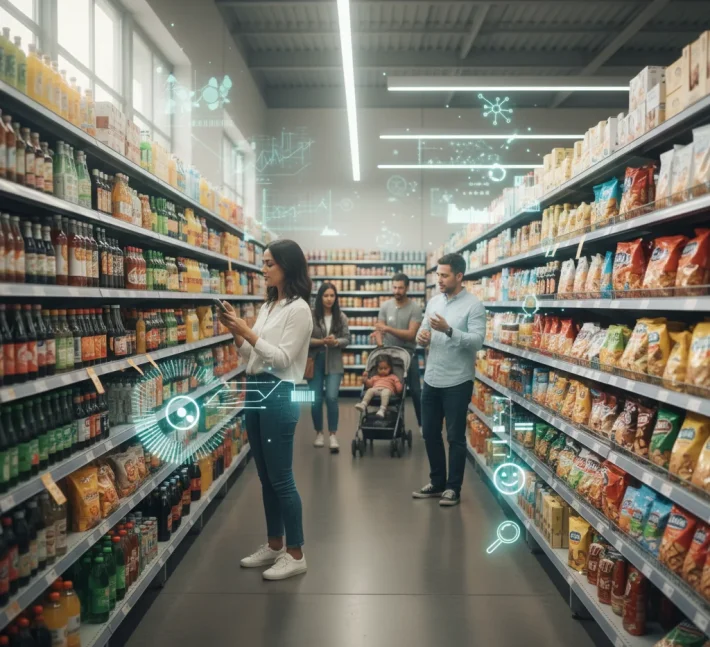
The modern shopping aisle isn’t just a physical shelf; it’s a digital ecosystem of endless data points. The new battleground isn’t for eye-level placement at the supermarket—it’s for “top-of-mind” placement in a customer’s app, voice assistant, and social media feed.
In this new environment, Artificial Intelligence (AI) is more than a buzzword; it’s the new operational engine. AI in FMCG isn’t about futuristic robots in aisles; it’s about using intelligent algorithms to make thousands of better, faster decisions every single second. It’s about predicting how much ice cream will be sold in a specific city during a heatwave, personalizing a coupon for a single customer to prevent them from switching brands, and optimizing a delivery route in real-time to save on fuel.
The urgency is clear. The industry is grappling with fragile supply chains, razor-thin profit margins, and a complete erosion of traditional brand loyalty. The “why now?” is simple: adapt or become irrelevant. It’s no surprise that, according to a 2024 Honeywell report, 80% of retail executives expect their companies to adopt AI-powered automation by the end of 2025 to stay competitive.
Why the FMCG Industry is Ripe for an AI Revolution
AI isn’t a buzzword for FMCG—it’s the practical way to fix problems the industry has carried for decades. And because this sector runs on speed, scale, and razor‑thin margins, it’s especially primed for AI to make a real, measurable difference.
The “High‑Volume, Low‑Margin” Paradox
FMCG is a game of pennies. Companies fight for a few cents of profit on each unit, and the only way to win is through massive volume. In this environment, a 1% optimization isn’t just “nice”—it’s millions of dollars. The human brain can’t possibly analyze all the variables needed to find these small efficiencies at scale. AI can. It can analyze millions of data points to find the 0.5% reduction in packaging waste or the 1% improvement in logistics efficiency that directly translates to a healthier bottom line.
Taming the “Bullwhip Effect”
The supply chain world has a classic problem: the “bullwhip effect.” A small, 5% increase in consumer demand for soda at the retail level can cause a 20% spike in orders for the distributor, a 40% jump for the bottler, and an 80% panic-order for the sugar supplier. This massive distortion creates chaos, waste, and stockouts. AI acts as a “damper” for this bullwhip. By analyzing real-time consumer data instead of relying on delayed, lagging orders, AI predictive models can forecast actual demand, not just the panic-driven noise coming up the chain.
The Fight for the Hyper‑Informed Consumer
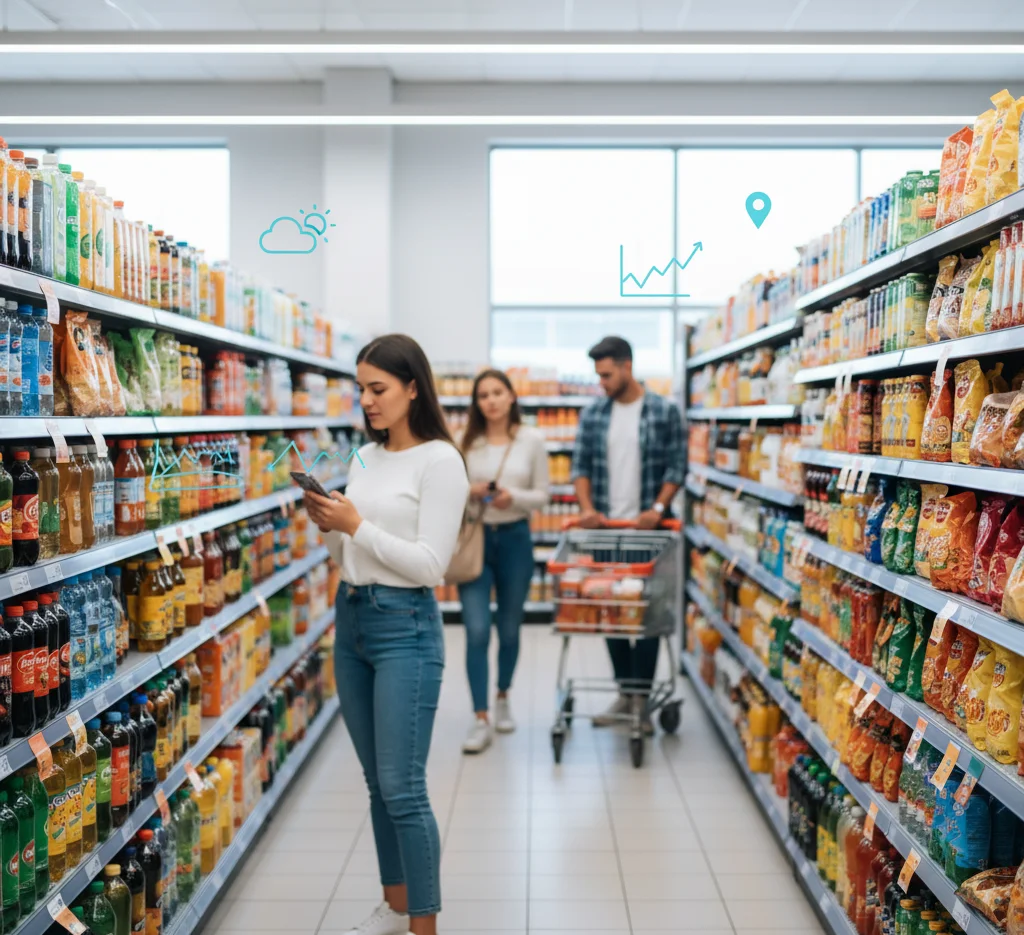
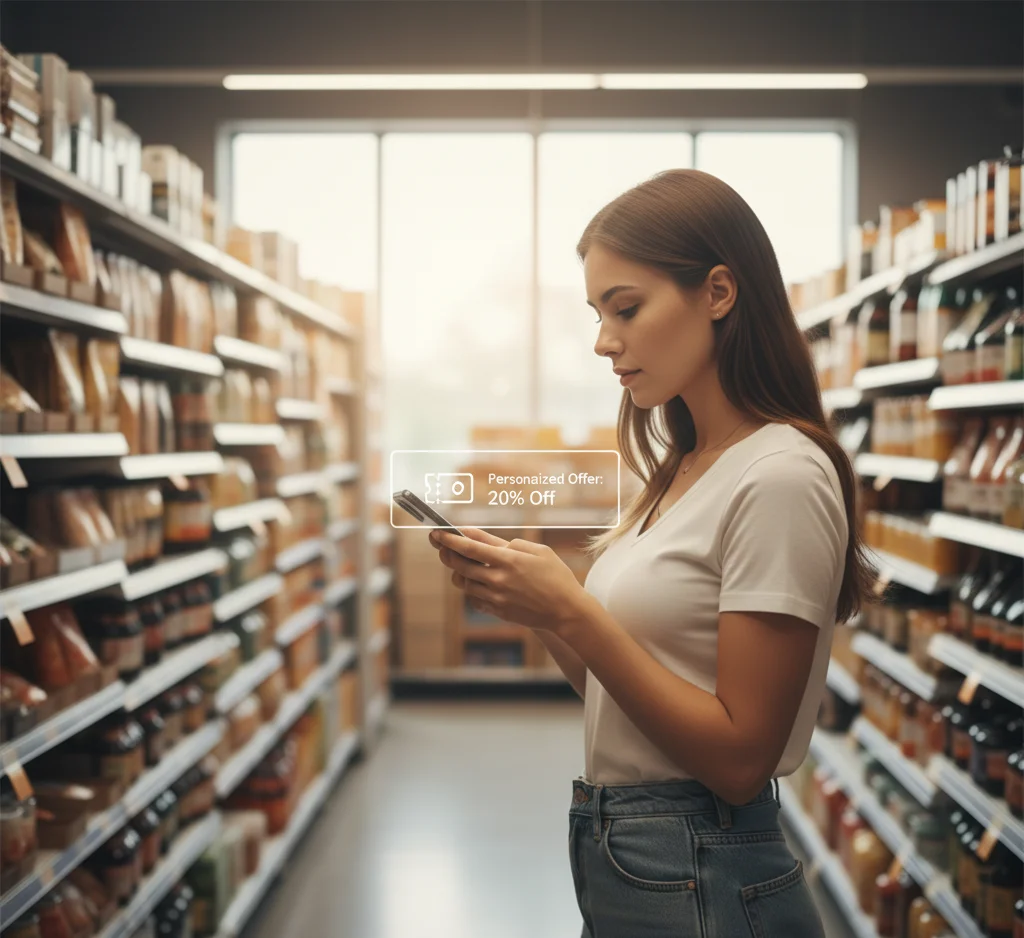
Today’s consumer is standing in your store’s aisle, phone in hand, comparing your price, checking your ingredients, reading reviews, and looking at your competitor’s product all at once. Their loyalty is fickle and won’t be held by a 1990s TV ad. They demand personalization. They want to know about sustainable sourcing. AI is the only way to deliver this “segment of one” marketing. It allows brands to move from mass-market shouting to having a one-on-one conversation with millions of customers simultaneously.
The Perishable Problem
FMCG doesn’t just mean canned goods. It means fresh produce, dairy, baked goods, and even “fast fashion” trends. These products have a ticking clock. Every item that expires on a shelf or in a warehouse is a 100% loss. Traditional forecasting models, based on last year’s sales, are too rigid. AI models are dynamic; they can predict that a rainy forecast will reduce demand for salad kits and increase it for soup, allowing the company to adjust inventory before the waste occurs.
Real-World AI Use Cases: Transforming the FMCG Value Chain
AI is not a single, monolithic thing. It is a collection of technologies—like machine learning, computer vision, and natural language processing (NLP)—that can be applied to specific business problems. Let’s break down how AI is creating tangible value at every single step of the FMCG journey.
Revolutionizing Supply Chain and Demand Forecasting
This is the single biggest area of impact. An inefficient supply chain can bleed an FMCG company dry.
- Hyper-Accurate Demand Forecasting: This is the big win. Instead of guessing from last quarter’s numbers, AI pulls in live signals and spots patterns fast. It blends your sales history with real‑world drivers like:
Weather shifts (heatwaves = more ice cream and sports drinks)
Local events (music festivals mean a run on water and snacks)
Social buzz (a viral TikTok recipe can clear out feta overnight)
Competitor moves (price changes and promos that sway demand)
End result: forecasts that reflect what will happen—not just what happened.
- Inventory Optimization: Great forecasting leads to smart inventory. AI algorithms don’t just order “more.” They find the perfect balance to prevent two costly problems: stockouts (empty shelves, lost sales, and customer frustration) and overstocking (tied-up capital, warehousing costs, and the risk of spoilage).
- Logistics & Route Optimization: AI is used to solve the “Traveling Salesman Problem” on a massive scale. For a fleet of hundreds of delivery trucks, AI plots the most efficient routes based on traffic, fuel costs, delivery windows, and even vehicle load capacity. This directly cuts fuel consumption and improves on-time delivery.
The impact here is not theoretical. According to extensive research from McKinsey & Company, companies that implement AI-driven supply chain management can see a reduction in inventory of up to 20%, a decrease in supply chain costs of up to 10%, and an increase in revenue of up to 4% from fewer stockouts.
Smart Manufacturing and Production (Industry 4.0)
The modern factory is becoming a hub of data.
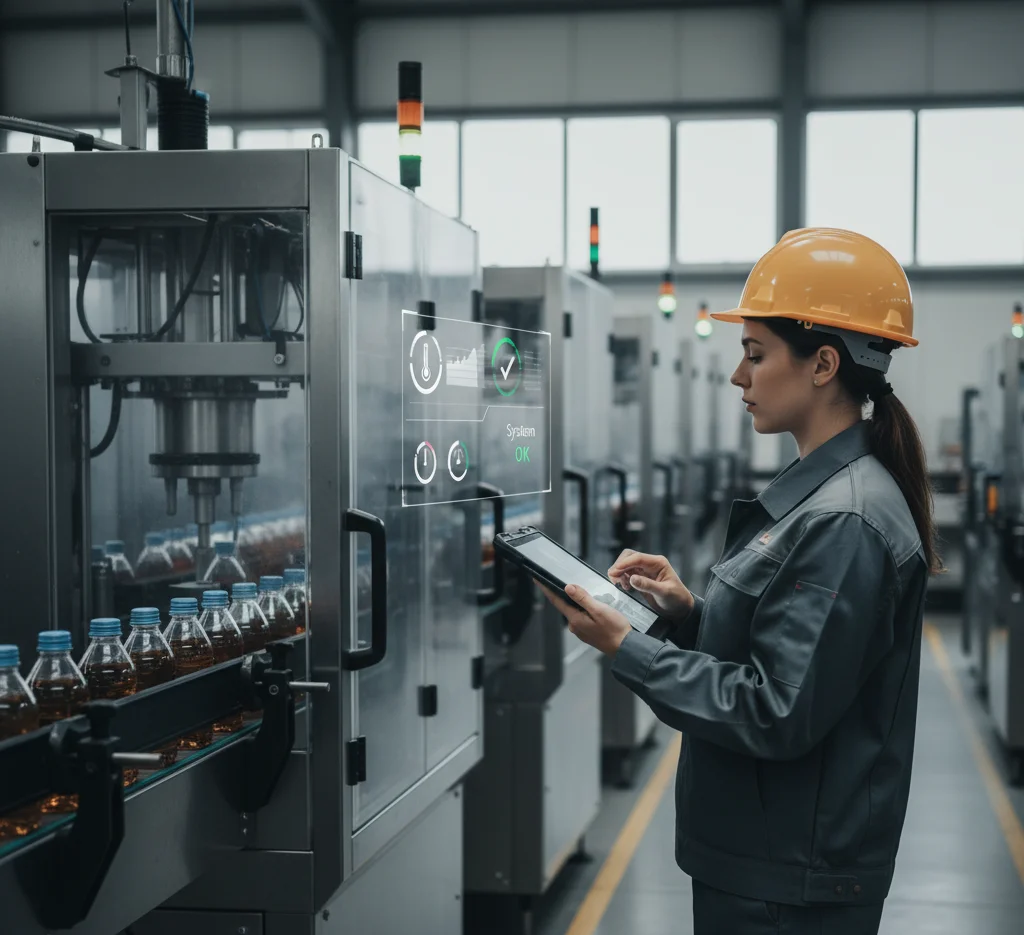
- Predictive Maintenance: On a high-speed bottling or packaging line, downtime is the enemy. Instead of waiting for a machine to break (reactive maintenance), AI uses sensors to “listen” to a machine’s vibrations, temperature, and output. The model can predict a failure before it happens, allowing the team to schedule maintenance during a planned stop, saving millions in unplanned downtime.
- AI-Driven Quality Control: The human eye gets tired. A computer vision system does not. AI-powered cameras on a production line can inspect 100% of products, 24/7. They can spot microscopic defects, check for correct label placement, ensure packaging is sealed, and verify fill levels—all with a speed and accuracy that is superhuman.
- Production Planning: AI algorithms can look at the latest demand forecast, the current inventory of raw materials, and the available machine capacity, and then create the most profitable and efficient production schedule for the next 24 hours.
Hyper-Personalization in Marketing and Sales
This is where AI helps you fight for the hyper-informed consumer.
- Dynamic Pricing: E-commerce platforms can use AI to adjust prices in real-time. This isn’t just about raising prices; it’s about being smart. The system can analyze demand, competitor stock, and time of day. It can even offer a slight, personalized discount to a price-sensitive customer who is about to abandon their cart.
- Personalized Promotions: The “one-size-fits-all” weekly flyer is dead. AI allows for micro-segmentation. It analyzes a customer’s purchase history and sends them a unique, relevant offer. If you always buy diapers and baby formula, you get a coupon for baby wipes—not a 2-for-1 deal on beer. This targeted approach dramatically increases promotion-to-sale conversion rates.
- Social Listening & Sentiment Analysis: When a brand launches a new flavor, they no longer have to wait weeks for focus group reports. AI-powered NLP tools can scan millions of social media posts, blogs, and reviews in real-time. They can tell a brand manager not only if people like the new product, but why—is the packaging a hit but the taste is off? This is instant, actionable feedback.
Enhancing the Customer Experience
AI is the new face of customer service, working 24/7.
- AI Chatbots & Virtual Assistants: These are no longer the “I don’t understand” bots of five years ago. Modern AI assistants can handle 80% or more of common customer inquiries: “Where is my order?”, “Is this product gluten-free?”, “What are your store hours?”. This frees up human support agents to handle complex, high-value customer issues.
- Recommendation Engines: The classic “Customers who bought this also bought…” is a powerful AI tool. In FMCG, this helps online grocers increase the average basket size. By understanding purchase patterns, the AI can suggest that you might be out of milk or that the brand of chips you’re buying pairs well with a specific salsa, driving incremental sales. In fact, research shows that for e-commerce sites, 71% use AI-driven recommendations, which can generate up to 35% of total revenue.
Optimizing In-Store Operations (The “Smart Store”)
AI isn’t just for e-commerce. It’s revolutionizing the physical brick-and-mortar store.
- Computer Vision for Shelf Monitoring: AI-powered cameras mounted in the aisles continuously scan the shelves. They can instantly detect an “out-of-stock” gap, a product in the wrong place, or an incorrectly priced item. An alert is sent directly to a store employee’s handheld device, allowing them to fix the problem in minutes, not hours. This “shelf availability” is a critical battleground.
- Frictionless Checkout: The “Just Walk Out” technology pioneered by Amazon Go is a powerful combination of AI, computer vision, and sensors. It allows customers to grab what they need and leave, with the system automatically billing their account. This is the ultimate in convenience and the next big leap in retail.
The Next Frontier: Emerging AI Trends in FMCG
What we’ve covered is what’s possible today. But the real excitement lies in what’s coming next. The companies that will dominate the 2030s are investing in these trends right now.
Generative AI: Your New Co-Pilot for Product Innovation
Generative AI (the technology behind tools like ChatGPT) is moving from writing text to creating tangible products.
- New Product Development: This is the big one. Instead of months of R&D, brand managers can now use GenAI as an innovation partner. A prompt could be: “Analyze the top 50 consumer wellness trends, current flavor profiles in the beverage market, and our available raw material database. Suggest three new formulas for a healthy energy drink targeting Gen Z, complete with branding and marketing copy.”
- Hyper-Personalized Content: We discussed personalized promotions, but GenAI takes it a step further. It can create 10,000 unique ad variations—different images, different copy, different calls-to-action—all tailored to 10,000 different micro-segments, all in a matter of seconds.
AI for Sustainability and ESG Goals
Consumers, investors, and regulators are all demanding that companies become more sustainable. AI is a critical tool for achieving these goals.
- Reducing Food Waste: This is a massive moral and financial opportunity. The UN Environment Programme’s 2024 Food Waste Index Report revealed a staggering 1.05 billion tonnes of food was wasted in 2022, with the retail and food service sectors accounting for 131 million and 290 million tonnes, respectively. AI attacks this problem directly. Hyper-accurate forecasting prevents over-ordering, and AI-driven dynamic pricing can automatically apply discounts to items nearing their expiry date to ensure they are sold, not thrown away.
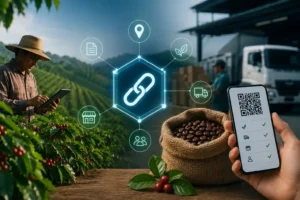
- Sustainable Sourcing & Supply Chain Transparency: AI platforms can provide “farm-to-shelf” transparency. By tracking products on a blockchain or database, AI can verify that raw materials like palm oil, coffee, or cocoa are coming from sustainable, ethically-certified sources, helping brands build real, verifiable trust with consumers.
The Rise of AI-Native Brands
In the near future, we will see the rise of “AI-Native” DTC (Direct-to-Consumer) brands. These companies won’t add AI to their business; their entire business will be built on AI. They will use AI to spot a niche market gap, use Generative AI to formulate the product and design the packaging, use AI to run targeted marketing, and use AI to manage a fully automated supply chain. These lean, agile competitors will be able to launch and scale faster than any traditional CPG giant.
The Implementation Playbook: Challenges & A 5-Step Roadmap
This all sounds transformative, so why isn’t every company already doing it? Because, in practice, AI implementation is hard. It’s not a technology problem; it’s a people, process, and data problem.
The Hard Truth: Common Implementation Challenges
- Challenge 1: Data Silos & Quality: This is the #1 killer of AI projects. AI is fueled by data. Most large companies have their data locked in “silos”—the marketing team’s data doesn’t talk to the supply chain’s data, which doesn’t talk to finance’s data. Worse, the data is often messy, incomplete, or inaccurate. The “garbage in, garbage out” rule is iron-clad.
- Challenge 2: The Talent Gap: The people who truly understand AI and data science are in high demand. The people who truly understand the nuances of the FMCG supply chain are also rare. Finding people who understand both is almost impossible.
- Challenge 3: High Initial Cost & Unclear ROI: AI platforms can be expensive. It’s hard for a brand manager to get a multi-million dollar budget approved for a project whose return on investment (ROI) is a “maybe.” This creates a “chicken-and-egg” problem: you can’t get the budget without proving the ROI, but you can’t prove the ROI without the budget.
- Challenge 4: Integrating with Legacy Systems: The shiny new AI tool is fantastic, but it has to plug into your 20-year-old ERP (Enterprise Resource Planning) or warehouse management system. This technical integration work is not glamorous, but it’s where most projects fail.
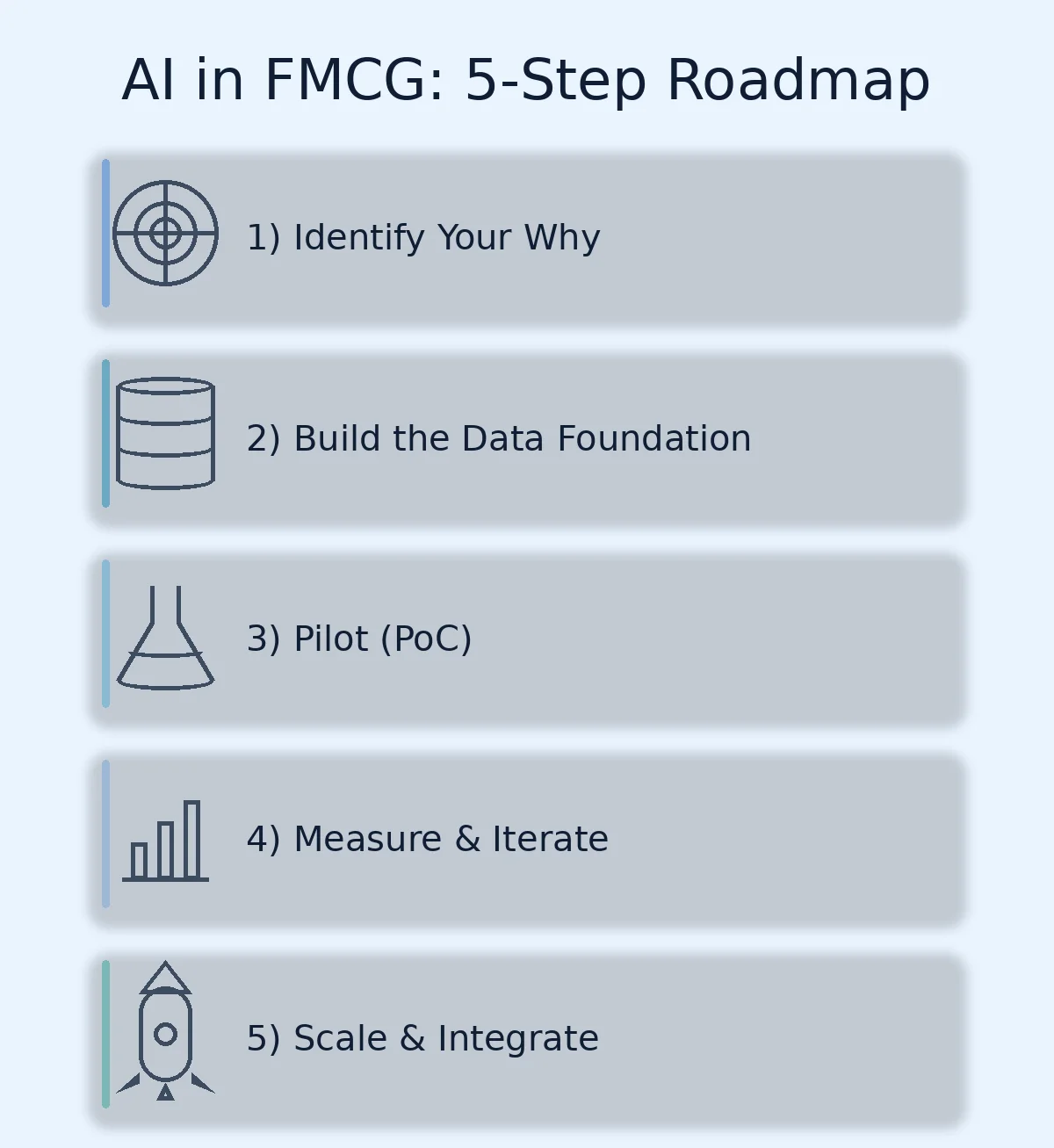
Your 5-Step Roadmap to AI Success
The solution to these challenges is to not try to “boil the ocean.” The most successful companies follow a disciplined, practical approach: Think Big, Start Small, Scale Fast.
- Step 1: Identify Your “Why” (The Business Case) Don’t start with “We need an AI strategy.” Start with a specific, high-value business problem. For example: “We have a 20% stockout rate on our top 50 products” or “Our food waste in the dairy category is 15%.” This gives you a clear, measurable goal.
- Step 2: Build Your Data Foundation Once you have your problem, focus on only the data needed to solve it. Don’t try to build a massive, company-wide “data lake.” Just get the sales history, promo calendars, and logistics data for your top 50 products. Clean it, unify it, and make it ready for a model.
- Step 3: Run a Pilot Project (Proof of Concept – PoC) This is how you solve the ROI problem. You “Start Small.” Test your AI model in a controlled, limited environment. For example, apply your new forecasting model to one product category in one city for three months. This is a small, low-risk, low-cost experiment.
- Step 4: Measure, Learn, and Iterate At the end of your 3-month pilot, you have clear results. Did your stockout rate drop from 20% to 10%? Did you reduce waste by 5%? You now have a proven, positive ROI. You’ve learned what works and what doesn’t, and you can refine the model.
- Step 5: Scale and Integrate Now you “Scale Fast.” You have the data, the business case, and the proven ROI. You can confidently go to leadership and get the budget to roll out the solution across all product categories and all regions. This is where partnering with a team that has experience building a scalable AI for FMCG Industry platform becomes critical.
The Future of FMCG is Fast, Personal, and Predictive
The era of mass production, mass marketing, and mass distribution is over. The FMCG industry is now defined by speed, personalization, and resilience.
Artificial Intelligence is the single most powerful tool companies have to master these three new pillars of competition. It is the only way to build a supply chain that is predictive and resilient, a marketing engine that is truly personal, and an operation that is fast and efficient enough to thrive on razor-thin margins.
The CPG and FMCG giants of the past were built on the strength of their brands and their distribution networks. The giants of the future will be built on the strength of their data and the intelligence of their algorithms.
The transition won’t be easy, and the challenges of data, talent, and integration are real. But as this guide has shown, the path forward is not a blind leap. It’s a series of practical, measurable steps.
The FMCG landscape is changing. Don’t get left behind.
See how Techelix is powering the next generation of FMCG with dedicated AI solutions.
Build custom AI solutions that deliver real business value
From strategy to deployment, we help you design, develop, and scale AI-powered software that solves complex problems and drives measurable outcomes.