The Invisible Concierge: How Agentic AI is Redefining Travel in 2026

By Techelix editorial team

A global group of technologists, strategists, and creatives bringing the latest insights in AI, technology, healthcare, fintech, and more to shape the future of industries.

Contents

The Trust Gap in the Used Car Market

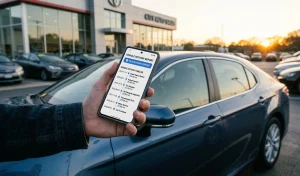
A close-up, first-person perspective of a hand holding a modern smartphone in a car dealership parking lot at sunset. The phone screen displays a "Vehicle History Report" with a "Blockchain Verified" badge and a detailed vertical timeline of service records like oil changes and inspections. In the soft-focus background, a blue sedan and several other cars are parked in front of a contemporary dealership building under a warm, orange-hued sky.If you’ve ever bought a used car, you know the feeling of doubt. Is the mileage real? Has it been in a major accident that isn’t on the report? In 2026, even with all our tech, the used car market is still plagued by fraud. Odometer tampering alone is a multi-billion dollar problem that drains value from honest owners and puts buyers at risk.

The issue is that our current records are “siloed”. The mechanic has one set of notes, the insurance company has another, and the DMV has a third. None of these systems talk to each other, and all of them can be edited by anyone with the right password.

In 2026, we are finally closing this “Trust Gap” by moving vehicle history onto a blockchain. Instead of a paper service book that can be lost or faked, every car now has an immutable digital record that no one person can change. It turns the vehicle’s history into a verifiable asset.
What is a Vehicle Digital Passport?

In 2026, we don’t just own a physical car; we own a Digital Twin that lives on the blockchain. The moment a vehicle rolls off the assembly line, it is assigned a unique cryptographic identity—a “Digital Passport”.

This passport is much more than a digital PDF of the VIN. It is a live, breathing record of the car’s entire existence. Every time the car is serviced, every time it passes an inspection, and even every time its battery is charged (in the case of EVs), a “block” of data is added to its history.

  • Ownership Transparency: When you buy a car, the title is transferred as a secure token. No more waiting weeks for the DMV to mail you a piece of paper.

  • Real-Time Valuation: Because the blockchain has a perfect record of the car’s health and mileage, lenders and insurance companies can give you an instant, accurate valuation of the asset.

  • Tamper-Proof Data: Since the data is decentralized across thousands of nodes, a dishonest seller cannot “roll back” the odometer or hide a frame-damage repair.

Explore our Blockchain Development services for secure asset tracking.

Parts Authenticity: Killing the Counterfeit Market

One of the biggest hidden dangers in the automotive world is the counterfeit parts market. In 2026, it’s estimated that fake brake pads, oil filters, and sensors cost the industry billions and—more importantly—cause thousands of preventable accidents.

Blockchain solves this using NFTs (Non-Fungible Tokens) for individual components. Here’s how it works:

  1. The Supplier: When a factory produces a set of high-end brake calipers, they “mint” a digital certificate for that specific part.

  2. The Supply Chain: As that part moves from the factory to the distributor to the dealership, the digital certificate moves with it.

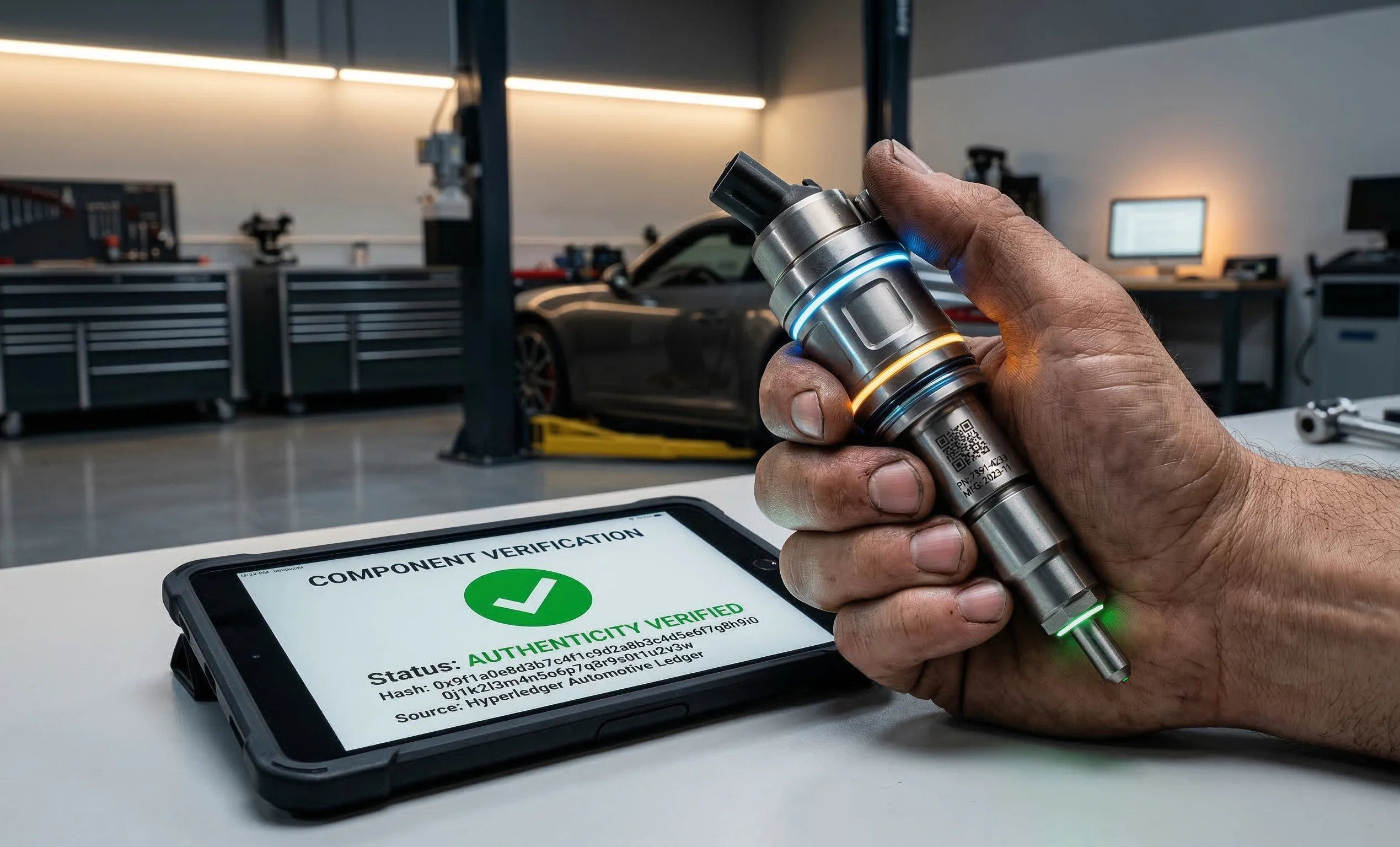
  3. The Installation: When the mechanic installs the part, they scan the QR code, and the part is officially linked to your car’s Digital Passport.

If a part doesn’t have a verified blockchain history, the car’s computer can actually flag it, warning the driver that an “unauthorized” or potentially dangerous component has been installed. This creates a closed-loop system where fake parts simply have nowhere to hide.

A realistic macro photograph taken in a modern automotive workshop, capturing a mechanic's hand holding a high-tech fuel injector. The injector features a laser-etched QR code and integrated blue, orange, and green LED lights, which illuminate the skin details. Next to the hand, a ruggedized tablet displays a clear "Authenticity Verified" status with a blockchain hash code and "Source: Hyperledger Automotive Ledger" confirmation. The background is a clean garage with tool cabinets, an automotive lift, a sports car, and a computer monitor, all with a cinematic shallow depth of field.

Smart Contracts: The Future of Maintenance & Insurance

We are moving away from the era where you have to remember when to change your oil. In 2026, your car manages its own maintenance through Smart Contracts.

These are self-executing bits of code that trigger actions when certain conditions are met. For example:

  • Auto-Scheduling: When your car’s sensors detect that the brake pads are at 10% life, a smart contract automatically pings your preferred service center, checks their availability, and books an appointment for you.

  • Parametric Insurance: In 2026, your insurance premium isn’t a fixed monthly cost. It’s “Parametric,” meaning it changes based on how you actually drive. If the blockchain records that you stayed within speed limits and avoided hard braking for a month, the smart contract automatically triggers a 10% refund on your premium for that period.

This removes the friction and the “human error” from the equation. The car becomes a proactive partner in its own upkeep, ensuring it stays safe and holds its value for longer.

See how our Smart Contract services are automating the future of business.

Autonomous Vehicles: Securing the "V2X" Network

A dynamic nighttime photograph of a blue autonomous Tesla Model S driving through a modern smart city intersection. The car is connected by a network of glowing geometric lines to nearby vehicles and a smart traffic light. Above the vehicle, a large, translucent 3D holographic shield composed of hexagonal digital patterns symbolizes a blockchain security layer. The city background features illuminated skyscrapers, a train on an elevated track, and people walking on the sidewalk, set against a warm dusk sky.As we move toward a world of self-driving cars in 2026, the biggest fear isn’t a mechanical failure—it’s a digital one. Autonomous vehicles rely on a “Vehicle-to-Everything” (V2X) network, constantly talking to other cars, traffic lights, and smart city sensors.

If a hacker can “spoof” this data—for example, making a car believe a red light is green—the results could be catastrophic. This is where blockchain becomes a literal lifesaver. By using a decentralized authentication system, every piece of data sent in the V2X network is cryptographically signed and verified in milliseconds.

  • No Central Failure: Since there is no single “hub” for a hacker to attack, the network remains resilient even if one node is compromised.

  • Immutable Logs: Every decision an autonomous car makes is recorded on a private blockchain. If an accident does happen, investigators don’t have to guess what went wrong; they have a tamper-proof “Black Box” of every data packet the car received and sent.

According to recent research on V2X security, blockchain is the only technology that can provide the sub-millisecond trust needed for safe, high-speed autonomous coordination.

Sustainability: The EU Battery Passport Requirement

In 2026, the automotive industry is facing a massive new hurdle: the EU Battery Passport. Starting this year, every electric vehicle (EV) battery sold in Europe with a capacity over 2kWh must have a unique, QR-linked digital passport.

This isn’t just about showing the battery’s health. It’s about proving the “Green Origin” of the materials inside.

  • Ethical Sourcing: Blockchain is used to track cobalt, lithium, and nickel from the moment they are mined to the moment they are installed in a car. This ensures that no child labor or illegal mining was involved in your EV.

  • Carbon Footprint Tracking: Every battery must show its total CO2 impact, from production to recycling.

  • Circular Economy: When a battery reaches the end of its life, the passport helps recyclers see exactly what chemicals are inside, making it 50% faster to recover precious metals like lithium for the next generation of cars.

The 2026 Roadmap: Driving Toward Transparency

The global automotive blockchain market is set to hit $1.39 billion this year, growing at a massive 26% annually. If you aren’t already integrating these ledgers into your fleet or manufacturing process, you are falling behind.

Here is how we help you start:

  1. Identity First: We assign every vehicle a MOBI-standard digital identity, creating the foundation for your “Digital Twin” ecosystem.

  2. Secure the Supply Chain: We implement blockchain tracking for high-value spare parts to protect your brand from counterfeit liability.

  3. Automate with Smart Contracts: We build the payment and maintenance rails that allow your cars to “talk” to insurance providers and service centers automatically.

Summary: The Road Ahead is Decentralized

The cars of 2026 are more than just transport; they are high-speed data centers on wheels. In a world where data is as important as fuel, blockchain is the only way to ensure that data is honest, secure, and valuable.

Whether you are trying to kill the counterfeit parts market, secure an autonomous fleet, or comply with new global battery laws, a decentralized strategy is no longer optional—it is the engine of the modern automotive industry.

Ready to digitize your fleet and secure your brand?

Build custom AI solutions that deliver real business value

From strategy to deployment, we help you design, develop, and scale AI-powered software that solves complex problems and drives measurable outcomes.

Facebook
Twitter
LinkedIn

Recent Post

Your journey to innovation starts here

Let’s bring your vision to life with our expertise in AI and custom development. Reach out to us to discuss your project today!