

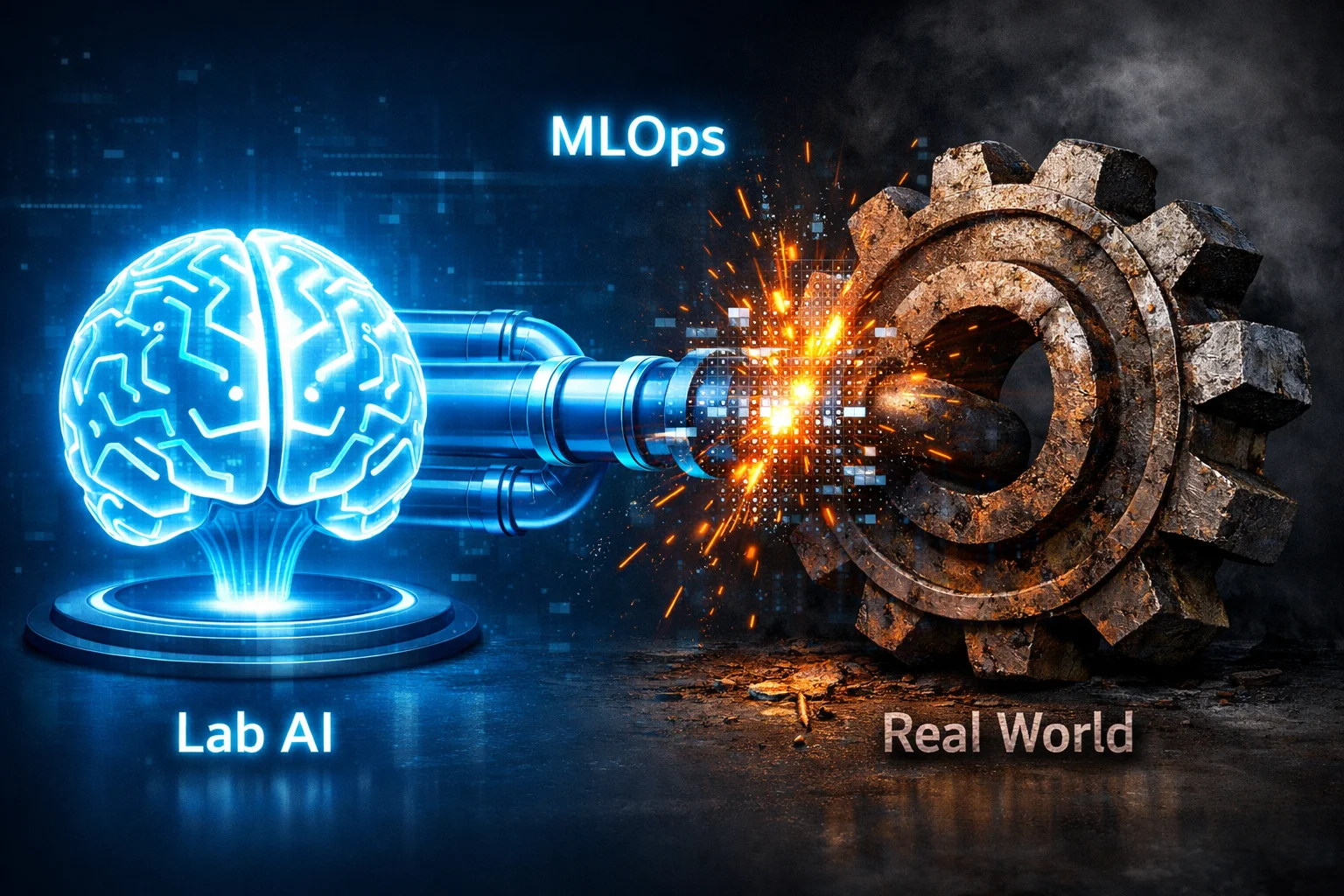
Here’s the thing: building an AI model is like training a racehorse. It looks great on the track during practice, but the moment the actual race starts, everything changes. In the world of FMCG, most companies get the “training” part right, but they fail at the “race.” They build a brilliant demand forecasting model in a controlled lab environment, only to watch it fall apart the second it hits the real world.
In 2026, the gap between a “cool experiment” and a “core business asset” is a discipline called MLOps (Machine Learning Operations).
Think of MLOps as the pit crew for your AI. Without it, your models start “decaying” the moment they are deployed. In an industry where consumer trends shift by the hour and supply chains are under constant pressure, you can’t afford to let your models go stale. If you want your AI to actually deliver long-term ROI, you have to stop treating it like a one-time project and start treating it like a living system.
Want the full picture? Read our Ultimate Guide to AI in the FMCG Industry.
The FMCG Data Swamp: Deployment Hurdles
If you’re a software house working with an FMCG giant, you quickly realize that the “clean data” you had in the pilot phase was a lie. Real-world deployment is messy. Most FMCG companies are sitting on what we call a Data Swamp—a fragmented mess of 20-year-old ERP systems, siloed warehouse data, and spreadsheets that don’t talk to each other.
The biggest hurdle isn’t the AI itself; it’s the plumbing. You have to find a way to plug a modern, high-speed machine learning model into a legacy infrastructure that was never designed for it. If the connection is slow, your “real-time” prediction arrives three hours too late to stop a stockout.
Then there is the issue of Scalability. It’s one thing to run an AI model for a single warehouse; it’s another thing entirely to scale it across 5,000 retail locations globally. Each location has its own quirks, its own local events, and its own data quality issues. Without a robust MLOps pipeline to standardize how these models are deployed, you end up with a fragmented mess that is impossible to monitor or update.
The Silent Killer: Data & Concept Drift
In most software engineering, once you write the code and test it, it stays fixed. But in Machine Learning, the “code” is the data—and data changes every single day. This is what we call Data Drift.
Imagine your AI was trained on sales data from a time when a specific snack was healthy and trendy. Suddenly, a new study comes out or a competitor launches a “healthier” version, and your sales patterns shift overnight. Your model is still using the old rules, but the world has moved on. According to research on Sustainable MLOps, failing to detect this drift is the #1 reason AI projects fail in production.
Even worse is Concept Drift. This is when the fundamental “why” behind the data changes. Think about how the pandemic permanently changed how people shop for groceries. A model trained in 2019 was completely useless in 2021 because the “concept” of a normal shopping trip had been rewritten. In FMCG, where margins are thin, waiting a month to realize your model is wrong can cost millions in wasted inventory.
Monitoring What Matters: Beyond Accuracy
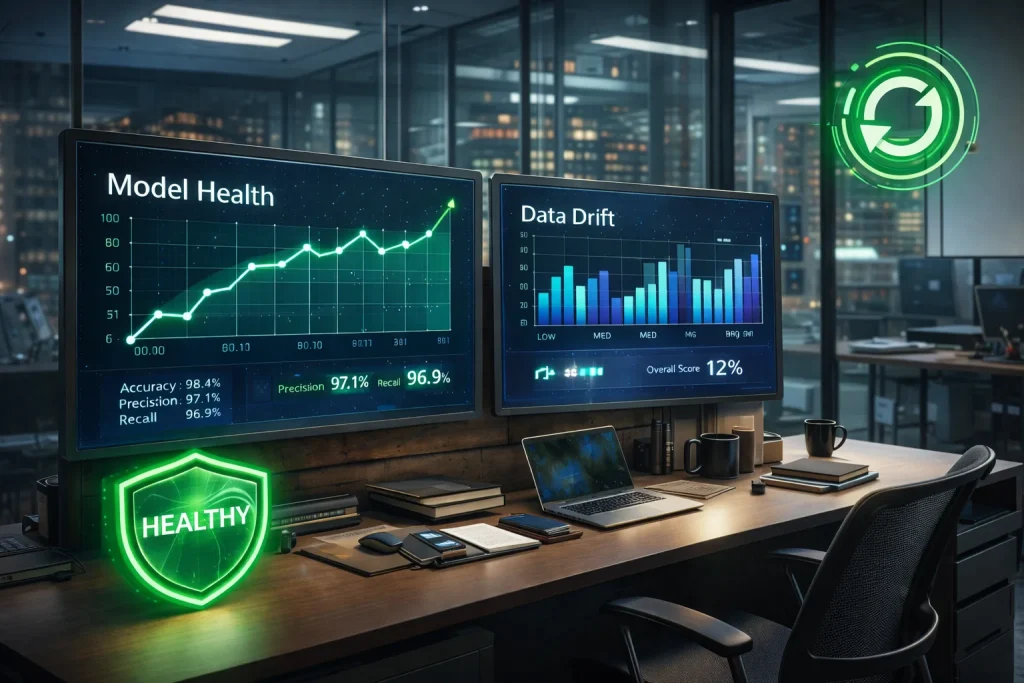
Here is a hard truth: a model that is “95% accurate” in a test environment can still be a disaster in the real world. Why? Because accuracy is a lagging metric. By the time you realize your accuracy has dropped, you’ve already sent the wrong amount of stock to five hundred different stores.
In MLOps for FMCG, we have to monitor the leading indicators. We look at things like “Feature Stability”—are the inputs (like weather data or competitor pricing) still coming in correctly? If the weather API fails and starts sending “0 degrees” for every city, your model will start predicting a massive surge in hot chocolate sales.
We also monitor Prediction Latency. In high-speed retail, if your model takes ten seconds to give a prediction instead of 200 milliseconds, it might miss the window for a real-time automated order. An effective MLOps setup includes “Automated Alerts.” The moment the data looks “weird” or the system slows down, your engineering team should get a ping in Slack before the warehouse manager even notices a problem.
The Feedback Loop: Continuous Training (CT)
The old way of doing things was to have a data scientist manually retrain the model every six months. That doesn’t work in 2026. By the time six months have passed, the market has changed four times.
The goal of a mature software house is to implement Continuous Training (CT). This is a pipeline that automatically triggers a retraining session whenever the model’s performance dips below a certain threshold. It’s like a car that tunes its own engine while it’s driving down the highway.
But you can’t just let the AI retrain itself blindly. You need Versioning. Just like you have different versions of an app, you need versions of your models. If a new model is trained on “junk” data and starts making crazy predictions, you need the ability to hit a “Rollback” button instantly to return to the last stable version. This safety net is what allows FMCG brands to innovate without risking their entire supply chain.
Governance & Compliance: The "Trust" Layer
In a massive FMCG organization, people are naturally skeptical of “the algorithm.” If a computer tells a veteran category manager to stop ordering the company’s best-selling product, they’re going to ignore it—unless you can explain why.
This is where Explainable AI (XAI) and governance come in. MLOps isn’t just about the code; it’s about the “audit trail.” You need to be able to show exactly what data led to a specific prediction. This builds trust between the tech and the humans running the business.
Furthermore, you have to consider data security. Your demand forecasts are incredibly sensitive—if a competitor got hold of your predicted sales for the next quarter, they could undercut you perfectly. A professional MLOps framework ensures that your models and the data they use are encrypted and access-controlled, meeting the highest enterprise security standards.
Need a strategy for stable AI? Check out our AI Solutions for FMCG Brands.
Infrastructure Choice: Cloud vs. Edge
 In 2026, the question isn’t just how to process your data, but where. For a global FMCG brand, you have two main choices: the Cloud or the Edge.
The Cloud is great for the big picture. It’s where you store years of historical data and train those massive, complex models we talked about. It gives you the “God’s eye view” of your entire global supply chain. But the cloud has a weakness: latency. If you’re waiting for a server halfway across the world to tell a smart shelf in a local grocery store that it’s out of stock, you’re losing precious seconds.
This is where Edge Computing comes in. By processing data locally—right there in the warehouse or on the retail floor—you get instant insights. In 2026, we’re seeing “Smart Shelves” and “IoT-enabled Warehouses” that use Edge AI to make split-second decisions. If a pallet is misplaced, the Edge system flags it immediately, rather than waiting for a nightly cloud sync.
The most successful MLOps strategies use a Hybrid approach. Use the Edge for immediate, “on-the-ground” action, and use the Cloud for long-term strategy and retraining. It’s about being fast where it counts and smart where it matters.
The Human Side of MLOps: Breaking Silos
You can have the best AI in the world, but if your Sales team doesn’t talk to your Logistics team, the system will fail. One of the biggest challenges in MLOps isn’t technical—it’s organizational. We call these Data Silos.
When the Marketing team launches a “Flash Sale” but doesn’t feed that information into the AI demand model, the Logistics team gets blindsided by a surge they weren’t prepared for. MLOps forces these departments to share a “Single Source of Truth.”
A professional technical partner doesn’t just hand over a piece of software; they help you build a culture where data flows freely between departments. This cross-functional collaboration is what turns a “software project” into a company-wide transformation. According to Nagarro, the most successful AI implementations are the ones that prioritize these human connections as much as the code.
Turning AI Experiments into Business Assets
Here’s the thing: the “hype” phase of AI is over. In 2026, FMCG brands are no longer impressed by a model that only works in a presentation. They want systems that are stable, scalable, and secure.
That is the true value of MLOps. It’s the difference between a pilot program that quietly disappears after six months and a robust system that saves the company millions every year. By focusing on monitoring, continuous training, and smart infrastructure, you ensure that your AI investment actually pays off in the long run.
If you’re tired of seeing your AI projects stall out after the initial launch, it’s time to stop looking for a better model and start looking for a better operation. The competitive edge in FMCG isn’t just about being the first to use AI—it’s about being the best at keeping it running.
Ready to move beyond the pilot phase? Explore our Strategic AI Planning for the FMCG Industry.
Or, let the Techelix team audit your current deployment pipeline.
Build custom AI solutions that deliver real business value
From strategy to deployment, we help you design, develop, and scale AI-powered software that solves complex problems and drives measurable outcomes.