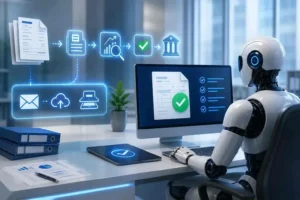

The 2026 Automation Paradox: Why RPA Didn’t Die

In the early 2020s, every “tech visionary” predicted that Robotic Process Automation (RPA) was a temporary band-aid. They argued that as companies migrated to the cloud, every piece of software would eventually have a clean, RESTful API, making “UI-mimicking bots” obsolete.
By 2026, we know they were wrong.
The global RPA market is currently valued at $28 billion, growing at over 30% annually. Why? Because the modern enterprise is built on “Legacy Debt”. While a startup can be 100% API-driven, a Tier-1 Bank or a National Healthcare provider still relies on mainframes and “closed” vendor portals that were built before the term “API” was common.
The paradox of 2026 is that the more “Intelligent” our automation becomes, the more we need RPA. An AI Agent can reason out a complex mortgage application in seconds, but if that application needs to be typed into a 15-year-old green-screen portal, that agent needs “hands”.
RPA provides those hands. It is no longer just a band-aid; it is the execution layer for the autonomous enterprise.
RPA: The Universal Execution Layer
In 2026, we have moved beyond “Rule-Based RPA” into Cognitive RPA.
Traditional bots were brittle; if a button moved 5 pixels to the left, the bot would break, sending an error alert to your IT team. Modern RPA, however, uses Computer Vision and LLMs to understand the intent of the screen. It doesn’t look for a specific pixel; it looks for “The Submit Button.”
When is RPA your only choice?
Legacy Systems: Mainframes or on-premise software without a web interface or API.
Vendor Portals: Third-party websites (like government portals or insurance clearinghouses) that refuse to provide API access to protect their own data.
Citrix/VDI Environments: Where you are interacting with a remote desktop stream and have zero access to the underlying code.
API Automation: The High-Speed Backbone
If RPA is the “hands” of your business, APIs are the “nervous system.” In 2026, API-first automation is the gold standard for any process that requires 99.99% uptime and ultra-high data throughput.
The Reliability Gold Standard: Unlike RPA, which is sensitive to a single pixel moving on a screen, APIs are governed by strict “contracts”. If you connect Salesforce to Slack via API, the integration remains stable even if Salesforce updates its entire user interface.
Scalability at the Speed of Light: An RPA bot can only “type” as fast as a human could. To process 10,000 invoices an hour with RPA, you might need 50 parallel bot licenses. A single API endpoint can handle those same 10,000 invoices in seconds for a fraction of the cost.
Security & Governance: APIs are built for 2026’s strict SOC 2 and GDPR world. They use OAuth tokens and granular permissions to ensure that a workflow can only see the specific data it needs, rather than giving a bot full “human-level” access to a screen.
The “Architect’s Decision Matrix” (A 2026 Framework)
Choosing between RPA and API isn’t a coin toss; it’s a calculation of Total Cost of Ownership (TCO) and Time-to-Value.
| Metric | RPA (The Bot) | API (The Handshake) | 2026 Strategy |
| Setup Time | Fast (Days) | Slow (Weeks/Months) | Use RPA for “Quick Wins” |
| Stability | Low (Breaks on UI update) | High (Versioned Endpoints) | Use API for core workflows |
| Volume | Low-Medium | Ultra-High | Use API for 10k+ daily runs |
| Access | Front-end (No code needed) | Back-end (Needs documentation) | Use RPA for Legacy/Citrix |
| Cost | Higher (Per-bot license) | Lower (Usage-based) | Use API for better long-term ROI |
The Hidden Math of 2026
In 2026, an RPA Developer earns between $85,000 and $120,000 annually. When you add the license fees for tools like UiPath (approx. $1,380/month for a basic bot), the cost of a “brittle” bot that breaks every time a vendor updates their website becomes a major drag on your margin.
Strategic Advice: We recommend RPA for any system that is “end-of-life” or lacks an API, but we push for API-first for any system that will be part of your business for the next 5+ years.
The Hybrid Strategy: The Rise of Agentic Process Automation (APA)
The most advanced companies we consult for in 2026 aren’t choosing one; they are building Hybrid Orchestrations. This is known as APA (Agentic Process Automation).
In an APA model, an AI Agent acts as the “Decision Maker.” It looks at a task and chooses the most efficient path:
The Trigger: A complex customer request arrives.
The Reasoning: The AI Agent (GPT-4o or Claude 3.5) determines it needs to pull data from a modern CRM (API) and a 20-year-old mainframe (RPA).
The Execution: The Agent triggers an API call to Salesforce to get the client ID, then triggers an RPA bot to log into the legacy portal and retrieve the transaction history.
The Resolution: The AI summarizes the data and sends a personalized response back to the client via Slack.
Case Study: The “Modern Bank” (2026) One of our banking clients used this hybrid approach to reduce mortgage processing time from 14 days to 4 hours. They used APIs for the modern credit-scoring apps and RPA to “scrape” data from local government land-registry websites that had no digital interface.
Technical Implementation: The Hybrid Bridge
Building a hybrid automation system requires more than just connecting apps; it requires a Data Translation Layer. When moving data from a modern API (JSON) to a legacy RPA bot (often requiring flat strings or CSVs), you need precision.
The “Self-Healing” Logic with JSON Pathing
In 2026, we don’t hardcode data paths. We use JSON path expressions and JMESPath within n8n to dynamically extract only what the bot needs.
Example Use Case: If an API returns a deeply nested customer object, but your RPA bot only needs the Mailing_Address, we use a Code Node to sanitize and flatten that data before the “Bot” ever sees it. This prevents the bot from crashing due to unexpected “null” values in other fields.
Code Snippet: The Binary-to-RPA Bridge
Instruction: Use this JavaScript in an n8n Code Node to prepare binary files (like PDFs) for an RPA bot that needs a local file path to “upload” to a legacy portal.
// Techelix Hybrid Bridge: Prepare Binary for RPA
const fs = require('fs');
const path = require('path');

for (const item of $input.all()) {
  if (item.binary && item.binary.data) {
    // Save binary to a temp path the RPA bot can reach
    const tempPath = path.join('/tmp', item.binary.data.fileName);
    const buffer = await this.helpers.getBinaryDataBuffer(0, 'data');
    fs.writeFileSync(tempPath, buffer);

    // Pass the local path to the RPA Bot Trigger
    item.json.local_file_path = tempPath;
    item.json.rpa_status = "Ready for Upload";
  }
}
return $input.all();
The Watchtower: 2026 Infrastructure Observability
By 2026, every production-grade n8n or RPA instance must expose a /metrics endpoint. We use a “Watchtower” stack (Prometheus + Grafana) to track:
Bot Latency: How long is the RPA bot “waiting” for a page to load?
API Success Rates: Are your 200-series responses dropping?
Queue Depth: Is your Redis broker getting backed up during peak hours?
Techelix Pro-Tip: We set up Alertmanager to ping your DevOps team on Slack the moment an RPA bot fails three consecutive retries. This “Self-Healing Loop” allows the AI to attempt a restart before a human even knows there’s an issue.
Summary: Architecting for the Next Decade
The verdict for 2026 is clear: Stability is the new speed.
If you build solely on RPA, you build a “Brittle Empire” that will crumble under the weight of UI updates. If you wait for every legacy system to have an API, you will be left behind by competitors who are moving faster today.
The winner is the Hybrid Architect—the leader who uses APIs for scale, RPA for reach, and AI Agents to bridge the gap. At Techelix, we don’t just “install bots”; we build resilient, high-availability digital infrastructures that grow with your revenue.
Ready to build your hybrid future?
Book a Strategy Audit with the Techelix Team. Let’s audit your legacy debt and build your 2026 automation roadmap.
Build custom AI solutions that deliver real business value
From strategy to deployment, we help you design, develop, and scale AI-powered software that solves complex problems and drives measurable outcomes.