

In 2026, the honeymoon phase of RPA is over. Most enterprises have successfully automated a handful of “low-hanging fruit” tasks—simple data entry or invoice processing. But as they attempt to move from 5 bots to 50, they hit a metaphorical “Scaling Wall”. This is where the Accidental Automation Trap occurs. Without a centralized strategy, bots are built in silos by different departments using different standards, resulting in a fragmented, “brittle” infrastructure that breaks every time a minor software update occurs.
The Hidden Cost of Success: Technical Debt
Scaling without an RPA Center of Excellence (CoE) creates a mountain of Technical Debt. For every new bot built, the maintenance burden increases exponentially. If your team is spending 80% of their time “babysitting” existing bots (fixing broken selectors, managing credential timeouts) and only 20% building new ones, your ROI has effectively collapsed. In 2026, automation is no longer a “project”—it is a Digital Workforce that requires a professional operating model to survive the complexities of an enterprise ecosystem.

Defining the RPA Center of Excellence (CoE)
An Automation CoE is the centralized “Brain” of your digital transformation. Its mission is simple: Centralize Governance, Decentralize Innovation. You want your departments (Finance, HR, Sales) to identify what needs to be automated, but you want your CoE to dictate how it is built so it doesn’t break.
The Three Pillars of the CoE
People: Defining clear roles—from “Automation Champions” in the business units to “Solution Architects” in the core team.
Process: Establishing a Standard Operating Procedure (SOP) for bot development, ensuring every bot follows the same security, error-handling, and documentation protocols.
Technology: Selecting the “Golden Stack”—the specific combination of tools (n8n, Python, UiPath) and infrastructure (VPC, Docker, Credential Vaults) that all bots must use.
The Federated Operating Model
For 2026 enterprises, we recommend a Federated CoE. The core team provides the “Guardrails” (security, infrastructure, and standards), while decentralized “pods” within business units build the actual bots. This prevents the CoE from becoming a bottleneck while ensuring that no “Shadow IT” bots are created in the dark.
Managing the Digital Workforce: The Bot Lifecycle
Treating a bot like a “macro” is a mistake. In a professional CoE, every bot is treated as a Digital Employee with a defined lifecycle.
Ideation & The Complexity Matrix
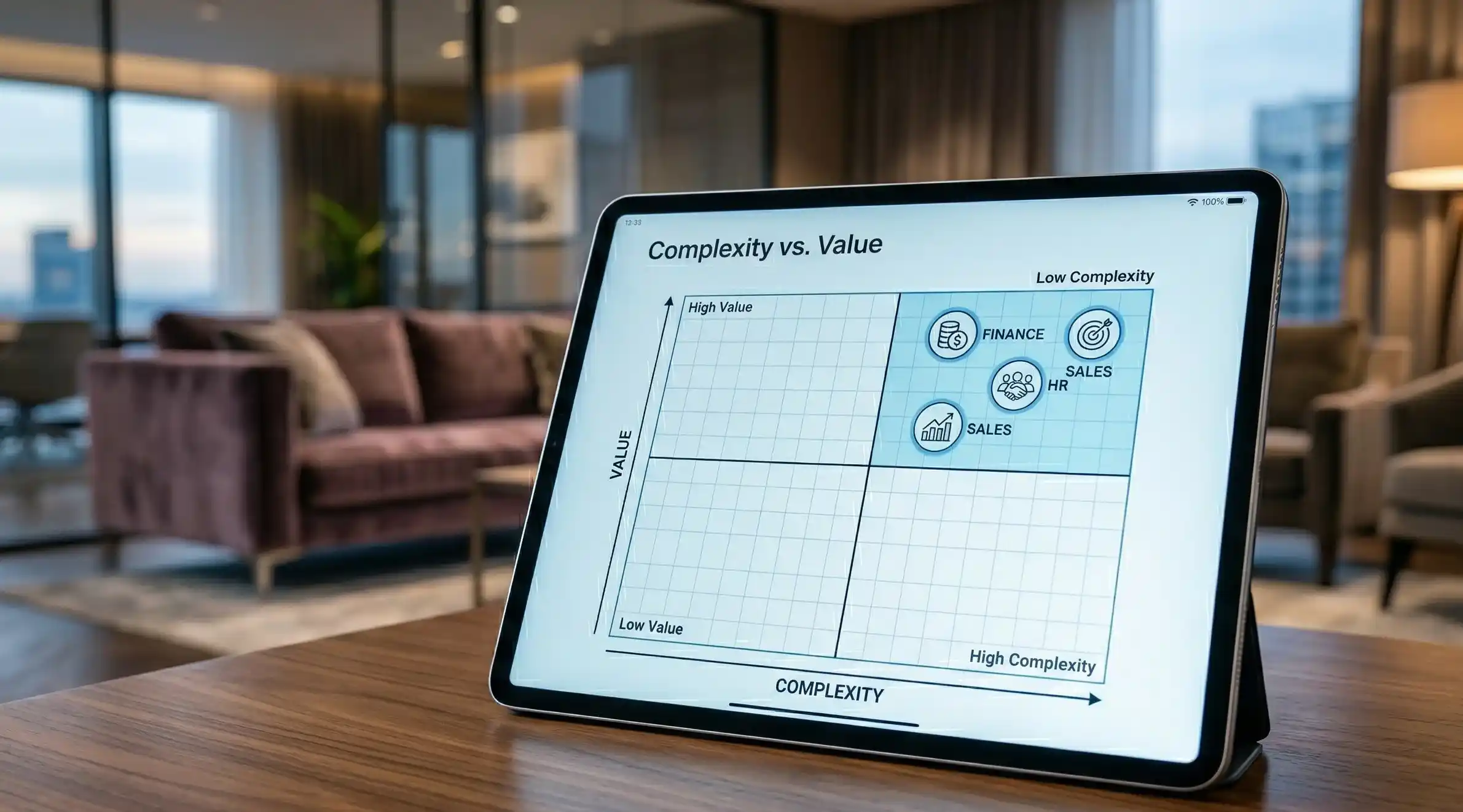
Not everything should be automated. We use a “Complexity vs. Value” Matrix to filter your pipeline.
High Value / Low Complexity: These are your “Quick Wins” (The first 1–10 bots).
High Value / High Complexity: These are your “Strategic Pillar” bots (The path to 100).
Low Value / High Complexity: These are “Maintenance Traps” that the CoE must explicitly reject to avoid technical debt.
The "Birth Certificate" and Decommissioning
Every bot must have a “Birth Certificate”—comprehensive documentation that includes the underlying API endpoints, the “Owner” in the business unit, and the specific “Kill-Switch” protocols. Furthermore, a CoE must have a Decommissioning Strategy. If a bot is costing more in server resources and maintenance than it is saving in man-hours, it must be “retired” to keep the digital workforce lean and profitable.
Preventing Technical Debt: Standardizing the Stack
The enemy of enterprise RPA scaling is “Special Snowflakes”—bots built with custom, unique logic that only one developer understands.
Modular Logic and Reusable Components
At Techelix, we enforce a Modular Design philosophy. Instead of building a “Login” sequence for 100 different bots, the CoE builds one “Master Login Sub-workflow”. Every bot then “calls” this sub-workflow. If the underlying application updates its login screen, you fix it in one place, and all 100 bots are instantly repaired. This is the only way to scale to 100+ bots without hiring 100+ maintenance engineers.
Governance & Operational Excellence: The "Zero-Trust" CoE
In 2026, scaling to 100 bots means you are running a massive, distributed software ecosystem. Without a professional Governance Framework, you aren’t scaling—you’re just accumulating risk. A world-class CoE operates on the principle of Zero-Trust Automation.
The SLA for the Digital Workforce
Just as you hold human employees to performance standards, your digital workforce must have a Service Level Agreement (SLA). The CoE must define:
Uptime Requirements: Does this bot need to run 24/7, or is it a batch process?
Accuracy Thresholds: At what “Error Rate” does the bot automatically shut down and alert a human?
Latency Benchmarks: How fast should the bot process a single record before it’s considered “Underperforming”?
Change Management: The "App-Update" Defense
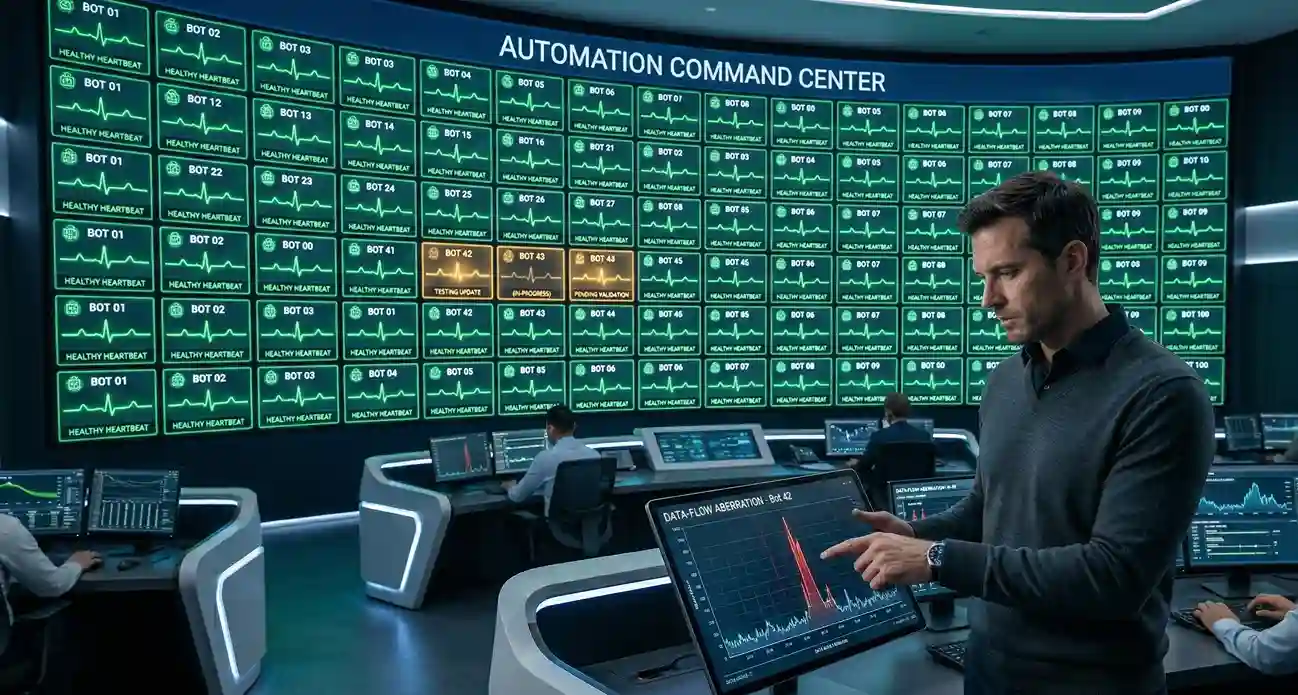
The #1 killer of bots is an unexpected change in the underlying application (e.g., a Salesforce UI update or an SAP patch). A CoE manages this through a Pre-Production Testing Sandbox. Every time a core enterprise application is updated, the CoE runs a “regression test” on all affected bots before the update goes live. This proactive stance is the only way to avoid the “Monday Morning Meltdown” where 50% of your workforce is suddenly offline.
Human-Bot Orchestration: The Cultural Shift
Scaling to 100 bots is as much a Human Resources challenge as it is a technical one. The CoE is responsible for the “Socio-Technical” bridge—turning the fear of “Robots taking jobs” into the excitement of “Robots taking the boring parts of my job”.
Upskilling: The "Citizen Developer" Revolution
A CoE cannot build every bot. To reach 100, you must empower the business units. We implement an Upskilling Program where we identify “Super Users” in Finance, HR, and Operations and train them to be Citizen Developers. They build the simple automations using the CoE’s “approved” templates, while the core CoE team focuses on high-complexity, mission-critical architecture.
The Automation Champion Network
We establish a Champion Network—a monthly meeting of minds where representatives from every department share their automation successes and failures. This prevents “Duplicated Effort” (where two departments build the same bot twice) and encourages the cross-pollination of ideas. This cultural layer is what transforms a company from an “Organization with Bots” into an Autonomous Enterprise.
Summary: From Bot Factory to Autonomous Enterprise
The transition from 1 to 100 bots is the most difficult phase of digital transformation. It is the moment where “Productivity Hacks” must become “Enterprise Infrastructure”.
A well-architected Automation Center of Excellence (CoE) is the only way to ensure this transition doesn’t lead to technical debt, security holes, or a collapse in ROI. At Techelix, we don’t just “deploy bots”—we build the Strategic Brains that allow organizations to scale their digital workforce with total confidence and operational excellence.
Ready to build your Automation Center of Excellence?
Audit Your Existing Digital Workforce. Let’s identify your technical debt and build a roadmap to 100 bots.
Build custom AI solutions that deliver real business value
From strategy to deployment, we help you design, develop, and scale AI-powered software that solves complex problems and drives measurable outcomes.