
The Death of Linear Logic
Most businesses are still stuck in the 2022 way of thinking: “If I get a new lead in my CRM, then send an email”. In 2026, that’s not enough. What if the lead is a fake? What if they asked a question that isn’t in your FAQ? What if they reached out via a casual Slack message instead of a formal web form?
Traditional, linear automation breaks the moment it hits unstructured data. This is why Agentic AI is taking over. An agent doesn’t just follow a list of steps; it is given a goal and access to a set of tools. It looks at the problem, reasons out the best path, and executes it autonomously.
If it hits an error, a linear workflow just stops and sends you an “Alert.” An n8n AI agent observes the error, adjusts its strategy, and tries again.
The n8n 2.0 AI Ecosystem: The “Neural Cluster”
In 2026, we don’t just “connect” an LLM to n8n; we build a Neural Cluster. The 2.0 update of n8n changed the canvas from a simple flow to a specialized AI Orchestrator.
To build a self-thinking agent, you need four core components working together on your canvas:
The Brain (Model Node): This is where you connect GPT-4o, Claude 3.5, or a local Llama 3 model. It handles the reasoning.
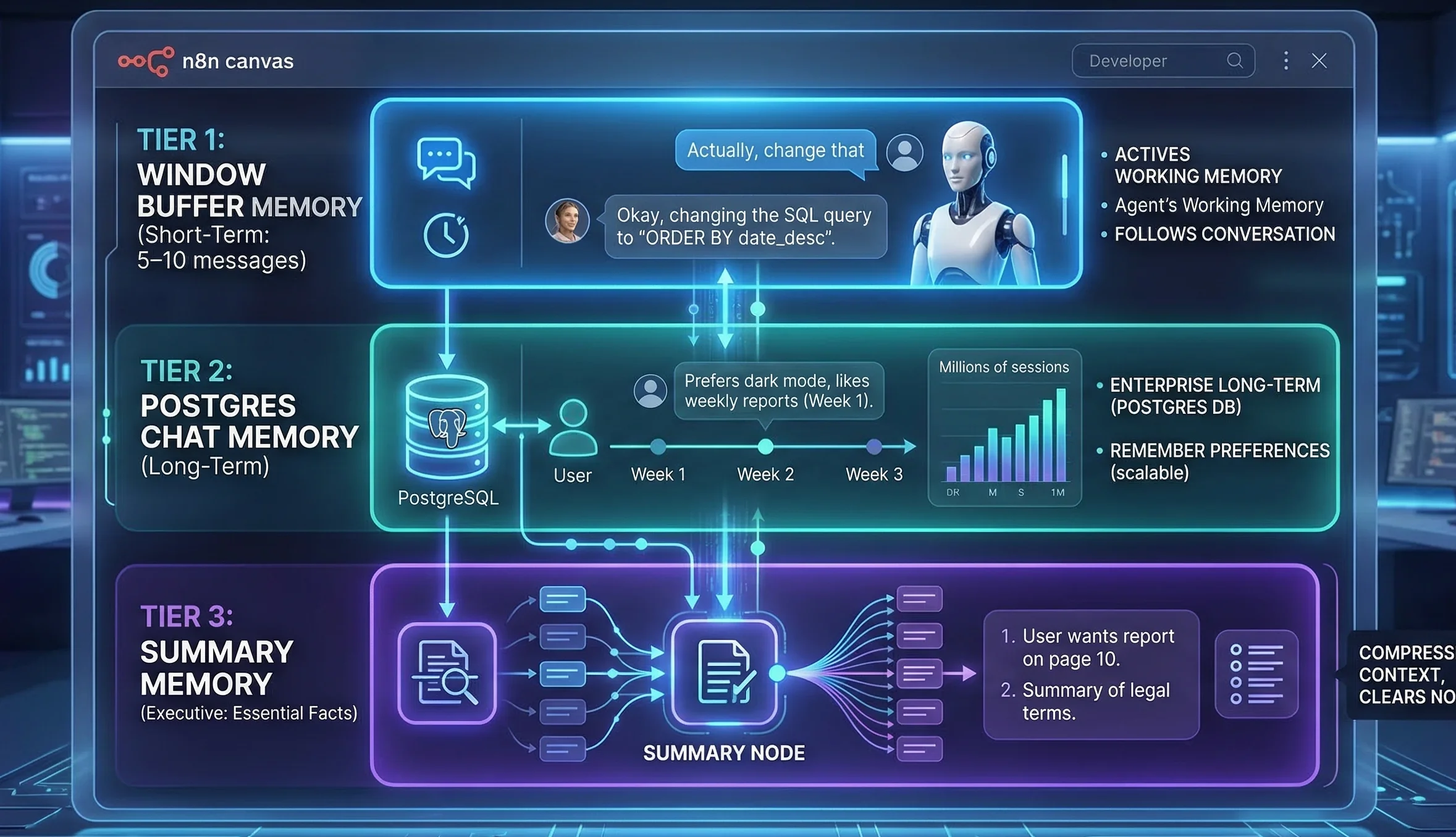
The Memory (Chat Memory Node): Without this, your agent is “goldfishing”—forgetting everything every time the workflow ends. We use Window Buffer Memory for quick chats and Summary Memory for long, complex projects that take hours to complete.
The Tools (Agent Tool Node): This is the most powerful part of n8n. You can give your AI “hands.” It can search Google, query your SQL database, or even call another n8n workflow as a sub-routine.
The Guardrails (Output Parser Node): This ensures the AI doesn’t just “talk”—it produces structured data (JSON) that your other systems can actually use.
Explore our custom n8n AI agent development for building high-performance neural clusters.
The Memory Problem: Why Your Agent Needs “Context Persistence”
One of the most common failures in 2026 is the “Amnesic Agent”—an automation that starts every task from scratch because it has no memory of the last five minutes. In n8n, we solve this by building a multi-layered memory system.
Window Buffer Memory (The Short-Term): This is like the agent’s “working memory.” It stores the last 5–10 messages so the AI can follow a conversation. If you say, “Actually, change that,” the agent knows what “that” refers to.
Postgres Chat Memory (The Long-Term): For enterprise workflows, we move away from volatile memory and use a PostgreSQL database. This allows the agent to remember a user’s preferences from a week ago, providing a truly personalized experience that scales to millions of sessions.
Summary Memory (The Executive): In very long workflows—like analyzing a 100-page legal document—the context window can get “clogged.” We use a specialized node that periodically summarizes the conversation so far, keeping the “essential facts” while clearing out the digital noise.
LangChain: The “Engine” Under the Hood
If n8n is the body, LangChain is the nervous system. By using the native LangChain nodes in n8n, we move away from “Keyword Matching” and into Semantic Understanding.
In 2026, we use Vector Stores (like Pinecone or Weaviate) to give your agents “Domain Knowledge.” This is known as RAG (Retrieval-Augmented Generation). Instead of training a new model every time your company policy changes, you simply upload a PDF to your vector database. When a guest or client asks a question, the n8n agent:
Retrieves the relevant paragraph from your private data.
Augments the prompt with that specific fact.
Generates an answer that is 100% accurate and cite-able.
This kills “hallucinations” and makes your AI agents safe for professional use in legal, medical, or financial sectors.
Chains vs. Agents: When to Control and When to Delegate
A common mistake in 2026 is trying to use an “Agent” for everything. Sometimes, you don’t need a self-thinking brain; you just need a very smart assembly line.
LLM Chains (Deterministic): These are best for predictable, step-by-step tasks like “Summarize this email $\to$ Extract the date $\to$ Add to Calendar.” There is no room for the AI to “wonder” or choose a different path. It is reliable, fast, and uses fewer tokens.
AI Agents (Autonomous): These are for ambiguous goals like “Research this company and find their latest three press releases.” The agent decides which tool to use (Google Search, Wikipedia, or a Web Scraper) and in what order. If the first search fails, the agent reasons and tries a different keyword.
At Techelix, we often build Hybrid Systems: an n8n Chain handles the reliable data entry, while an AI Agent is called only when the data is messy or requires a high-level decision.
Case Study: The Research & Action Multi-Agent System
One of the biggest shifts we’ve implemented for clients in 2026 is the Multi-Agent System. Why use one AI for everything when you can have a team?
On a single n8n canvas, we build “Squads”:
The Researcher: Its only job is to use the Google Search and Web Scraper tools to find facts.
The Analyst: It takes the raw data from the Researcher and looks for patterns or errors.
The Producer: It takes the Analyst’s report and writes the final email, LinkedIn post, or SEO report.
Because these agents “talk” to each other within n8n, they can catch each other’s mistakes. If the Producer sees a fact that doesn’t look right, it can autonomously send a request back to the Researcher to “Double Check.” This produces a level of quality that a single-prompt AI can never reach.
See our AI/ML services for building reliable multi-agent systems.
Human-in-the-Loop: Adding the “Safety Brake”
In 2026, “autonomous” doesn’t mean “unsupervised.” For high-stakes industries like Healthcare or Banking, you cannot let an AI agent make a final decision without a human heartbeat in the loop.
We use n8n’s v2.0 Wait Node to build “Approval Gates.”
The Pause: When an agent reaches a sensitive step—like approving a $5,000 refund or sending a medical diagnosis—the workflow automatically pauses and offloads its state to the database.
The Resume: The agent sends a secure message via Slack, WhatsApp, or a custom n8n Form. The human reviewer sees the AI’s reasoning, makes the final call, and clicks “Approve.”
The Resume URL: Once the human acts, n8n reloads the execution data and continues the workflow exactly where it left off.
This ensures that AI provides the speed, while human judgment provides the ethical integrity.
Don’t Just Watch Your Data Walk Away
One of the biggest “Success Taxes” in 2026 isn’t just the platform fee—it’s the API bill. If an AI agent gets stuck in a “Reasoning Loop,” it can burn through thousands of tokens in minutes.
At Techelix, we implement Token Monitoring Sub-workflows for every agent we build:
Real-time Cost Tracking: We use a sub-workflow that taps into the metadata of every execution to extract the exact
prompt_tokensandcompletion_tokensused.Automated Kill-Switches: If a single execution exceeds a specific dollar amount (e.g., $5.00), the system automatically kills the process and alerts an administrator.
Usage Dashboards: We pipe this data into n8n Data Tables or a Google Sheets dashboard to give you a live view of your AI spend across different models like GPT-4o, Claude 3.5, and Gemini.
Explore our AI/ML services for building reliable, cost-governed agentic systems.
The 2026 Roadmap: From Automator to Architect
Scaling AI agents in 2026 requires more than just good prompts; it requires a Deployment Strategy:
Semantic Readiness: We ensure your data is “AI-Ready” by adding a semantic layer, so your agents aren’t just guessing based on stale extracts.
Modular Orchestration: We break large processes into reusable sub-workflows. This makes your system 10x faster and much easier to debug.
Continuous Evaluation: We track Task Success Rates and Policy Compliance as core KPIs, ensuring the AI is actually delivering ROI and not just “acting busy.”
Summary: Building the Digital Brain
2026 is the year we stop “connecting apps” and start “building brains”. By moving from rigid, linear logic to Agentic AI on n8n, you are giving your business a system that can think, reason, and adapt to the unpredictable world of modern commerce.
With the right balance of LangChain intelligence and n8n governance, you aren’t just automating—you are evolving.
Ready to build your first self-thinking agent?
Book an AI Strategy Call with Techelix. Let’s design your 2026 agentic roadmap today.
Build custom AI solutions that deliver real business value
From strategy to deployment, we help you design, develop, and scale AI-powered software that solves complex problems and drives measurable outcomes.