

Here’s the thing: most Consumer Packaged Goods (CPG) companies are trying to build a Ferrari engine (AI) on a horse-and-buggy chassis (their data architecture). You can have the most advanced machine learning models in the world, but if they are being fed “dirty,” fragmented, or slow data, they are going to stall out before they ever reach the finish line.
In 2026, the biggest crisis in the industry isn’t a lack of AI—it’s Data Debt.
Most brands have plenty of data. They have decades of sales figures, warehouse logs, and shipping receipts. The problem is that this data is trapped in “silos.” The sales team has their own spreadsheet, the marketing team has a separate dashboard, and the logistics team is using a legacy ERP system that hasn’t been updated since 2005. When you try to run AI on top of that mess, you don’t get insights; you get errors.
If you want your AI to actually predict the next big trend or optimize your supply chain, you have to stop thinking about “storing” data and start thinking about “serving” it. Your data architecture is the plumbing of your entire intelligence system. If the pipes are clogged, the brain can’t think.
Looking for the big picture? Read our Ultimate Guide to AI in the FMCG Industry.
The Modern AI Data Stack: A Four-Layer Framework
Building a data architecture for a global consumer goods brand isn’t about buying one piece of software and calling it a day. It’s about building a stack that can handle the sheer volume and variety of retail data without breaking.
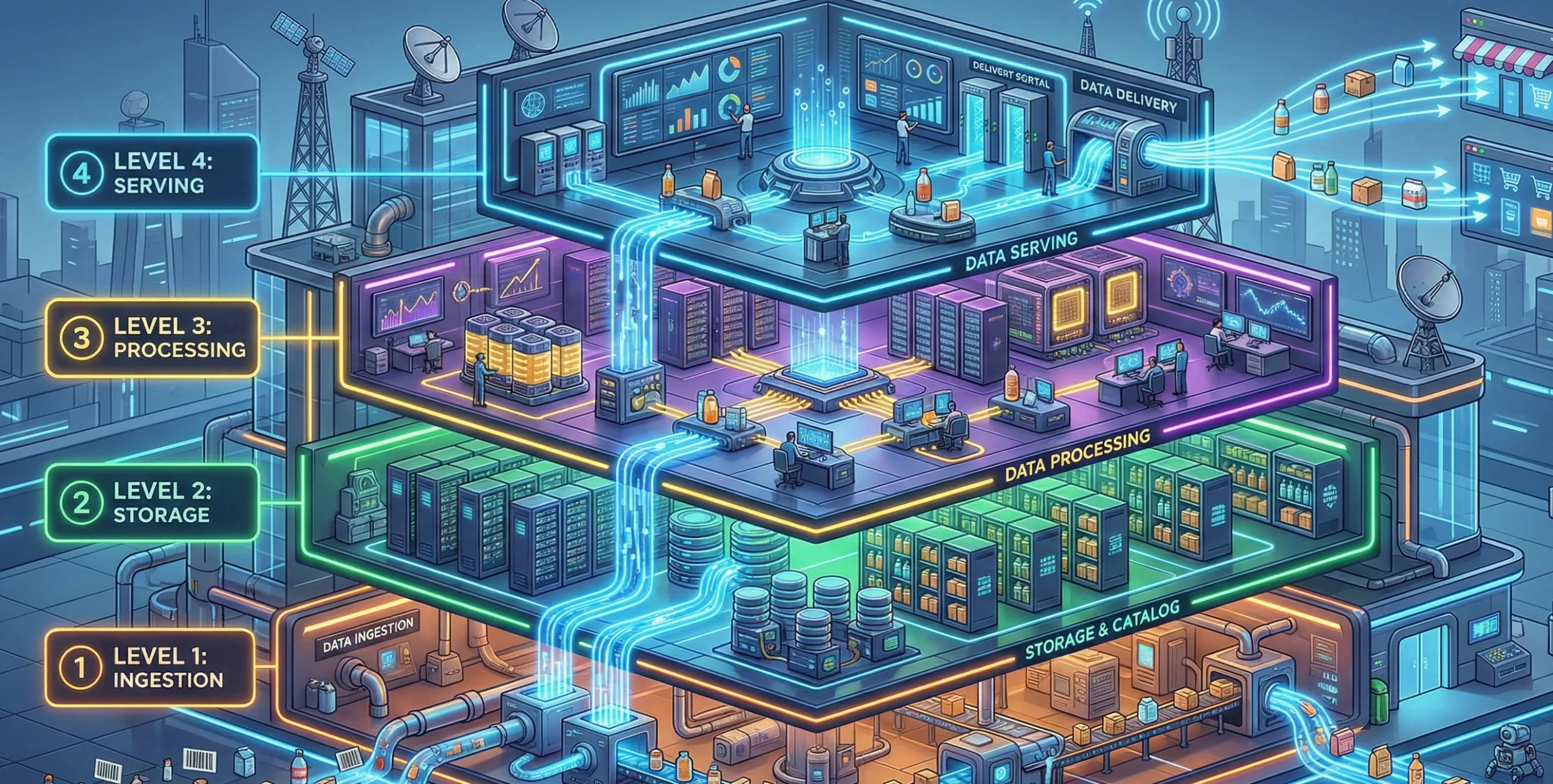
We break this down into four essential layers:
1. The Ingestion Layer: Handling the Mess
This is where the “raw” data enters the system. In CPG, this is a nightmare of variety. You have structured data from Point-of-Sale (POS) systems, semi-structured data from social media feeds, and unstructured data like PDF invoices. A modern architecture uses “Data Pipelines” to pull this information in real-time, cleaning and normalizing it so that a “Unit” in the warehouse matches a “Unit” in the sales report.
2. The Storage Layer: From Lakes to Lakehouses
The old debate was “Data Lake” (cheap, messy storage) vs. “Data Warehouse” (expensive, organized storage). In 2026, smart brands use a Data Lakehouse—specifically the “Medallion Architecture.” You store everything in a “Bronze” layer (raw), refine it into “Silver” (cleaned), and then serve it in “Gold” (business-ready). This gives you the flexibility of a lake with the performance of a warehouse.
3. The Processing Layer: Making Data "AI-Ready"
This is where the magic happens. You don’t just feed raw sales numbers into an AI. You need to “transform” them. This layer creates “features”—like calculating the moving average of sales over the last 14 days or adjusting for holiday spikes. It’s about turning raw numbers into the specific “food” that machine learning models crave.
4. The Serving Layer: Real-Time Intelligence
Finally, you need a way to get that processed data to the models. Whether it’s an API that tells a delivery truck where to go or a dashboard for a category manager, this layer ensures the data is delivered with zero “latency.” In a world where a flash sale can start and end in an hour, a slow serving layer is a deal-breaker.
Need to see how this fits your brand? Explore our AI Solutions for CPG Brands.
Breaking Down Silos: The Unified Data Fabric
Here’s the thing: most CPG brands don’t have a “data problem”—they have a “silo problem.” Your sales data is in one building, your marketing data is in the cloud, and your supply chain data is in a legacy database that only one guy named Bob knows how to access.
In 2026, the solution isn’t just to move all that data into one giant bucket. It’s to build a Data Fabric.
Think of a Data Fabric as an intelligent layer that sits on top of all your different systems. It doesn’t necessarily move the data; instead, it “weaves” it together. According to Gartner, this architecture uses metadata to understand where your data is, how it’s being used, and how to get it to your AI models instantly. It breaks the silos by creating a single, unified view of the truth without requiring a massive “rip and replace” of your old systems.
The Secret Ingredient: Master Data Management (MDM)
But even a Data Fabric can’t fix a “naming” problem. If your retail system calls a product “Diet Soda 12oz” and your warehouse calls it “DS-12-C,” the AI will think they are two different things. This is where Master Data Management (MDM) comes in.
MDM creates a “Golden Record” for every product, customer, and supplier. It ensures that when your AI looks at a data point, it knows exactly what it’s looking at, no matter which system it came from. Without a solid MDM foundation, your AI is essentially trying to read a book where every third word is in a different language.
Want to see how this fits into the bigger picture? Read our Ultimate Guide to AI in the FMCG Industry.
Data Governance & Quality: Garbage In, Garbage Out
We’ve all heard the phrase, but in the age of AI, it’s more like “Garbage In, Disaster Out.” Because AI models amplify patterns, a small error in your data quality can lead to a massive error in your demand forecast.
Modern data architecture for CPG requires Automated Data Governance. You can’t rely on humans to manually check every row of data for errors. Instead, you need systems that use “Data Observability” to proactively spot issues. If a price field suddenly shows a negative number or a sales spike looks physically impossible, the system should flag it before it ever reaches the AI.
Furthermore, you need Data Lineage. If your AI makes a weird prediction that says you should stop selling your most popular product in New York, you need to be able to “trace” that decision back to the exact data points that caused it. This transparency is what builds trust with your human managers. As DataRobot points out, real-time monitoring and intervention are the only ways to ensure your AI stays aligned with your actual business goals.

Real-Time vs. Batch: Finding the Right Balance
In 2026, the question of “when” you get your data is just as important as “what” the data says. CPG companies have to balance two different speeds of business. According to IDC, by this year, 60% of enterprises will be processing real-time data streams to stay competitive, yet the “batch” mindset still has its place.
When Real-Time is Non-Negotiable
If you are dealing with Flash Sales, Dynamic Pricing, or Agentic Commerce (where AI agents shop on behalf of humans), you need sub-second data. If your AI agent doesn’t know that a product is out of stock right now, it will continue to promise deliveries it can’t fulfill, destroying customer trust. Real-time pipelines—often built on event-driven architectures—are the only way to “sense” these immediate shifts in the market.
The Case for Batch Processing
However, you don’t need real-time data for everything. For long-term strategic tasks like Monthly Financial Planning or Deep Seasonal Trend Analysis, batch processing is still king. It’s more cost-effective and allows for complex “heavy lifting” across billions of rows of data that would crash a real-time system. A modern architecture uses a Hybrid Model: streaming for operational agility and batch for strategic depth.
Scalability: Moving from a Local Pilot to Global Operations
Most CPG AI initiatives die in the “Pilot Purgatory.” They work great for one product line in one country, but they collapse when you try to scale them to five continents.
The "Legacy Trap" vs. Digital Sovereignty
As you scale, you hit the wall of Legacy Integration. You might be using a modern cloud stack in your HQ, but your regional office in another country is still running on a 15-year-old on-premise server. To solve this, global brands are moving toward Sovereign Architectures. This allows them to maintain a unified global strategy while keeping data local to comply with increasingly strict digital sovereignty and geopolitical pressures.
Compliance at Scale (GDPR & Beyond)

Scaling also means navigating a minefield of regulations. In 2026, data residency isn’t just a legal checkmark; it’s an architectural requirement. You need to be able to “anonymize” customer data at the source before it ever crosses a border. This ensures you stay compliant with GDPR and other regional laws without slowing down your global AI training. By building “Privacy by Design” into your data pipes, you can scale your intelligence without scaling your legal risk.
Security & Compliance in the Age of AI
Here’s the thing: your data architecture isn’t just a warehouse; it’s a vault. In the CPG world, your demand forecasts and supply chain logic are your most valuable secrets. If a competitor sees exactly where you are overstocked or which new product line you’re betting on, they can outmaneuver you in days.
As we move through 2026, security is no longer just about “keeping hackers out.” It’s about Data Sovereignty and Privacy-Preserving AI. You need to be able to train your models on customer behavior without actually “seeing” the customers’ private details. Techniques like Federated Learning or Differential Privacy allow your AI to learn from the data while it stays encrypted at the source.
Furthermore, you have to protect the “integrity” of the data. If an attacker can subtly change the numbers in your ingestion layer—what we call an “Adversarial Attack”—they could trick your AI into ordering millions of dollars of products that you don’t need. A secure architecture has “zero-trust” built into the pipes, verifying every data point at every stage of the journey.
The Roadmap: Transitioning from Legacy to AI-First
So, how do you actually get there? You don’t do it by shutting down your business for a year to “rebuild.” That’s a recipe for disaster. Instead, smart CPG brands use the “Strangler Pattern.” You identify one critical business problem—say, inventory forecasting for your top three products—and you build a modern data pipe just for that. You “strangle” that specific old process by replacing it with the new AI-driven one. Once that’s working, you move to the next piece. Piece by piece, the old legacy mess disappears, and the new architecture takes over.
But here is the most important lesson we’ve learned at Techelix: Your first hire shouldn’t be a Data Scientist; it should be a Data Engineer. A scientist can build a great model, but an engineer builds the infrastructure that keeps that model alive. Without the right “pipes,” even the best scientist in the world is just playing with static spreadsheets. According to Databricks, data engineering is the actual foundation of AI success—if you get the engineering right, the science becomes easy.
Building a Foundation for 2026 and Beyond
 The “hype” phase of AI is officially over. We are now in the “implementation” phase. In the low-margin, high-speed world of Consumer Packaged Goods, you can’t afford to be guessing.
Your AI is only as good as the data architecture beneath it. If you spend all your budget on the “brain” but ignore the “nervous system” (the data pipes), you’ll end up with a system that is smart but paralyzed. By focusing on a unified data fabric, automated governance, and scalable infrastructure, you aren’t just building a software project—you’re building a sustainable competitive advantage.
The brands that will own the shelves in 2027 are the ones that are fixing their data architecture today. It’s time to stop fighting with your data and start making it work for you.
Ready to audit your data infrastructure? Explore our AI Solutions for CPG Brands.
Build custom AI solutions that deliver real business value
From strategy to deployment, we help you design, develop, and scale AI-powered software that solves complex problems and drives measurable outcomes.